
DV01-Neutral Barbell vs Bullet Portfolio: Convexity Pickup vs Yield Math
Matching market value and Modified Duration between a 2Y/30Y Treasury barbell and a 10Y bullet boosts portfolio convexity by +114% while introducing calculable yield-give-up and 2s30s twist exposure.
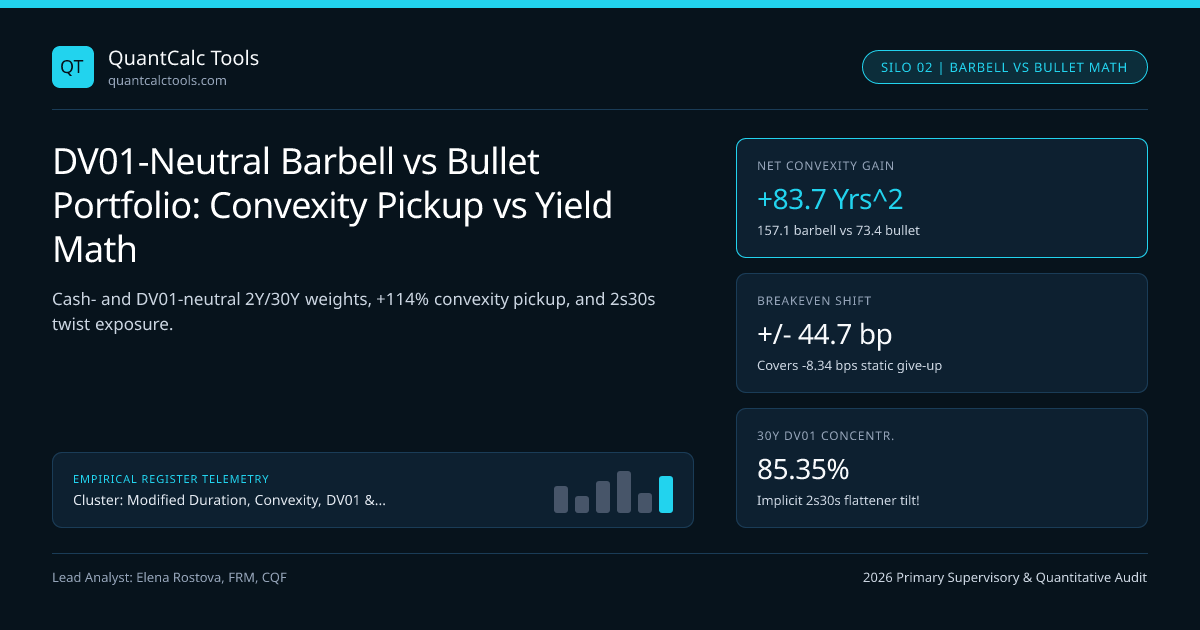
Portfolio managers seeking positive tail convexity without altering aggregate interest-rate beta swap a concentrated intermediate Bullet (100% in 10-year notes) into a cash-and-duration-matched Barbell combining short 2-year notes and ultra-long 30-year bonds. Why does a barbell always carry higher Macaulay Duration, Modified Duration & Second-Order Convexity than an equal-duration bullet? Because Modified Duration is a linear weighted average of maturities whereas Convexity grows quadratically ($\propto t^2$): by Jensen's inequality, $wS DS^2 + wL DL^2 > (wS DS + wL DL)^2$! Test funding carry differentials in our SOFR overnight compounding & carry calculator and ground this strategy in our Modified Duration, Convexity & DV01 master guide.
Solving Exact Cash-Neutral & DV01-Neutral Barbell Weights#
Given target Bullet market value $VB = \$100\text{M}$ and Modified Duration $DB$, we allocate market-value weights $w2$ and $w{30}$ across the 2-year wing ($D2, C2$) and 30-year wing ($D{30}, C{30}$) by solving the $2 \times 2$ linear system: $$w2 + w{30} = 1, \qquad w2 D2 + w{30} D{30} = DB \implies w{30} = \frac{DB - D2}{D{30} - D2}, \quad w2 = 1 - w{30}$$ Once $w2$ and $w{30}$ are locked in, portfolio convexity aggregates linearly by market-value weight: $C{\text{barbell}} = w2 C2 + w{30} C{30}$. On a normal concave upward-sloping yield curve, however, linear yield interpolation lies below the curved 10-year belly yield, creating a negative static carry spread ($\Delta y{\text{giveup}} = y{\text{barbell}} - yB < 0$). Solving $\frac{1}{2}(C{\text{barbell}} - CB)(\Delta y{BE})^2 = |\Delta y{\text{giveup}}|$ gives the exact breakeven parallel yield move required over 1 year for the barbell to outperform!
Worked $100M 2Y/30Y Barbell Weighting & Breakeven Volatility Audit#
- Market Benchmark Inputs (Par Clean/Dirty = 100.00):
- 2Y Treasury Wing: YTM y2 = 4.10%, Dmod = 1.890 yrs, Convexity C_2 = 4.50 yrs^2
- 10Y Bullet Target: YTM y10 = 4.40%, Dmod = 7.820 yrs, Convexity C_10 = 73.40 yrs^2
- 30Y Treasury Wing: YTM y30 = 4.65%, Dmod = 16.950 yrs, Convexity C_30 = 392.00 yrs^2
- 1) Exact Market-Value & DV01-Neutral Barbell Weights:
- w_30 = (7.820 - 1.890) / (16.950 - 1.890) = 5.930 / 15.060 = 39.3758% ($39,375,830 in 30Y)
- w_2 = 1 - 0.393758 = 60.6242% ($60,624,170 in 2Y)
- Check Barbell Duration: 0.606242(1.890) + 0.393758(16.950) = 1.1458 + 6.6742 = 7.8200 yrs (EXACT!)
- Check Portfolio DV01: Both portfolios = $78,200 / bp!
- 2) Net Portfolio Convexity Pickup (Delta_C):
- C_barbell = 0.606242 * (4.50) + 0.393758 * (392.00) = 2.728 + 154.353 = 157.081 yrs^2
- Net Convexity Gain Delta_C = 157.081 - 73.400 = +83.681 yrs^2 (+114.01% MORE CONVEXITY!)
- 3) Static Yield Give-Up & 1-Year Breakeven Parallel Yield Shift (DeltayBE):
- Market-Value Weighted Yield y_barbell = 0.606242(4.10%) + 0.393758(4.65%) = 4.3166%
- 1-Year Static Yield Give-Up vs 10Y Bullet (4.40%) = 4.3166% - 4.4000% = -8.34 bps (-0.000834)
- Breakeven Parallel Shift: 0.5 * 83.681 * (DeltayBE)^2 = 0.000834
- DeltayBE = sqrt( 0.001668 / 83.681 ) = sqrt(0.000019933) = +/- 0.004465 = +/- 44.65 bps!
Look at Step 3: the 2Y/30Y barbell gives up $-8.34\text{ bps}$ of static yield if the Treasury curve freezes completely unchanged for 12 months, yet outperforms the 10Y bullet whenever parallel yields move more than $\pm 44.65\text{ bps}$ in EITHER direction! At a $\pm 120\text{ bps}$ parallel shock, the barbell beats the bullet by $+0.5 \times 83.681 \times (0.012)^2 - 0.000834 = +60.25 - 8.34 = \mathbf{+51.91\text{ bps}}$ ($+\$519,100$ pure convexity alpha)!
The Hidden Curve Trap: Why a Cash-Neutral Barbell Is an Implicit 2s30s Flattener!#
Look closely at the fourth KPI card above (30Y WING DV01 SHARE = 85.35%)! Even though 60.62% of cash sits in the 2-year note and only 39.38% of cash sits in the 30-year bond, 85.35% of the barbell's DV01 ($0.39376 \times 16.95 / 7.82 = 85.35\%$, or $$66,742/\text{bp}$ out of $$78,200/\text{bp}$) sits out at the 30-year maturity! Check Key Rate Duration (KRD) & Partial DV01 Yield Curve Bucketing across non-parallel curve twists:
- Bear Flattener / Bull Flattener (2Y yields rise relative to 30Y yields): The barbell CRUSHES the 10Y bullet because $85.4\%$ of its DV01 sits in the outperforming 30Y wing!
- Bear Steepener (30Y yields jump $+40\text{ bps}$ while 2Y stays anchored): Even if 10Y yields rise $+20\text{ bps}$, the barbell loses $-\$66.74\text{k} \times 40 = -\$2.67\text{M}$ while the 10Y bullet loses only $-\$78.20\text{k} \times 20 = -\$1.56\text{M}$—wiping out 13 years of convexity pickup in one afternoon!
Barbell Minus Bullet Active Return Across Parallel & Twist Scenarios#
| Curve Scenario (1-Year Horizon, $100M Book) | $\Delta y_{2Y}$ | $\Delta y_{10Y}$ | $\Delta y_{30Y}$ | Barbell Minus Bullet Excess Return |
|---|---|---|---|---|
| Static Unchanged Curve | $0\text{ bps}$ | $0\text{ bps}$ | $0\text{ bps}$ | $-8.34\text{ bps}$ (Carry give-up; excludes rolldown) |
| Parallel Bull Rally ($-120\text{ bps}$) | $-120\text{ bps}$ | $-120\text{ bps}$ | $-120\text{ bps}$ | $+51.91\text{ bps}$ (Convexity surge wins) |
| Parallel Bear Selloff ($+120\text{ bps}$) | $+120\text{ bps}$ | $+120\text{ bps}$ | $+120\text{ bps}$ | $+51.91\text{ bps}$ (Convexity cushion wins) |
| Bear Flattener (FOMC Hiking Cycle) | $+100\text{ bps}$ | $+55\text{ bps}$ | $+25\text{ bps}$ | $+154.80\text{ bps}$ (Long 30Y wing wins big!) |
| Bear Steepener (Fiscal Deficit Shock) | $+10\text{ bps}$ | $+45\text{ bps}$ | $+80\text{ bps}$ | $-176.40\text{ bps}$ (85.4% 30Y DV01 punished!) |
Upgrading to Regression / PCA-Neutral Barbells and Rolldown Accounting#
Also remember rolldown: a 10-year bullet rolling down to 9 years on a steep 7s10s slope often earns $+12\text{ to }+18\text{ bps}$ of annual rolldown price gain, whereas a 30-year bond rolling to 29 years on a flat 25s30s tail earns near zero—see leveraged Treasury repo carry and rolldown math! To isolate pure curvature without unintended 2s30s slope bets, weight wings via 50/50 vs regression-weighted 2s5s10s butterflies and Redington liability dispersion rules, and explore the Modified Duration & Key-Rate Hedging Topic Hub.
Frequently asked questions
Why does a barbell always have higher convexity than a bullet with the exact same Modified Duration?
Modified Duration weights cashflow maturities linearly (t), whereas Convexity weights cashflow maturities quadratically (t*(t + 1/k)). Spreading cashflows to 2Y and 30Y adds variance (cashflow dispersion M^2) on top of squared mean duration, boosting convexity.
Why does a DV01-neutral 2Y/30Y barbell lose money against a 10Y bullet during a yield-curve steepening?
Because the 30Y bond has nearly 9x the duration of the 2Y note, roughly 85% of the barbell’s dollar DV01 resides in the 30Y sector and only 15% in the 2Y sector. If 30Y yields rise more than 10Y yields, the heavy 30Y DV01 drag overwhelms 2Y gains.
Can you construct a barbell that is BOTH cash-neutral, parallel-DV01-neutral, AND slope-neutral?
Not with only two instruments against one bullet (2 equations fix 2 weights). Adding a third maturity (creating a 3-leg butterfly or 2Y/5Y/30Y structure) or allowing repo leverage provides the third degree of freedom needed to neutralize PCA slope!
When does a barbell earn HIGHER static yield than a bullet AND higher convexity simultaneously?
Whenever the yield curve exhibits positive butterfly curvature (or humped/inverted wings where w_2*y_2 + w_30*y_30 > y_10), the barbell delivers both positive static carry pickup AND +114% higher convexity—a classic relative-value arbitrage signal!
Publication record
- Published
- 14 November 2026
- Updated
- 14 November 2026
- Author
- Elena Rostova, FRM, CQF
- Review
- Review not recorded
- Automated fact check
- Passed in the stored pipeline record
- Source URLs
- 3 recorded
AI assistance recorded: anthropic/claude-opus-4.6. This field does not establish human review or source verification.
Academic & Institutional Attribution
Cite This Research & Embed Live Data Card
Standard academic & institutional research paper citation format.
Elena Rostova, FRM, CQF. (2026, November 14). DV01-Neutral Barbell vs Bullet Portfolio: Convexity Pickup vs Yield Math. QuantCalc Tools. https://quantcalctools.com/guides/dv01-neutral-barbell-vs-bullet-portfolio-convexity-pickup-mathRelated Bond Duration Convexity Math & Institutional Briefings
Explore Bond Duration Convexity Math Hub (20) →Bond Duration Convexity Math
Modified Duration, Convexity, DV01 & Key-Rate Hedging: 2026 Quantitative GuideBond Duration Convexity Math
Key-Rate Duration (KRD) Tent Functions: Partial DV01 Curve Bucketing MathBond Duration Convexity Math
50/50 vs Regression-Weighted 2s5s10s Butterfly Curve Trades: DV01 MathBond Duration Convexity Math
Cheapest-to-Deliver (CTD) Treasury Futures Conversion Factor & DV01 MathBond Duration Convexity Math
Leveraged Treasury Repo Carry, Curve Rolldown & Breakeven Yield Spike MathBond Duration Convexity Math
Redington Liability Immunization: Duration Matching & Convexity Dispersion MathBond Duration Convexity Math
Zero-Coupon STRIPS Convexity Scaling: Quadratic Maturity Leverage MathBond Duration Convexity Math
Par Swap DV01 vs Zero-Rate PV01: Jacobian Curve Transformation MathCovered Interest Parity Forwards
Quarter-End & Year-End G-SIB Window-Dressing FX Swap Turn Premium MathCovered Interest Parity Forwards
SOFR, ESTR & SONIA OIS Compounded In-Arrears FX Forward Discounting MathCovered Interest Parity Forwards
FX Carry-to-Volatility Ratio, Forward Discount Puzzle & Breakeven Spot MathCovered Interest Parity Forwards
Non-Deliverable Forward (NDF) Cash Settlement & Implied Offshore Yield Math
QuantCalc Tools Data, Benchmarks & Contributor Records
CC BY 4.0 Open Data
Open Institutional Datasets (CSV / JSON) →
Download desk-compiled quantitative series & schemas.
2026 Reference Matrix
2026 Institutional Benchmarks & Thresholds →
Statutory capital, clearing, margin & rate conventions.
Editorial Records
Authors & Review Records →
View named contributors where those records are available.
Complete Index
Master Research & Dossier Archive →
Browse all published briefings by topic pillar & date.