
Par Swap DV01 vs Zero-Rate PV01: Jacobian Curve Transformation Math
Risk engines compute sensitivities to bootstrapped zero-coupon spot rates, whereas trading desks execute hedges in par SOFR OIS swaps; inverting the lower-triangular Jacobian matrix bridges the two.
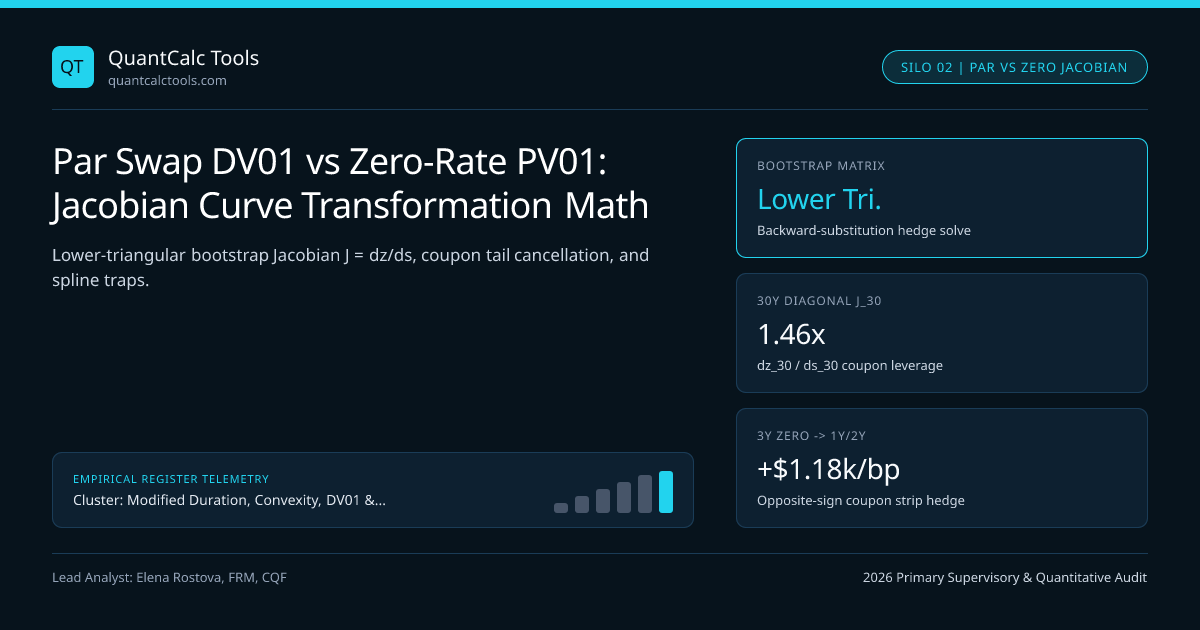
Internal pricing engines value exotic swaptions, corporate bond books, and structured notes off a bootstrapped Zero-Coupon Spot Curve $z = (z1, z2, \dots, zn)^\top$, outputting a vector of Zero-Rate PV01s ($\nablaz V = \partial V / \partial zi$). Yet you cannot call an interdealer broker to trade a "10-year zero-coupon swap"—live liquidity sits in Par NY Fed SOFR Index Overnight Index Swaps (OIS) $s = (s1, s2, \dots, sn)^\top$! Converting zero-rate risk into exact par swap hedge notionals requires the Multivariate Chain Rule Jacobian Matrix $J = \partial z / \partial s$, underpinning both Key Rate Duration (KRD) Bucketing and ISDA SIMM v2.6 sensitivity grids. Anchor scalar duration definitions in our Modified Duration, Convexity & DV01 master guide.
Deriving the Lower-Triangular Bootstrap Jacobian Matrix $J = \partial z / \partial s$#
Annual-pay par SOFR OIS swaps satisfy $si \sum{j=1}^{i} \alphaj P(0, Tj) + P(0, Ti) = 1$, where $P(0, Tj) = e^{-zj Tj}$ (or $(1 + zj)^{-Tj}$). Because bootstrapping solves $z1$ from $s1$, then $z2$ from $(s1, s2)$, and generally $zi$ from $(s1, \dots, si)$, changing a long par swap rate $sk$ never alters shorter zero rates $zj$ ($j < k$)—making the Jacobian $J{ij} = \partial zi / \partial sj$ strictly lower-triangular! By the multivariate chain rule: $$\nablas V = \left(\frac{\partial z}{\partial s}\right)^\top \nablaz V = J^\top \nablaz V, \qquad H{\text{notional}} = -\text{diag}(PV01{\text{swap}})^{-1}\,\nabla_s V$$ Look at $J^\top$: because $J$ is lower-triangular, $J^\top$ is upper-triangular, meaning we solve exact par-swap hedge notionals cleanly by backward substitution from the 30-year tenor inward to 1 year!
Worked $3 \times 3$ Jacobian Inversion: Hedging a $100M 3-Year Zero Exposure with 1Y, 2Y, 3Y Par Swaps#
- Market Par OIS Curve: s1 = 4.00%, s2 = 4.20%, s_3 = 4.50% (Annual ACT/360 = 1.0 accrual for clarity)
- Bootstrapped Discount Factors & Zero Rates (Annual Compounding):
- T=1Y: DF1 = 1 / 1.0400 = 0.961538 => z1 = 4.0000%
- T=2Y: 0.0420*(0.961538 + DF2) + DF2 = 1 => DF2 = 0.920999 => z2 = 4.2042%
- T=3Y: 0.0450*(0.961538 + 0.920999 + DF3) + DF3 = 1 => DF3 = 0.875977 => z3 = 4.5138%
- Exact Lower-Triangular Bootstrap Jacobian J = dzi / dsj:
- [ ds1 ds2 ds_3 ]
- dz_1 [ 1.0000 0.0000 0.0000 ]
- dz2 [ -0.0206 1.0210 0.0000 ] <-- Notice dz2/ds_1 = -0.0206 < 0!
- dz3 [ -0.0155 -0.0315 1.0475 ] <-- Notice dz3/ds2 = -0.0315 < 0 & dz3/ds_3 = 1.0475 > 1!
- Target Portfolio Risk: Pure $100,000,000 3-Year Liability Zero => Zero-PV01 Vector nabla_z V = [ $0, $0, -$25,144 ]^T / bp
- Apply Upper-Triangular J^T to get Par-Swap PV01 Vector nablas V = J^T * nablaz V:
- ParPV011Y = (-0.0155) * (-$25,144) = +$389.73 / bp! (POSITIVE sensitivity to 1Y par swap!)
- ParPV012Y = (-0.0315) * (-$25,144) = +$792.04 / bp! (POSITIVE sensitivity to 2Y par swap!)
- ParPV013Y = (+1.0475) * (-$25,144) = -$26,338.34 / bp! (4.75% LARGER than zero PV01!)
- Sum of Par PV01s = +$389.73 + $792.04 - $26,338.34 = -$25,156.57 / bp (Preserves parallel shift PV01!)
Examine those off-diagonal signs in $J$:
- Why did a pure 3-year zero liability generate positive $+$389.73/\text{bp}$ and $+$792.04/\text{bp}$ Par-Swap PV01 at 1Y and 2Y? Because when you hedge the 3Y principal by receiving fixed on a 3Y Par Swap, that 3Y Par Swap introduces unwanted 1Y and 2Y fixed coupons! You must pay fixed on small 1Y and 2Y swaps ($-$390/\text{bp}$ and $-$792/\text{bp}$) to strip out the 3Y swap's intermediate coupons!
Crucial Production Warning: Cubic Spline Curve Builders Break Lower-Triangularity!#
Watch out for a classic quantitative developer bug when building $J$ numerically:
- Under piecewise-flat forward or linear-on-log-discount bootstrapping, $J$ is strictly lower-triangular ($J_{ij} = 0$ for $j > i$).
- Under natural cubic spline or monotone convex (Hagan-West) global curve fitting, bumping the 30-year par swap rate $s{30}$ causes tiny "spline waves" (ringing) back into the 10-year and 5-year zero segments ($J{5,30} \neq 0$)! Institutional derivatives engines therefore compute direct instrument bump-and-rebootstrap Par PV01s ($V(\text{rebootstrap}(s + e_k \cdot 1\text{bp})) - V(s)$), which implicitly captures the exact full-rank Jacobian regardless of spline choice! Test overnight leg mechanics in our SOFR overnight compounding & carry calculator.
Comparing Curve Sensitivity Representations Across Desk & Regulatory Systems#
| Sensitivity Coordinate System | Mathematical Definition | Matrix Sparsity vs Tradable Swaps | Off-Diagonal Coupon Feedback? | Primary Institutional Consumer |
|---|---|---|---|---|
| Zero-Coupon Spot PV01 ($\nabla_z V$) | $\partial V / \partial z(T_i)$ | Upper-triangular $J^{-\top}$ needed | Zero (Pure single-date cashflow) | Quant pricing & XVA engines |
| Instantaneous Forward PV01 ($\nabla_f V$) | $\partial V / \partial f(T{i-1}, Ti)$ | Bidiagonal step mapping | Step-forward telescopic sum | HJM / Libor Market Model calibration |
| Par OIS Swap DV01 ($\nabla_s V$) | $(\partial z / \partial s)^\top \nabla_z V$ | Identity ($I_n$) — Direct hedge! | Yes (Sign-flipped short tails) | Linear rates desks & ISDA SIMM |
| PCA Factor DV01 ($\nabla_{PC} V$) | $E3^\top \nablas V$ (Top 3 eigenvectors) | $3 \times n$ orthogonal compression | Compressed into Level/Slope/Curv | Macro risk limits & VaR engines |

Connecting Jacobian Algebra to Key-Rate Tents & PCA Hedging#
That $1.46\times$ diagonal amplification at 30 years explains the exact mathematical root of the negative intermediate Par-KRDs highlighted in Key-Rate Duration tent functions and partial DV01! Compress 12-tenor Par Swap DV01 vectors into 3 tradable macro factors using PCA level, slope, and curvature DV01 hedging, inspect institutional clearing venues in our proprietary trading software directory, and explore the Modified Duration & Key-Rate Hedging Topic Hub.
Frequently asked questions
Why is the diagonal entry dz_30 / ds_30 of the swap Jacobian substantially greater than 1.0 (around 1.46)?
When you raise the 30-year par swap coupon by +1 bp while holding 1Y through 20Y par rates fixed, all first 20 annual coupons still discount at unchanged rates—forcing the final 20Y–30Y zero discount factor to drop extra hard (+1.46 bps) to keep the swap at par!
What happens if a trader uses raw Zero-Rate PV01s directly as Par Swap hedge notionals without Jacobian inversion?
At the 30-year tenor, skipping Jacobian inversion over-hedges 30Y par swap notional and leaves unhedged intermediate coupon exposure across 2Y–20Y, creating up to a 25% curve-steepener hedge error!
Does ISDA SIMM v2.6 require Zero-Rate PV01 or Market Par-Swap PV01 across its 12 interest-rate vertices?
ISDA SIMM specifies market par-rate sensitivities (bumping par OIS andibor/term swap curves by +1 bp at each of the 12 vertices from 2w to 30y), matching live interdealer hedge instruments directly.
Why do modern XVA engines use Adjoint Algorithmic Differentiation (AAD) to compute the swap Jacobian?
Bumping and re-bootstrapping 12 vertices across 10 currencies requires 120 full Monte Carlo re-valuations. AAD propagates sensitivities backward through the bootstrap graph in ~3x the cost of a single valuation!
Publication record
- Published
- 14 November 2026
- Updated
- 14 November 2026
- Author
- Elena Rostova, FRM, CQF
- Review
- Review not recorded
- Automated fact check
- Passed in the stored pipeline record
- Source URLs
- 3 recorded
AI assistance recorded: anthropic/claude-opus-4.6. This field does not establish human review or source verification.
Academic & Institutional Attribution
Cite This Research & Embed Live Data Card
Standard academic & institutional research paper citation format.
Elena Rostova, FRM, CQF. (2026, November 14). Par Swap DV01 vs Zero-Rate PV01: Jacobian Curve Transformation Math. QuantCalc Tools. https://quantcalctools.com/guides/par-swap-dv01-vs-zero-rate-pv01-jacobian-curve-transformationRelated Bond Duration Convexity Math & Institutional Briefings
Explore Bond Duration Convexity Math Hub (20) →Bond Duration Convexity Math
Modified Duration, Convexity, DV01 & Key-Rate Hedging: 2026 Quantitative GuideBond Duration Convexity Math
ACT/ACT ICMA vs 30/360 Accrued Interest & Odd-Stub Duration Bias MathBond Duration Convexity Math
TIPS Real-Yield Duration vs Nominal Treasury Empirical Beta Hedging MathBond Duration Convexity Math
Spread Duration vs Duration-Times-Spread (DTS): Credit Hedging MathBond Duration Convexity Math
Floating-Rate Note (FRN) Interest-Rate Reset Duration vs Spread Duration MathBond Duration Convexity Math
Ultra-Long 50Y Gilt & 100Y Century Bond Convexity Asymmetry MathBond Duration Convexity Math
Principal Component Analysis (PCA) Level, Slope & Curvature DV01 Hedging MathBond Duration Convexity Math
Pull-to-Par Horizon Return, Reinvestment Yield & Macaulay Duration Gap MathCovered Interest Parity Forwards
Synthetic USD Commercial Paper Funding: FX Swap Implied SOFR Spread MathCovered Interest Parity Forwards
Currency-Hedged Foreign Sovereign Bond Yield Pickup: 3M Rolling FX Swap MathCovered Interest Parity Forwards
USD/CAD T+1 Spot Lag, Modified Following & End-of-Month FX Calendar MathCovered Interest Parity Forwards
FX Time-Option (Window) Forward Pricing: Worst-Case Swap Point Rule Math
QuantCalc Tools Data, Benchmarks & Contributor Records
CC BY 4.0 Open Data
Open Institutional Datasets (CSV / JSON) →
Download desk-compiled quantitative series & schemas.
2026 Reference Matrix
2026 Institutional Benchmarks & Thresholds →
Statutory capital, clearing, margin & rate conventions.
Editorial Records
Authors & Review Records →
View named contributors where those records are available.
Complete Index
Master Research & Dossier Archive →
Browse all published briefings by topic pillar & date.