
Covered Interest Parity Forwards
Quarter-End & Year-End G-SIB Window-Dressing FX Swap Turn Premium Math
Because Basel III G-SIB capital scores snapshot notional FX derivative books strictly on December 31, overnight year-end FX swap points routinely spike to 250–600 bps annualized implied USD rates.
Why did the overnight FX swap implied USD borrowing rate on December 31st surge to $8.90\%$ annualized (+435 bps over NY Fed SOFR Index!) even when cash Fed Funds and Treasury repo stayed calm? Because the Basel Committee's G-SIB (Global Systemically Important Bank) Systemic Score—particularly in European jurisdictions calculating leverage and notional derivative buckets on a single December 31 point-in-time snapshot rather than daily averages—penalizes every gross dollar of open FX swaps sitting on a bank's balance sheet across New Year's Eve! Test normal vs stressed forward points in our FX forward points & carry calculator and ground full swap mechanics in our Covered Interest Parity & FX Forward Points master guide.
Exact Dirac-Impulse "Turn" Parameterization & Implied Annualized Turn Basis#
Let $d{\text{turn}}$ denote the exact number of calendar days in the single overnight Tom-Next roll spanning December 31st to January 2nd (for example, $d{\text{turn}} = 2$ days when Dec 31 is Wednesday and Jan 2 is Friday; up to $d_{\text{turn}} = 4$ days when Dec 31 is Thursday and Jan 1 is Friday ahead of a weekend!). Dealer curves add a discrete Turn Basis Jump ($\tau_{\text{YE}}$, in annualized bps) strictly across those $d{\text{turn}}$ days: $$\Delta \text{Points}{\text{Turn}} = S \times \tau{\text{YE}} \times \frac{d{\text{turn}}}{360} \times M{\text{pip}} \quad \Longleftrightarrow \quad \tau{\text{YE}} = \frac{\Delta \text{Points}{\text{Turn}}}{S \times M{\text{pip}}} \times \frac{360}{d_{\text{turn}}}$$ Notice the invariant cash-pip consequence for all maturities spanning New Year's Eve:
- Whether you trade a 1-week swap, a 1-month swap, or a 3-month swap crossing Dec 31, the dollar/pip turn surcharge ($\Delta \text{Points}_{\text{Turn}}$, say
+7.8 pipsonEUR/USD) is IDENTICAL! - When annualized over 90 days,
+7.8 pipsadds a mild+28.8 bpsto the 3-month basis; when annualized over the 2-day Dec 31 -> Jan 2 turn, the exact same+7.8 pipsequates to an explosive+1,294 bps(12.94%/yr!) overnight basis surcharge!
Worked December 30 vs January 2 Settlement Optimization ($100M Institutional Hedge)#
- Inputs (Trade Date: Dec 1; Spot Value Date: Dec 3; Spot EUR/USD S = 1.08500):
- Normal Dec Overnight Differential (SOFR 4.55% - [ESTR 2.65% - 15bp normal basis]) = +2.05% (+0.6179 pips/day)
- Year-End Turn Span: Dec 31 (Wed) -> Jan 2 (Fri, since Jan 1 New Year’s Day is global holiday!) = 2 Calendar Days!
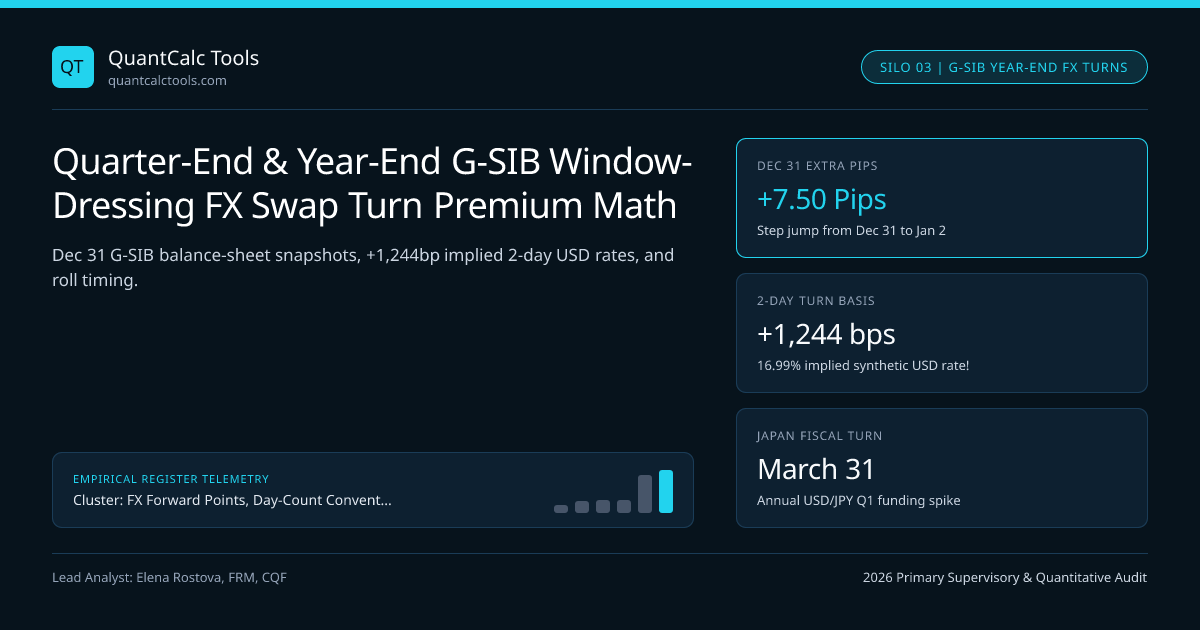
- Interdealer Quoted "EUR/USD Year-End Turn" Surcharge = +7.50 EXTRA PIPS across Dec 31 -> Jan 2!
- 1) Implied Overnight USD Borrowing Rate Across the 2-Day Year-End Turn:
- Normal 2-Day Carry Points (Dec 31 -> Jan 2) = 2 * 0.6179 = +1.24 pips
- Total Quoted Dec 31 -> Jan 2 Turn Points = +1.24 + 7.50 = +8.74 pips (for just 2 days!)
- Implied 2-Day Turn Basis Spread tau_YE = (0.000750 / 1.08500) * (360 / 2) = +0.12442 = +1,244.2 bps!
- Implied Synthetic Overnight USD Cost = 4.55% SOFR + 12.44% Turn Basis = 16.99% ANNUALIZED!
- 2) Corporate / Asset Manager Maturity Date Optimization (Borrowing Synthetic USD / Rolling Hedge):
- Option A — Naive 1-Month Hedge Maturing Jan 2 (30 days, CROSSES Dec 31 Turn!):
- Total Swap Points Paid = (30 * 0.6179) + 7.50 Turn Surcharge = +18.54 + 7.50 = +26.04 pips ($260,400)
- Option B — Smart Pre-Turn Maturity Dec 30 (27 days, STOPS BEFORE Dec 31!) + Re-Enter Jan 2:
- 27-Day Dec Points = 27 * 0.6179 = +16.68 pips ($166,800)
- CASH SAVED BY AVOIDING DEC 31 BALANCE-SHEET SNAPSHOT = 7.50 PIPS = $75,000 PURE SAVINGS ON €100M!
Look at Step 2: simply shifting a non-essential swap roll maturity by 48 hours (settling December 30 instead of January 2, or locking a 2-month swap in November before year-end dealer balance sheets clog up) saves $$75,000$ per €100M—while a cash-rich USD reserve manager lending USD exclusively over those 2 days (Dec 31 -> Jan 2) earns an annualized 16.99% risk-free return!

Jurisdictional Asymmetry: Daily-Averaged US G-SIBs vs Snapshot European/Asian G-SIBs!#
Why do Eurozone (EUR/USD) and Japanese (USD/JPY) turns spike 3x to 5x harder on December 31 than intra-US repo?
- Under Federal Reserve Regulation
YY/Q, US G-SIBs compute Supplementary Leverage Ratio (SLR) assets on quarterly daily averages, spreading balance-sheet cost evenly across all 90 days! - Conversely, Eurozone Single Resolution Fund (
SRF) levies and several non-US G-SIB indicator buckets historically evaluate on December 31st spot snapshots—incentivizing European and Japanese banks to withdraw FX swap intermediation for just 48 hours over New Year's Eve!
Historical & Structural FX Turn Spikes Across Quarter-Ends vs Year-End#
| Reporting Turn Date | Calendar Span ($d_{\text{turn}}$) | Typical EUR/USD Extra Turn Pips | Typical USD/JPY Extra Turn Pips | Primary Regulatory Balance-Sheet Trigger |
|---|---|---|---|---|
March 31 (Q1 Turn) | $1\text{–}3$ days | $+0.8\text{ to }+1.8$ pips | $-1.5\text{ to }-4.0$ pips | Japanese Fiscal Year-End (Mar 31) + Q1 SLR! |
June 30 (Q2 Half-Year) | $1\text{–}3$ days | $+1.0\text{ to }+2.4$ pips | $-1.2\text{ to }-3.0$ pips | Semi-annual Pillar 3 & stress-test disclosures |
September 30 (Q3 Turn) | $1\text{–}3$ days | $+1.0\text{ to }+2.2$ pips | $-1.2\text{ to }-3.2$ pips | Japanese Half-Year + Q3 Basel leverage print |
December 31 (YE Turn) | $2\text{–}4$ days | $+5.5\text{ to }+14.0$ pips! | $-10.0\text{ to }-28.0$ pips! | Basel G-SIB Systemic Score + EU Bank Levy! |
Integrating Turn Impulses Into Broken-Date Curves & SA-CCR Capital Pricing#
Because a December 31 turn adds a step discontinuity (+7.50 pips jump between Dec 31 value date and Jan 2 value date), broken-date engines must isolate turns prior to interpolating broken-date FX forwards and central-bank kinks, while understanding why banks ration balance sheet requires mastering SA-CCR and ISDA SIMM FX forward margin drag and cross-currency basis CIP deviations. Browse all 20 guides on the FX Forward Points & Basis Topic Hub.
Frequently asked questions
Why does March 31 hit USD/JPY FX swap turns harder than EUR/USD?
March 31 is the statutory Fiscal Year-End for Japanese megabanks, life insurers, and GPIF/pension accounts. Japanese institutions aggressively tidy balance sheets and lock in USD funding ahead of March 31, creating a distinct "Japanese Fiscal Turn" in USD/JPY swaps.
What is "trading the turn" in interdealer FX swap markets?
Starting as early as August or September, interdealer brokers quote a standalone forward-starting 1-business-day FX swap ("The Turn": e.g. Buy Dec 31 / Sell Jan 2), allowing hedge funds and reserve managers to speculate on or supply year-end G-SIB balance sheet months in advance!
Why does January 1 being a global holiday double the Calendar Day denominator of the Year-End Turn?
Because banks and RTGS wires are closed worldwide on January 1st, a swap whose near leg settles December 31st cannot settle its far leg until at least January 2nd (2 calendar days—or 4 days if Jan 2 falls on Saturday!), multiplying daily interest accrual accordingly.
Did Basel III reforms eliminate European G-SIB year-end window dressing?
While EBA/ECB supervisory scrutiny and partial averaging have curbed the most extreme 2016–2018 spikes, G-SIB Score notional derivative cutoffs and Single Resolution Fund snapshot levies still keep December 31 FX swap turns 5x to 8x wider than normal nights.
Publication record
- Published
- 13 November 2026
- Updated
- 14 November 2026
- Author
- Elena Rostova, FRM, CQF
- Review
- Review not recorded
- Automated fact check
- Passed in the stored pipeline record
- Source URLs
- 3 recorded
AI assistance recorded: anthropic/claude-opus-4.6. This field does not establish human review or source verification.
Academic & Institutional Attribution
Cite This Research & Embed Live Data Card
Standard academic & institutional research paper citation format.
Elena Rostova, FRM, CQF. (2026, November 14). Quarter-End & Year-End G-SIB Window-Dressing FX Swap Turn Premium Math. QuantCalc Tools. https://quantcalctools.com/guides/quarter-end-year-end-gsib-window-dressing-fx-swap-turn-premiumRelated Covered Interest Parity Forwards & Institutional Briefings
Explore Covered Interest Parity Forwards Hub (20) →Covered Interest Parity Forwards
Covered Interest Parity, FX Forward Points & Cross-Currency Basis: 2026 GuideCovered Interest Parity Forwards
SOFR, ESTR & SONIA OIS Compounded In-Arrears FX Forward Discounting MathCovered Interest Parity Forwards
FX Carry-to-Volatility Ratio, Forward Discount Puzzle & Breakeven Spot MathCovered Interest Parity Forwards
Non-Deliverable Forward (NDF) Cash Settlement & Implied Offshore Yield MathCovered Interest Parity Forwards
Historic-Rate vs Market-Rate FX Swaps: Uneven Notional & NPV Tail MathCovered Interest Parity Forwards
Cross-Rate Triangular FX Forward Arbitrage & Bid-Ask Swap Bounds MathCovered Interest Parity Forwards
Continuous Garman-Kohlhagen vs Discrete Money-Market CIP FX Options MathCovered Interest Parity Forwards
Synthetic USD Commercial Paper Funding: FX Swap Implied SOFR Spread MathCagr Irr Drawdown Compounding
Calmar, Sterling & Ulcer Performance Index: Path-Dependent Drawdown MathCagr Irr Drawdown Compounding
Omega Ratio Threshold Partition (LPM1): Full-Distribution Skew & Kurtosis MathCagr Irr Drawdown Compounding
Probabilistic & Deflated Sharpe Ratio (DSR): Backtest Multiple-Testing MathCagr Irr Drawdown Compounding
Sequence-of-Returns Risk & Withdrawal Depletion: Breaking CAGR Invariance
QuantCalc Tools Data, Benchmarks & Contributor Records
CC BY 4.0 Open Data
Open Institutional Datasets (CSV / JSON) →
Download desk-compiled quantitative series & schemas.
2026 Reference Matrix
2026 Institutional Benchmarks & Thresholds →
Statutory capital, clearing, margin & rate conventions.
Editorial Records
Authors & Review Records →
View named contributors where those records are available.
Complete Index
Master Research & Dossier Archive →
Browse all published briefings by topic pillar & date.