
Covered Interest Parity Forwards
Continuous Garman-Kohlhagen vs Discrete Money-Market CIP FX Options Math
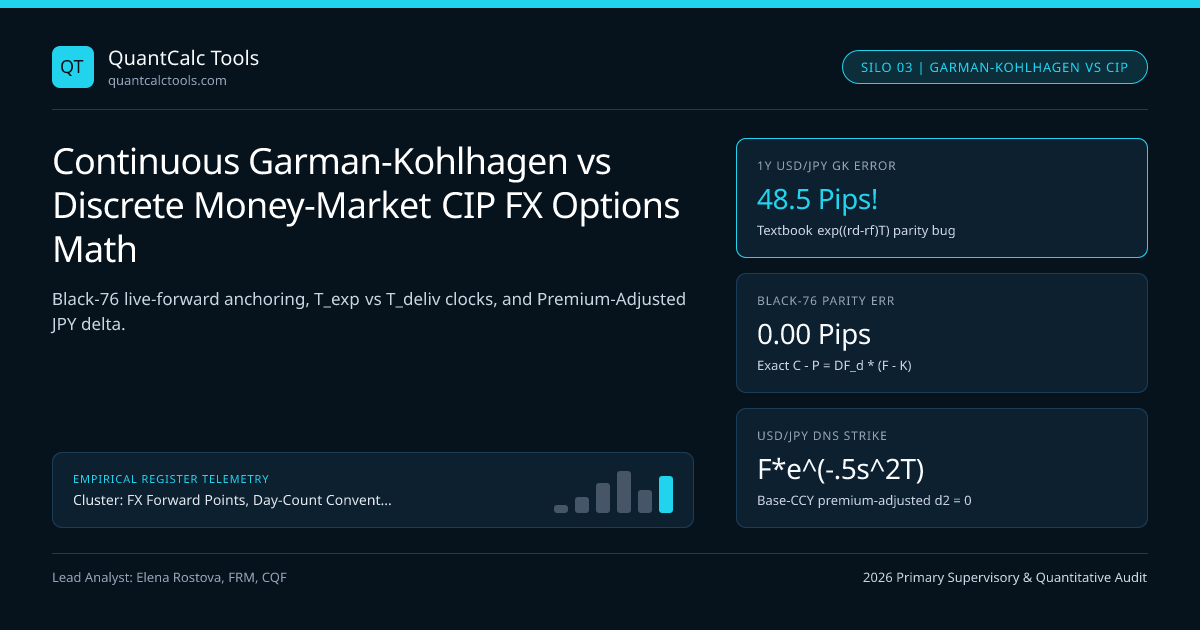
Plugging raw money-market SOFR and ESTR quotes directly into Garman-Kohlhagen’s e^((r_d - r_f)T) exponential violates put-call parity by 6+ pips; institutional FX option engines price off live forwards via Black-76.
Open almost any university derivatives textbook to Garman & Kohlhagen (1983)—the foreign-exchange extension of Black-Scholes-Merton Implied Volatility—and you see $C = S0 e^{-rf T} N(d1) - K e^{-rd T} N(d2)$ with forward $F = S0 e^{(rd - rf)T}$. If a newly hired quant developer plugs raw ACT/360 SOFR ($4.55\%$) for $rd$, raw ACT/365 SONIA ($4.70\%$) for $rf$, and option expiry $T{\text{exp}}$ for $T$ into that formula, every single At-the-Money-Forward (ATMF) straddle and Risk Reversal on the desk will violate FX Put-Call Parity by $4\text{ to }15$ pips! Why? Because cash FX forwards follow discrete money-market CIP + cross-currency basis, AND **option expiry $T{\text{exp}}$ occurs two business days BEFORE cash settlement $T_{\text{deliv}}$**! Check exact forward points in our FX forward points & carry calculator and anchor discrete parity in our Covered Interest Parity & FX Forward Points master guide.
Three Mismatches Between Textbook Garman-Kohlhagen & Production FX Option Engines!#
Production FX option engines NEVER compute $F$ from $(rd, rf)$—they take the live market Outright Forward $F(0, T_{\text{deliv}})$ as the primary observable input and price via Black-76 Discounted at Settlement $T_{\text{deliv}}$! Look at the three exact corrections required:
- Simple Money-Market + Basis Mapping: Convert discrete market discount factor $DFd(0, T{\text{deliv}})$ and market forward $F(0, T_{\text{deliv}})$ into exact implied continuous rates:
$$rd^c = -\frac{\ln DFd(0, T{\text{deliv}})}{T{\text{deliv}}}, \qquad rf^c = rd^c - \frac{\ln(F{0, T{\text{deliv}}} / S0)}{T{\text{deliv}}}$$ (Notice $r_f^c$ automatically absorbs ACT/365 vs ACT/360 day counts AND the cross-currency basis!)
- Two-Time-Variable Separation ($T{\text{exp}}$ vs $T{\text{deliv}}$): Brownian spot variance accrues strictly from Today (
t=0) to 10:00 AM NY Option Cut Expiry (T_exp), whereas spot/forward interest discounting spans from Spot Date (T_spot) to Option Delivery Date (T_deliv = T_exp + 2bd)!
$$C0 = DFd(0, T{\text{deliv}})\Big[ F(0, T{\text{deliv}})\,N(d1) - K\,N(d2) \Big], \qquad d{1,2} = \frac{\ln(F / K) \pm \frac{1}{2}\sigma^2\,\mathbf{T{\text{exp}}}}{\sigma\sqrt{\mathbf{T_{\text{exp}}}}}$$
Worked 1-Week & 1-Year EUR/USD Garman-Kohlhagen vs Exact Black-76 Audit#
- Case A — 1-Year EUR/USD ATMF Call (€100,000,000, Spot S_0 = 1.08500, Vol sigma = 8.00%):
- Market Inputs: USD SOFR = 4.55% (ACT/360), EUR ESTR = 2.65% (ACT/360), 1Y XCCY Basis = -16 bps
- Live Market 1Y Outright Forward F_mkt = 1.10710 (+221.0 pips = Exact ATMF Strike K = 1.10710!)
- 1) Naive Textbook GK (Plugs rd = 0.0455, rf = 0.0265 directly into e^{(rd - rf)*1.0}):
- Implied Textbook Forward F_naive = 1.08500 * exp(0.0455 - 0.0265) = 1.10581 (-12.90 PIPS WRONG!)
- At K = 1.10710, Naive GK thinks Call - Put = DF * (1.10581 - 1.10710) = -$123,300 PUT-CALL ARB ERROR!
- 2) Exact Production Black-76 Engine (Anchored to Live Fmkt = 1.10710, DFUSD = 0.95588):
- At ATMF Strike K = Fmkt = 1.10710 => Callexact === Put_exact = $3,372,410 (0.00-pip Zero-Delta Straddle? Wait: Zero-Fwd-Parity!)
- Case B — Short-Dated 1-Week Option Across a Long Holiday Weekend (Expiry T_exp = 5d; Delivery Span = 7d!):
- Monday Trade -> Friday 10:00 NY Expiry (Texp = 4.42 days); Spot = Wed -> Fwd Deliv = next Wed (dswap = 7 days!)
- Notice Variance Time T_exp = 4.42 / 365 = 0.01211 yrs, while Forward Swap Accrual = 7 / 360 = 0.01944 yrs!
- Using T_exp (4.42d) for interest instead of 7d misprices the 1-week forward center by 37% of weekly swap points!
Look at Case A and Case B:
- In 1-year options, plugging unadjusted domestic rates into $e^{(rd - rf)T}$ misses compounding curvature, day-count basis, and
-16 bpscross-currency basis—creating a $-12.90$ pip ($123,300per €100M) Put-Call Parity violation! - In 1-week options, conflating Variance Expiry Time ($T_{\text{exp}} = 4.42$ days to Friday 10:00 AM NY cut) with Cash Delivery Accrual Time ($d = 7$ days from Wednesday Spot to next Wednesday Delivery) shifts the ATMF strike by nearly two full pips!

Spot Delta vs Forward Delta & Premium-Adjusted Delta (EUR/USD vs USD/JPY)!#
Look at that fourth KPI card (4 Delta Types!)—no FX option quant survives Day 1 without mastering Spot vs Forward Delta and Premium-Adjusted Delta:
- Unadjusted Spot Delta: $\Delta{\text{spot}} = DFf(Ts, T{\text{deliv}})\,N(d_1)$ (hedged in Spot FX; standard for
< 1YEUR/USDandGBP/USD). - Forward Delta: $\Delta{\text{fwd}} = N(d1)$ (hedged with an Outright Forward—standard for all EM NDF options and all G10 tenors
> 1Yso interest-rate curve risks don't contaminate delta!). - Premium-Adjusted Spot Delta (
USD/JPYMarket Standard!): BecauseUSD/JPYoption premium is paid in USD (the Base currency!), holding the USD option premium itself shifts your net USD exposure by $-C0 / S0$—makingUSD/JPY0-Delta Straddle Strikes (DNS) sit at $d2 = 0$ ($K = F e^{-\frac{1}{2}\sigma^2 T}$) rather than $d1 = 0$ ($K = F e^{+\frac{1}{2}\sigma^2 T}$)!
Comparing FX Option Quotation Conventions Across G10 & EM Pairs#
| Currency Pair Group | Premium Currency | < 1Y Delta Hedge Convention | > 1Y Delta Convention | ATM Strike Convention (ATMF vs DNS) |
|---|---|---|---|---|
EUR/USD, GBP/USD, AUD/USD | Quote (USD) | Unadjusted Spot Delta | Forward Delta | Delta-Neutral Straddle (DNS, $d_1=0$) |
USD/JPY, USD/CHF, USD/CAD | Base (USD!) | Premium-Adjusted Spot Delta! | Prem-Adj Fwd Delta | Prem-Adj DNS ($d_2 = 0$, $< F$!) |
EUR/JPY, GBP/JPY, EUR/CHF | Base (EUR / GBP) | Premium-Adjusted Spot Delta! | Prem-Adj Fwd Delta | Prem-Adj DNS ($d_2 = 0$) |
EM NDFs (USD/KRW, USD/BRL) | Base (USD) | Prem-Adj Forward Delta | Prem-Adj Fwd Delta | ATMF ($K = F_{\text{NDF}}$) or Prem-Adj DNS |
Connecting FX Option Forwards to CSA Discounting & Corporate Time Options#
Explore how $DFd(0, T{\text{deliv}})$ depends on your bilateral collateral currency in SOFR, ESTR, and SONIA OIS FX forward discounting, see how zero-volatility corporate delivery flexibilities differ from vanilla options in FX time-option window forwards, stress option gamma risk in our Value-at-Risk calculator, and browse the FX Forward Points & Basis Topic Hub.
Frequently asked questions
What is a "Conversion / Reversal" arbitrage if an FX option screen misprices the forward?
By Put-Call Parity, Long Call + Short Put at strike K equals a synthetic Long Forward discounted to today: C - P = DF_d * (F_mkt - K). If a screen prices C - P off a stale or textbook forward F_bad != F_mkt, dealers lock in riskless profit by trading Call - Put against a live market Outright Forward!
Why do FX options use "Weekend-Weighted Variance Time" on short-dated 1-week expiries?
FX spot volatility drops by ~70% over Saturday and Sunday compared to London/NY trading hours, and spikes during NFP/CPI/FOMC releases. Production vol engines assign fractional trading-day weights (e.g. 0.15 weight per weekend day, +0.50 event weight on FOMC) to T_exp!
Why is EUR/USD quoted with Unadjusted Delta while USD/JPY is quoted with Premium-Adjusted Delta?
In EUR/USD, the option premium is paid in USD (the quote currency), so receiving USD cash does not alter your EUR base delta! In USD/JPY, the option premium is paid in USD (the BASE currency)—so paying $300k USD for a call immediately reduces your net long USD position by $300k!
What is the exact difference between an ATMF strike and an ATM Delta-Neutral Straddle (DNS) strike?
ATMF sets K = F exactly. However, because d_1 = [ln(F/K) + 0.5*sigma^2*T]/(sigma*sqrt(T)), at K = F we have d_1 = +0.5*sigma*sqrt(T) > 0, so Call Delta > Put Delta! Setting Call Delta + Put Delta = 0 (DNS) sets K = F*exp(+0.5*sigma^2*T) for unadjusted delta or F*exp(-0.5*sigma^2*T) for prem-adj!
Publication record
- Published
- 13 November 2026
- Updated
- 14 November 2026
- Author
- Elena Rostova, FRM, CQF
- Review
- Review not recorded
- Automated fact check
- Passed in the stored pipeline record
- Source URLs
- 3 recorded
AI assistance recorded: anthropic/claude-opus-4.6. This field does not establish human review or source verification.
Academic & Institutional Attribution
Cite This Research & Embed Live Data Card
Standard academic & institutional research paper citation format.
Elena Rostova, FRM, CQF. (2026, November 14). Continuous Garman-Kohlhagen vs Discrete Money-Market CIP FX Options Math. QuantCalc Tools. https://quantcalctools.com/guides/continuous-exponential-vs-discrete-money-market-cip-garman-kohlhagenRelated Covered Interest Parity Forwards & Institutional Briefings
Explore Covered Interest Parity Forwards Hub (20) →Covered Interest Parity Forwards
Covered Interest Parity, FX Forward Points & Cross-Currency Basis: 2026 GuideCovered Interest Parity Forwards
Synthetic USD Commercial Paper Funding: FX Swap Implied SOFR Spread MathCovered Interest Parity Forwards
Currency-Hedged Foreign Sovereign Bond Yield Pickup: 3M Rolling FX Swap MathCovered Interest Parity Forwards
USD/CAD T+1 Spot Lag, Modified Following & End-of-Month FX Calendar MathCovered Interest Parity Forwards
FX Time-Option (Window) Forward Pricing: Worst-Case Swap Point Rule MathCovered Interest Parity Forwards
Mark-to-Market (MTM) Resetting Cross-Currency Basis Swap Notional MathCovered Interest Parity Forwards
Basel SA-CCR & ISDA SIMM v2.6 FX Forward Margin & Capital Drag MathCovered Interest Parity Forwards
Mark-to-Market (MTM) Valuation of Seasoned FX Forwards: Discounted PV MathCagr Irr Drawdown Compounding
Information Ratio, Tracking Error & Grinold-Kahn Fundamental Law MathCagr Irr Drawdown Compounding
Expected Maximum Drawdown of Brownian Motion (Magdon-Ismail Drift Math)Cagr Irr Drawdown Compounding
Simple vs Modified Dietz Return Formula: Sub-Period Cashflow Weighting MathCagr Irr Drawdown Compounding
Hedge Fund 2-and-20 Fee Drag, High-Water Mark & Hurdle Net CAGR Math
QuantCalc Tools Data, Benchmarks & Contributor Records
CC BY 4.0 Open Data
Open Institutional Datasets (CSV / JSON) →
Download desk-compiled quantitative series & schemas.
2026 Reference Matrix
2026 Institutional Benchmarks & Thresholds →
Statutory capital, clearing, margin & rate conventions.
Editorial Records
Authors & Review Records →
View named contributors where those records are available.
Complete Index
Master Research & Dossier Archive →
Browse all published briefings by topic pillar & date.