
50/50 vs Regression-Weighted 2s5s10s Butterfly Curve Trades: DV01 Math
Standard 50/50 DV01-weighted 2s5s10s butterfly trades suffer hidden front-end volatility bias; empirical regression and PCA weighting immunize 5-year belly curvature against 2s10s slope steepeners.
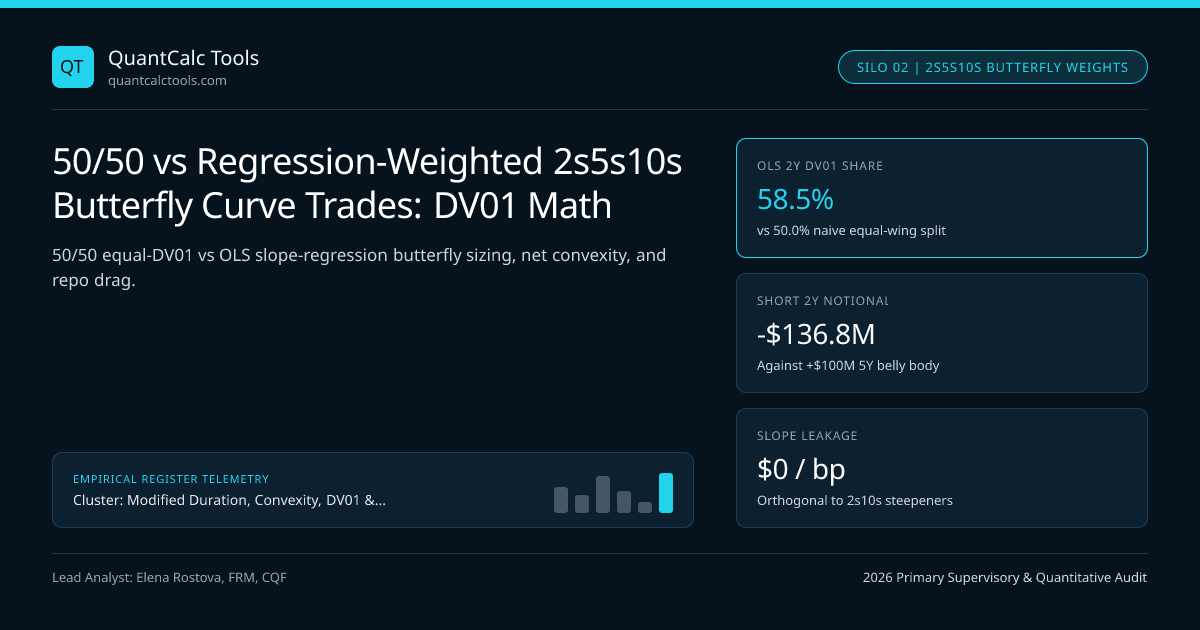
Relative-value sovereign bond traders express pure curvature views on the 5-year yield curve belly using a 2s5s10s butterfly—going long $100$ million of the 5-year note ("body") against short positions in both the 2-year and 10-year notes ("wings"), quoted in basis points as $Fly{2s5s10s} = 2 y5 - y2 - y{10}$. If you split the short wing DV01 equally (50% / 50%), front-end monetary policy shocks from Secured Overnight Financing Rate (SOFR) repricings leak directly into butterfly PnL because 2-year and 5-year yields exhibit $1.28\times$ higher empirical basis-point volatility than 10-year yields! Anchor partial tenor sensitivities in Key Rate Duration (KRD) & Partial DV01 Yield Curve Bucketing and review foundational duration mechanics in our Modified Duration, Convexity & DV01 master guide.
Exact DV01 System of Equations for 50/50 vs Beta-Weighted Butterflies#
Let $V2, V5, V{10}$ denote dirty market values and $DV012, DV015, DV01{10}$ denote dollar basis-point sensitivities of the 2Y, 5Y, and 10Y legs. Every butterfly enforces net parallel DV01 neutrality: $$w2 \cdot DV012 + DV015 + w{10} \cdot DV01{10} = 0 \implies (-w2\,DV012) + (-w{10}\,DV01{10}) = DV015$$ How we allocate that total short wing DV01 ($DV015$) between the 2Y short leg ($\alpha \cdot DV015$) and the 10Y short leg ($(1 - \alpha) \cdot DV01_5$) distinguishes three institutional desk conventions:
- 50/50 Equal-DV01 Weighting ($\alpha = 0.50$): Sets $DV012^{short} = 0.50 \cdot DV015$ and $DV01{10}^{short} = 0.50 \cdot DV015$, tracking $-\Delta(2 y5 - y2 - y_{10})/2$ with zero econometric estimation risk.
- Slope-Regression Weighting ($\alpha = \hat{\beta}_{slope}$): Regresses daily yield changes $(y5 - y{10})$ on $(y2 - y{10})$ via Ordinary Least Squares ($\Delta(y5 - y{10}) = c + \beta{reg}\,\Delta(y2 - y{10}) + \epsilont$). Setting the 2Y DV01 share equal to $\alpha = \beta{reg}$ (empirically $0.56\text{ to }0.62$ on US Treasuries) makes butterfly PnL strictly orthogonal ($\text{Cov}(PnL, \Delta(y{10} - y_2)) = 0$) to 2s10s steepeners and flatteners!
Worked $100M 5-Year Belly Butterfly Notional & Carry Calibration#
- Instrument Inputs (Dirty Price = 100.00 Par):
- 2Y Treasury Wing: YTM = 4.15%, D_mod = 1.890 yrs => $1,890 DV01 per $10M par
- 5Y Belly Body: YTM = 4.28%, D_mod = 4.420 yrs => $44,200 DV01 on +$100,000,000 Long Body
- 10Y Treasury Wing: YTM = 4.45%, D_mod = 7.820 yrs => $7,820 DV01 per $10M par
- 90-Day Rolling OLS Slope Beta: Cov(d(y5-y10), d(y2-y10)) / Var(d(y2-y10)) = 0.5850
- Case A — Classical 50/50 DV01-Neutral Butterfly (alpha = 0.5000):
- Target Short 2Y DV01 = -0.5000 * $44,200 = -$22,100/bp => Short $116,931,217 of 2Y Notes
- Target Short 10Y DV01 = -0.5000 * $44,200 = -$22,100/bp => Short $28,260,870 of 10Y Notes
- Net Cash Residual = +$100.00M - $116.93M - $28.26M = -$45.19M (Invested in overnight repo!)
- Case B — OLS Regression Slope-Neutral Butterfly (alpha = 0.5850):
- Target Short 2Y DV01 = -0.5850 * $44,200 = -$25,857/bp => Short $136,809,524 of 2Y Notes
- Target Short 10Y DV01 = -0.4150 * $44,200 = -$18,343/bp => Short $23,456,522 of 10Y Notes
- Slope Shock Stress (2Y drops -30 bps, 5Y drops -17.55 bps, 10Y flat 0 bps => +30bp Bull Steepener):
- 50/50 Fly PnL: +$44.2k(17.55) - $22.1k(30) - $22.1k*(0) = +$775.7k - $663.0k = +$112,710 LEAK!
- Regression Fly PnL: +$44.2k(17.55) - $25.857k(30) - $18.343k*(0) = +$775.71k - $775.71k = $0.00 IMMUNIZED!
Notice the dramatic difference in par notional sizing: because the 2-year note has less than a quarter of the 10-year note's Modified Duration ($1.89$ vs $7.82$ years), achieving slope neutrality requires shorting $$136.81\text{M}$ of 2Y notes and only $$23.46\text{M}$ of 10Y notes against $+$100\text{M}$ of the 5Y belly!
Repo Specialness Traps and Net Convexity Asymmetry in Butterflies#
Never enter a cash Treasury butterfly without checking net convexity AND special collateral repo rates in our SOFR overnight compounding & carry calculator! Unlike a long-wings barbell, a long-belly / short-wings 2s5s10s butterfly is SHORT net convexity ($C{net} < 0$) because the 10-year short wing carries far higher quadratic curvature ($C{10} = 73.4$) per unit of DV01 than the 5-year body ($C5 = 22.8$): $$\text{Dollar Convexity}{\text{reg}} = \$100\text{M}(22.8) - \$136.81\text{M}(4.5) - \$23.46\text{M}(73.4) = -\$57.5\text{M}\cdot\text{yrs}^2 < 0$$ Furthermore, if the on-the-run 2-year or 10-year Treasury trades "on special" in repo at $150\text{ bps}$ below General Collateral SOFR (meaning short-sellers earn a penalized rebate rate when borrowing the bond), financing $$160.27\text{M}$ of short wings bleeds substantial daily carry!
Comparing Institutional Butterfly Weighting Schemes Across Curve Regimes#
| Butterfly Weighting Methodology | 2Y Short DV01 Share ($\alpha$) | 10Y Short DV01 Share ($1-\alpha$) | Net Cash Balance ($100M Body) | Primary Desk Advantage & Vulnerability |
|---|---|---|---|---|
| Classical 50/50 DV01-Neutral | $50.0\%$ ($-\$22.10\text{k}$) | $50.0\%$ ($-\$22.10\text{k}$) | $+\$45.19\text{M}$ excess cash | Tracks quoted $2y5 - y2 - y_{10}$; leaks 2s10s slope |
| Cash- & DV01-Neutral Fly | $36.0\%$ ($-\$15.92\text{k}$) | $64.0\%$ ($-\$28.28\text{k}$) | $0.00 (Zero net cash!) | No net repo balance; heavily exposed to 10Y term premium |
| OLS Slope-Regression Fly | $58.5\%$ ($-\$25.86\text{k}$) | $41.5\%$ ($-\$18.34\text{k}$) | $+\$60.27\text{M}$ excess cash | Immunizes 2s10s twists; requires rolling beta updates |
| Volatility-Parity Weighted Fly | $44.2\%$ ($-\$19.54\text{k}$) | $55.8\%$ ($-\$24.66\text{k}$) | $+\$34.80\text{M}$ excess cash | Equalizes standalone leg VaR; leaves residual slope beta |
| Two-Factor PCA (PC1+PC2=0) Fly | $60.2\%$ ($-\$26.61\text{k}$) | $39.8\%$ ($-\$17.59\text{k}$) | $+\$63.25\text{M}$ excess cash | Purest PC3 curvature factor; model-window sensitive |
Live Execution via SOFR OIS Swaps vs Cash Bonds and PCA Governance#
To dodge cash Treasury repo specialness altogether, macro funds regulated by the UK FCA frequently execute 2s5s10s butterflies in cleared SOFR OIS interest rate swaps—eliminating bond borrow squeezes while posting portfolio-margined initial margin under ISDA SIMM v2.6. Compare wing-versus-body trade mechanics with DV01-neutral barbell vs bullet convexity pickup, generalize regression weights to full eigenmodes in PCA level, slope, and curvature DV01 hedging, and browse all 20 guides on the Modified Duration & Key-Rate Hedging Topic Hub.
Frequently asked questions
Why does a 50/50 DV01-neutral 2s5s10s butterfly make or lose money when the 2s10s curve steepens?
During FOMC-driven steepeners or flatteners, the 5-year yield typically moves closer to the 2-year yield (~58.5% of the 2s10s spread change) rather than sitting at the 50% midpoint. A 50/50 split under-hedges the front end by ~8.5% of belly DV01.
Why do cash-neutral 2s5s10s butterflies distort wing DV01 weights so severely?
Forcing w_2 + w_{10} = -100M in market value alongside w_2*D_2 + w_{10}*D_{10} = -100M*D_5 fixes w_2 = -$58.3M and w_{10} = -$41.7M—placing 64% of short DV01 in the 10Y bond and turning the trade into a massive 5s10s steepener!
How does on-the-run Treasury repo specialness erode cash butterfly profitability?
Shorting on-the-run 2Y and 10Y benchmark notes requires borrowing them in the repo market. If either benchmark trades 100+ bps special below General Collateral SOFR, the lost repo interest on $160M of short wings can wipe out 15+ bps of belly carry!
Should institutional traders execute 2s5s10s butterflies in cash Treasuries, futures, or SOFR OIS swaps?
SOFR OIS swaps avoid repo specialness and balance-sheet leverage charges cleanly, whereas cash Treasuries capture bond-specific liquidity premia and Treasury futures (TU/FV/TY) offer CME SPAN 2 cross-margin offsets up to 80%!
Publication record
- Published
- 14 November 2026
- Updated
- 14 November 2026
- Author
- Elena Rostova, FRM, CQF
- Review
- Review not recorded
- Automated fact check
- Passed in the stored pipeline record
- Source URLs
- 3 recorded
AI assistance recorded: anthropic/claude-opus-4.6. This field does not establish human review or source verification.
Academic & Institutional Attribution
Cite This Research & Embed Live Data Card
Standard academic & institutional research paper citation format.
Elena Rostova, FRM, CQF. (2026, November 14). 50/50 vs Regression-Weighted 2s5s10s Butterfly Curve Trades: DV01 Math. QuantCalc Tools. https://quantcalctools.com/guides/fifty-fifty-vs-regression-weighted-2s5s10s-butterfly-curve-tradesRelated Bond Duration Convexity Math & Institutional Briefings
Explore Bond Duration Convexity Math Hub (20) →Bond Duration Convexity Math
Modified Duration, Convexity, DV01 & Key-Rate Hedging: 2026 Quantitative GuideBond Duration Convexity Math
Cheapest-to-Deliver (CTD) Treasury Futures Conversion Factor & DV01 MathBond Duration Convexity Math
Leveraged Treasury Repo Carry, Curve Rolldown & Breakeven Yield Spike MathBond Duration Convexity Math
Redington Liability Immunization: Duration Matching & Convexity Dispersion MathBond Duration Convexity Math
Zero-Coupon STRIPS Convexity Scaling: Quadratic Maturity Leverage MathBond Duration Convexity Math
Par Swap DV01 vs Zero-Rate PV01: Jacobian Curve Transformation MathBond Duration Convexity Math
ACT/ACT ICMA vs 30/360 Accrued Interest & Odd-Stub Duration Bias MathBond Duration Convexity Math
TIPS Real-Yield Duration vs Nominal Treasury Empirical Beta Hedging MathCovered Interest Parity Forwards
FX Carry-to-Volatility Ratio, Forward Discount Puzzle & Breakeven Spot MathCovered Interest Parity Forwards
Non-Deliverable Forward (NDF) Cash Settlement & Implied Offshore Yield MathCovered Interest Parity Forwards
Historic-Rate vs Market-Rate FX Swaps: Uneven Notional & NPV Tail MathCovered Interest Parity Forwards
Cross-Rate Triangular FX Forward Arbitrage & Bid-Ask Swap Bounds Math
QuantCalc Tools Data, Benchmarks & Contributor Records
CC BY 4.0 Open Data
Open Institutional Datasets (CSV / JSON) →
Download desk-compiled quantitative series & schemas.
2026 Reference Matrix
2026 Institutional Benchmarks & Thresholds →
Statutory capital, clearing, margin & rate conventions.
Editorial Records
Authors & Review Records →
View named contributors where those records are available.
Complete Index
Master Research & Dossier Archive →
Browse all published briefings by topic pillar & date.