
Redington Liability Immunization: Duration Matching & Convexity Dispersion Math
Matching asset and liability PV and Modified Duration satisfies only two of Redington’s three immunization rules; asset convexity must strictly exceed liability convexity while minimizing M-squared dispersion.
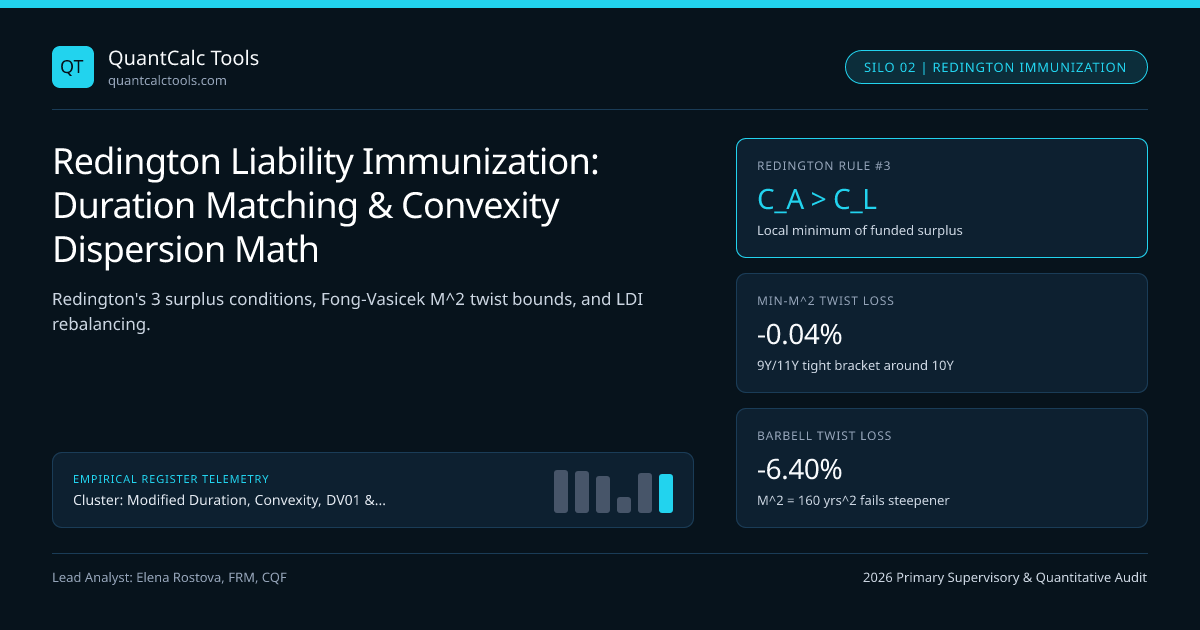
Defined-benefit pension funds and life-annuity insurers supervised by the UK Prudential Regulation Authority (PRA) must ensure asset market value $VA(y)$ never drops below discounted liability obligations $VL(y)$ when interest rates move (Surplus S(y) = V_A(y) - V_L(y) >= 0). British actuary Frank Redington (1952) proved that matching Present Value and Macaulay Duration, Modified Duration & Second-Order Convexity is necessary but NOT sufficient—if asset convexity sits below liability convexity, both rate hikes and rate cuts push the pension plan into deficit! Anchor single-bond sensitivity rules in our Modified Duration, Convexity & DV01 master guide.
Proving Redington's Three Classical Immunization Conditions via Taylor Expansion#
Expand funded surplus $S(y + \Delta y) = VA(y + \Delta y) - VL(y + \Delta y)$ around current yield $y$ to second order: $$S(y + \Delta y) \approx \underbrace{[VA(y) - VL(y)]}{\text{Condition 1: } S(y) \ge 0} - \underbrace{[VA D{mod,A} - VL D{mod,L}]}{\text{Condition 2: Net DV01 = 0}}\,\Delta y + \frac{1}{2}\underbrace{[VA CA - VL CL]}{\text{Condition 3: } CA > C_L!}\,(\Delta y)^2$$ To make $y$ a local minimum of surplus ($S(y + \Delta y) \ge S(y) \ge 0$ for all local parallel shifts $\Delta y$), all three conditions must hold simultaneously:
- Present Value Sufficiency: $VA(y) \ge VL(y)$ (100%+ funded ratio at inception).
- Dollar Duration Equality: $VA \cdot D{mod,A} = VL \cdot D{mod,L}$ ($\partial S / \partial y = 0$, matching asset and liability DV01).
- Strict Asset Convexity Dominance: $VA \cdot CA > VL \cdot CL$ ($\partial^2 S / \partial y^2 > 0$).
The Immunization Paradox: Fong-Vasicek $M^2$ Cashflow Dispersion vs Barbell Twist Risk!#
Wait—if Condition 3 says $CA > CL$ creates positive parallel surplus gains, why shouldn't a pension manager immunize a single 12-year liability bullet with an ultra-wide 1-year + 30-year barbell to maximize $CA$?! Because Fong & Vasicek (1984) proved that under arbitrary non-parallel slope shift $\Delta y(t)$ with maximum steepening slope $|\Delta y'(t)| \le K$, the worst-case immunization shortfall is bounded directly by Macaulay Dispersion ($M^2$): $$M^2 = \sum{t} wt\,(t - D{Mac})^2, \qquad C{cont} = D{Mac}^2 + M^2 \implies \Delta S{\text{worst twist}} \ge -\frac{1}{2}\,VA\,M_A^2\,K$$
- Liability Target: Single $780,096,000 Lump-Sum Pension Payout at T = 10.00 Years (Continuous y = 4.4520%)
- Liability PV VL = $500,000,000; Macaulay Duration DL = 10.00 yrs; Dispersion M^2L = 0.00 yrs^2; CL = 100.00
- Portfolio 1 — Tight 9Y / 11Y Zero-Coupon Immunization Ladder ($500M PV):
- Weights: 50% in 9Y Zero + 50% in 11Y Zero => D_A1 = 10.00 yrs (EXACT!)
- Dispersion M^2A1 = 0.5(9 - 10)^2 + 0.5(11 - 10)^2 = 1.00 yr^2; Convexity CA1 = 100 + 1 = 101.00 (> C_L!)
- +100 bps Parallel Shift Surplus Gain: +0.5 * $500M * (101 - 100) * (0.01)^2 = +$25,000 (Safe!)
- +4 bps/yr Curve Steepening Twist (9Y -4bp, 10Y 0bp, 11Y +4bp): Worst Shortfall = -$200,000 (-0.04% tiny!)
- Portfolio 2 — Wide 2Y / 30Y Cash-Matched Barbell ($500M PV):
- Weights: 71.43% in 2Y Zero ($357.14M) + 28.57% in 30Y Zero ($142.86M) => D_A2 = 10.00 yrs (EXACT!)
- Dispersion M^2A2 = 0.7143(2 - 10)^2 + 0.2857(30 - 10)^2 = 45.71 + 114.29 = 160.00 yrs^2! (CA2 = 260.00!)
- +100 bps Parallel Shift Surplus Gain: +0.5 * $500M * (260 - 100) * (0.01)^2 = +$4,000,000 (+0.80% gain!)
- Same +4 bps/yr Bear Steepening Twist (2Y -32bp, 10Y 0bp, 30Y +80bp):
- 2Y Gain = +$357.14M * 2 * (+0.0032) = +$2.29M; 30Y Loss = -$142.86M * 30 * (0.0080) = -$34.29M!
- NET SURPLUS WIPEOUT = -$32,000,000 (-6.40% DEFICIT!) despite satisfying all 3 Redington rules!
Look at that stunning tension at the heart of pension LDI (Liability-Driven Investment):
- For single-liability immunization, you want $MA^2$ strictly positive yet AS SMALL AS POSSIBLE ($CA$ just slightly above $C_L$, achieved with a tight 9Y/11Y or exact cashflow-matched bullet) to crush Fong-Vasicek non-parallel twist error!
- For multi-liability pension streams spanning 1 to 40 years (where $ML^2$ is already large, e.g. $ML^2 = 95\text{ yrs}^2$), a single 10Y bullet asset portfolio has $MA^2 = 0 < ML^2 = 95$, violating Redington Condition 3 ($CA < CL$) and losing money on every parallel rate shift!
Contingent Immunization, Rebalancing Drift & Multi-Liability Cashflow Matching#
Even on a flat, parallel-shifting yield curve, immunization is instantaneous, not permanent: as calendar time $\Delta t$ elapses without rate moves, a zero-coupon liability's Macaulay duration drops 1-for-1 ($\Delta D = -1.0\,\Delta t$), whereas a coupon-bearing asset bond's duration decays slower than 1-for-1 until a coupon pays out (when its duration jumps upward)! Institutional LDI managers therefore combine exact Dedication (Cashflow Matching) for years 1–7 with Key-Rate Duration tent bucketing across years 8–40.
Comparing Pension LDI Immunization & Cashflow Dedication Architectures#
| LDI Immunization Architecture | Satisfies $CA > CL$? | Fong-Vasicek Twist Risk ($M^2$) | Rebalancing Turnover | Best Institutional Pension Fit |
|---|---|---|---|---|
| Exact Cashflow Dedication | Exact Identity ($S \equiv 0$) | Zero ($0.0$) — Fully immune | Zero (Buy & hold to maturity) | Short/medium retiree payouts (1–10Y) |
| Single Bullet vs Multi-Liability | FAILS ($CA < CL$!) | High reverse butterfly risk | Moderate | Invalid — loses on +/- parallel moves! |
| Min-$M^2$ Linear Programming | PASSES ($CA = CL + \epsilon$) | Minimal (Optimal bound) | Quarterly drift rebalance | Core corporate DB pension buyouts |
| Wide 2Y/30Y Barbell vs Bullet | PASSES ($CA \gg CL$) | Extreme ($160\text{ yrs}^2$) | High twist-driven whipsaw | Tactical flattener view only |
| Levered LDI Repo + Swaps Overlay | PASSES across KRD buckets | Low (12-vertex KRD matched) | Daily VM cash collateral | Partial-cash LDI + growth equity sleeve |
Post-2022 UK Gilt LDI Liquidity Lessons & Horizon Gap Cross-Checks#
Remember the September 2022 UK Gilt LDI crisis: pension schemes using leveraged repo and 50-year Gilts satisfied Redington duration rules on paper, yet ran out of cash collateral when 30Y–50Y yields spiked $+130\text{ bps}$ in four days! Stress ultra-long convexity asymmetries in ultra-long 50Y Gilt and 100Y bond convexity math, connect single-horizon Macaulay matching to reinvestment income in pull-to-par horizon return and Macaulay duration gap, check compounding math in our CAGR calculator, and explore the Modified Duration & Key-Rate Hedging Topic Hub.
Frequently asked questions
Why does immunizing a 30-year stream of annual pension payouts with a single 12-year bullet bond fail Redington’s theorem?
Although both may share a 12-year Macaulay duration, the 30-year liability stream has wide cashflow dispersion (M^2_L > 0, boosting C_L = D^2 + M^2_L), whereas a zero-coupon 12Y bullet has M^2_A = 0. Since C_A < C_L, any parallel yield shift shrinks surplus!
What is the difference between Redington Immunization and Cashflow Dedication?
Cashflow Dedication matches every single liability date and dollar payout with exact bond coupons and maturities, eliminating BOTH parallel and non-parallel rate risk without rebalancing—though it costs 15–35 bps in illiquid bond selection.
How do Fong and Vasicek reconcile wanting higher convexity (C_A > C_L) with wanting lower dispersion (M^2)?
For a single liability where M^2_L = 0, you choose maturities tightly bracketing the liability date (e.g. 9Y and 11Y around 10Y) so C_A strictly exceeds C_L while keeping M^2_A tiny (~1 yr^2) to cap curve-twist vulnerability.
Why did UK pension LDI funds face emergency cash calls in 2022 if higher yields REDUCE pension liabilities?
While rising Gilt yields shrank unlevered long-term pension liabilities, LDI funds used 3x–4x repo and SONIA swap leverage to free cash for equities—triggering immediate variation-margin cash calls on the leveraged Gilt leg before assets could be sold!
Publication record
- Published
- 14 November 2026
- Updated
- 14 November 2026
- Author
- Elena Rostova, FRM, CQF
- Review
- Review not recorded
- Automated fact check
- Passed in the stored pipeline record
- Source URLs
- 3 recorded
AI assistance recorded: anthropic/claude-opus-4.6. This field does not establish human review or source verification.
Academic & Institutional Attribution
Cite This Research & Embed Live Data Card
Standard academic & institutional research paper citation format.
Elena Rostova, FRM, CQF. (2026, November 14). Redington Liability Immunization: Duration Matching & Convexity Dispersion Math. QuantCalc Tools. https://quantcalctools.com/guides/redington-cashflow-immunization-convexity-dispersion-conditionsRelated Bond Duration Convexity Math & Institutional Briefings
Explore Bond Duration Convexity Math Hub (20) →Bond Duration Convexity Math
Modified Duration, Convexity, DV01 & Key-Rate Hedging: 2026 Quantitative GuideBond Duration Convexity Math
Zero-Coupon STRIPS Convexity Scaling: Quadratic Maturity Leverage MathBond Duration Convexity Math
Par Swap DV01 vs Zero-Rate PV01: Jacobian Curve Transformation MathBond Duration Convexity Math
ACT/ACT ICMA vs 30/360 Accrued Interest & Odd-Stub Duration Bias MathBond Duration Convexity Math
TIPS Real-Yield Duration vs Nominal Treasury Empirical Beta Hedging MathBond Duration Convexity Math
Spread Duration vs Duration-Times-Spread (DTS): Credit Hedging MathBond Duration Convexity Math
Floating-Rate Note (FRN) Interest-Rate Reset Duration vs Spread Duration MathBond Duration Convexity Math
Ultra-Long 50Y Gilt & 100Y Century Bond Convexity Asymmetry MathCovered Interest Parity Forwards
Cross-Rate Triangular FX Forward Arbitrage & Bid-Ask Swap Bounds MathCovered Interest Parity Forwards
Continuous Garman-Kohlhagen vs Discrete Money-Market CIP FX Options MathCovered Interest Parity Forwards
Synthetic USD Commercial Paper Funding: FX Swap Implied SOFR Spread MathCovered Interest Parity Forwards
Currency-Hedged Foreign Sovereign Bond Yield Pickup: 3M Rolling FX Swap Math
QuantCalc Tools Data, Benchmarks & Contributor Records
CC BY 4.0 Open Data
Open Institutional Datasets (CSV / JSON) →
Download desk-compiled quantitative series & schemas.
2026 Reference Matrix
2026 Institutional Benchmarks & Thresholds →
Statutory capital, clearing, margin & rate conventions.
Editorial Records
Authors & Review Records →
View named contributors where those records are available.
Complete Index
Master Research & Dossier Archive →
Browse all published briefings by topic pillar & date.