
CME SPAN 2 Historical VaR Margin & Futures Maintenance Top-Up Math
Cleared futures margin migrated from 1988 16-scenario SPAN grids to CME SPAN 2 Historical VaR; master exact Pod aggregation, concentration add-ons, and full-Initial-Margin top-up calls.
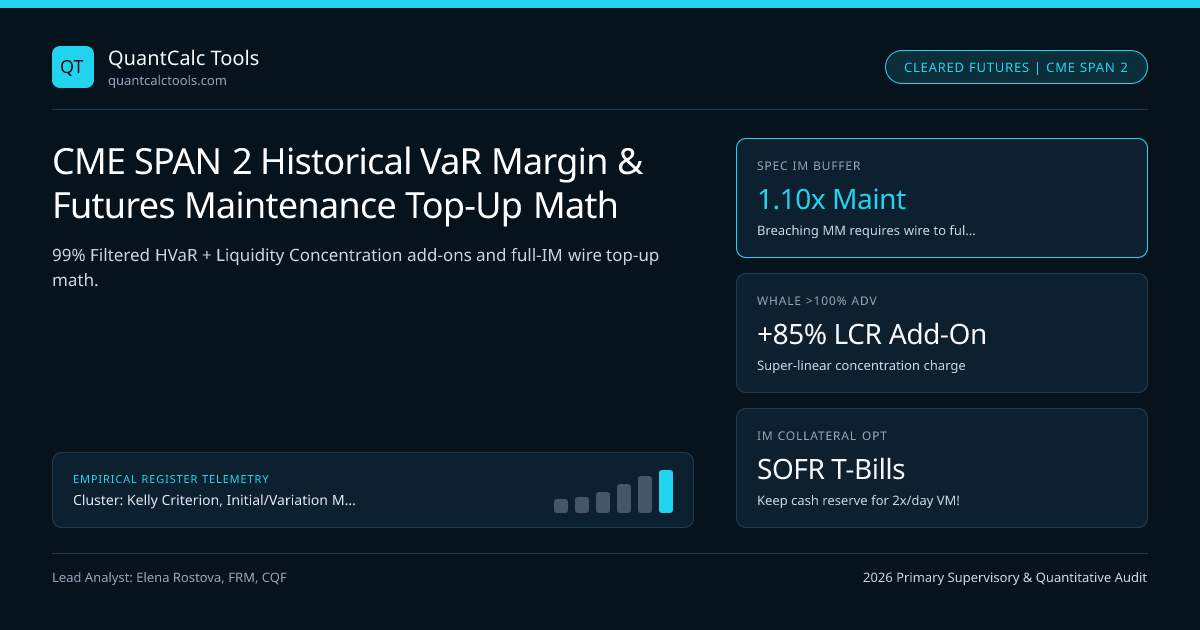
For thirty-five years after 1988, global futures exchanges calculated Initial Margin using Standard Portfolio Analysis of Risk (SPAN 1), scanning each commodity or equity-index contract across a rigid 16-scenario price-and-volatility grid plus heuristic inter-commodity spread credits. While revolutionary in 1988, 16 static grid points struggled to capture multi-curve yield twists, cross-product basis blowouts, and non-linear option concentration. CME Clearing's multi-year rollout of CME SPAN 2 replaces static 16-scenario tables with a unified 99% Historical Value-at-Risk (HVaR) + Extreme Stress VaR + Liquidity & Concentration Risk (LCR) framework! Model tail quantiles in our Value-at-Risk Calculator, inspect the CME SPAN 2 Historical Stress VaR Model, and anchor in our Kelly, Margin & Liquidation Hub.
Exact CME SPAN 2 Margin Decomposition & Futures Full-IM Top-Up Rule#
Under CME Clearing rules, retail and non-member speculative accounts typically post Initial Margin = 110% of Maintenance Margin (IM = 1.10 * MM, whereas clearing member / bona-fide hedger accounts post IM = MM at 1.00x). Crucially, futures margin calls do NOT work like Reg T equity margin calls: if daily mark-to-market settlement drops your futures equity $1.00$ below Maintenance Margin MM, your Futures Commission Merchant (FCM) issues a Variation Margin call requiring you to wire cash all the way back up to full Initial Margin (IM), NOT merely back to MM!
- 1. Pod-Level Base Risk : Riskpod = max( HVaR99%(MPOR, ProcyclicalityFloor), StressVaR_pod )
- MPOR (Margin Period of Risk): Typically 1-day to 5-day liquidation horizon depending on product tier
- Procyclicality Buffer : Blends current exponentially weighted vol with 10-year stressed lookback (>= 25% floor)
- 2. Cross-Pod Aggregation : CoreIM = Sumpods Riskpod - CrossPodCorrelationOffset + LiquidityConcAddon (LCR)
- 3. Speculator IM vs Maint : IMspec = 1.10 * MMexchange (Member / Hedger: IM = 1.00 * MM_exchange)
- 4. Futures Margin Call Trigger & Exact Wire Amount (Contrast with Equities!):
- Trigger Condition : AccountEquityEOD < MM_exchange
- Required Wire Top-Up : MarginCallWire = IMspec - AccountEquity_EOD (Restores FULL Initial Margin!)
- Worked E-Mini S&P 500 (ES) Futures Margin Call Audit (5 Contracts @ 5,800.00, Multiplier $50 => $1,450,000 Notional):
- Assume Exchange Maintenance MM = $14,000/contract ($70,000 total) -> Speculator IM (1.10x) = $15,400/contract ($77,000 total):
- Trader Deposits Exactly $85,000 ($8,000 excess above IM; $15,000 above $70,000 MM):
- S&P 500 drops -62.00 points (-1.07%): PnL = 5 * (-62.00) * $50 = -$15,500 -> Ending Equity = $85,000 - $15,500 = $69,500!
- Since $69,500 < $70,000 MM (by just $500!), Margin Call Fires!
- Required Wire Top-Up = $77,000 (Full IM!) - $69,500 = $7,500 wire due T+1 morning (NOT $500!)
Why Breaching Futures Maintenance By $500 Triggers a Full $7,500 Initial-Margin Wire#
Look at that $500 breach triggering a $7,500 cash wire: if a trader only budgeted to cover MM - Equity = $500, failing to wire the full $7,500 back to IM authorizes the FCM risk desk to liquidate contracts immediately!
Legacy SPAN 1 (16 Scenarios) vs CME SPAN 2: Four Quantitative Upgrades#
Why did clearinghouses worldwide retire 1988 SPAN 1 in favor of SPAN 2 / VaR-based margining (aligned with Basel FRTB tail modeling)?
| Structural Dimension | Legacy SPAN 1 (1988 Grid) | CME SPAN 2 (Modern HVaR Framework) | Impact on Quantitative Desks |
|---|---|---|---|
| Core Tail Engine | 16 discrete (Price +/-, Vol +/-) points | Full-revaluation 99% Filtered HVaR + Stress | Eliminates "pinning" short strikes between grid nodes! |
| Term-Structure Calendar Risk | Ad-hoc manual intra-commodity tiers | Joint historical curve-twist simulation | Prices WTI/NatGas seasonal calendar spreads accurately |
| Position Concentration Cost | Linear per lot (10,000 lots = 10,000 * 1 lot) | Super-linear Liquidity & Concentration (LCR) | Whale books exceeding ADV pay escalating impact margin! |
| Anti-Procyclicality Dampener | Manual emergency margin hikes in crashes | Built-in stressed lookback floor ($\ge 25\%$) | Dampens sudden $+100\%$ overnight COVID-style margin shocks |
Collateral Eligibility Crucial Distinction: T-Bills Can Fund IM, Only Cash Funds VM!#
Institutional treasurers earn full NY Fed SOFR yield on futures Initial Margin by posting short-term US Treasury bills (typically accepted at a 98%–99% collateral value after haircut) instead of dead zero-interest cash! However, daily Variation Margin (VM) losses settle strictly in hard currency cash twice a day—so posting 100% of your equity in T-bills with $0 cash forces emergency repo borrowing or intraday liquidation the first afternoon your futures dip -1.5%!
Integrating Futures Margin Buffers with Liquidity Spiral Stress Tests#
Size unencumbered cash reserves using central-clearing Variation Margin liquidity spiral math, compare cleared SPAN 2 against bilateral OTC ISDA SIMM v2.6 Initial Margin, and cap directional exposure via Half-Kelly continuous sizing and our methodology.
Frequently asked questions
What was the famous "between-node strike exploit" in legacy 1988 SPAN 1 that SPAN 2 eliminated?
Legacy SPAN 1 only evaluated option portfolios at discrete +/-1/3, +/-2/3, +/-3/3 scan-range points plus one extreme 2x/3x tail point (weighted at ~35%).Option sellers could structure butterfly or ratio spreads whose maximum loss sat precisely BETWEEN scan points, posting artificially tiny Initial Margin until SPAN 2 introduced full path HVaR!
What is "day-trade futures margin" offered by some retail brokers, and why is it dangerous?
Some retail FCMs allow intraday futures trading at $500/contract (~10% of exchange IM) strictly between 9:30 AM and 3:45 PM EST because exchange SPAN margin is enforced at EOD clearing. Holding past 3:45 PM without full $15,400 SPAN IM triggers instant automated broker liquidation + penalty fees!
How does CME SPAN 2 treat hedged spreads like Treasury cash-futures basis or Crack spreads?
Within and across product pods (e.g., Crude Oil vs RBOB Gasoline + Heating Oil in the Energy Pod, or 2Y vs 10Y Treasury futures in the Rates Pod), SPAN 2 revalues the combined net portfolio across historical joint shocks—granting 65% to 90% margin offsets while still charging basis tail stress!
If my futures equity sits BETWEEN Initial Margin ($77,000) and Maintenance Margin ($70,000), am I on margin call?
NO! That $70,000-to-$77,000 band is the exact buffer zone why Maintenance Margin exists: you can keep holding existing contracts at $72,000 without wiring a single dollar, though you cannot open NEW risk-increasing contracts until equity exceeds Initial Margin again.
Publication record
- Published
- 13 November 2026
- Updated
- 14 November 2026
- Author
- Elena Rostova, FRM, CQF
- Review
- Review not recorded
- Automated fact check
- Passed in the stored pipeline record
- Source URLs
- 4 recorded
AI assistance recorded: anthropic/claude-opus-4.6. This field does not establish human review or source verification.
Academic & Institutional Attribution
Cite This Research & Embed Live Data Card
Standard academic & institutional research paper citation format.
Elena Rostova, FRM, CQF. (2026, November 14). CME SPAN 2 Historical VaR Margin & Futures Maintenance Top-Up Math. QuantCalc Tools. https://quantcalctools.com/guides/cme-span-2-historical-var-initial-margin-maintenance-top-up-mathRelated Kelly Margin Leverage Sizing & Institutional Briefings
Explore Kelly Margin Leverage Sizing Hub (20) →Kelly Margin Leverage Sizing
Kelly Criterion, Initial/Variation Margin & Liquidation Math: 2026 GuideKelly Margin Leverage Sizing
ISDA SIMM v2.6 Uncleared OTC Initial Margin: Delta, Vega & Curvature MathKelly Margin Leverage Sizing
FX Pip-Value & Lot Sizing Calculator Math: Cross-Currency ConversionKelly Margin Leverage Sizing
Reg T 50% Equity Margin vs FINRA Rule 4210 Portfolio Margin & House CallsKelly Margin Leverage Sizing
Risk of Ruin Math: Fixed-Dollar Markov Absorption vs Fixed-Fractional SizingKelly Margin Leverage Sizing
Inverse Coin-Margined vs Linear Dollar Perpetual Liquidation & Convexity MathKelly Margin Leverage Sizing
Volatility-Target, Wilder ATR Stop-Loss & Equal Risk Contribution SizingKelly Margin Leverage Sizing
Central Clearing Variation Margin Liquidity Spirals & Cash Buffer MathMarket Insights
Dubai's DIP Holding is a yield play, says strategistIPO and Funding
Anthropic's IPO valuation could reach $1.4 trillionMarket Insights
Junk bonds are 'flashing yellow.' Watch these warning signsIPO and Funding
Anthropic targets valuation of up to $1.4tn in stock market flotation
QuantCalc Tools Data, Benchmarks & Contributor Records
CC BY 4.0 Open Data
Open Institutional Datasets (CSV / JSON) →
Download desk-compiled quantitative series & schemas.
2026 Reference Matrix
2026 Institutional Benchmarks & Thresholds →
Statutory capital, clearing, margin & rate conventions.
Editorial Records
Authors & Review Records →
View named contributors where those records are available.
Complete Index
Master Research & Dossier Archive →
Browse all published briefings by topic pillar & date.