
Kelly Criterion, Initial/Variation Margin & Liquidation Math: 2026 Guide
Position sizing and margin mechanics dictate whether a positive-expectancy edge compounds exponentially or hits forced liquidation; this quantitative hub unifies Kelly math, CCP margin, and close-out thresholds.
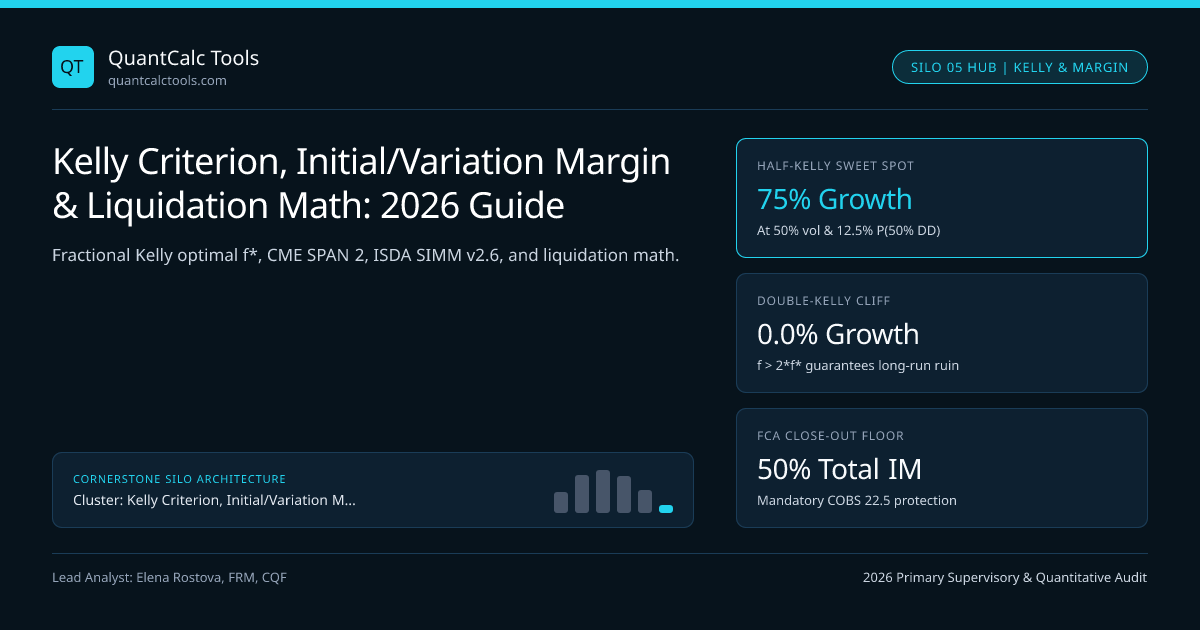
Positive expected value is a necessary condition for trading profitability, never a sufficient one: over-betting a genuinely profitable strategy beyond twice the Kelly Criterion ($f > 2f^$) drives terminal wealth to $0.00$ with $100\%$ mathematical probability, and miscalculating exchange Maintenance Margin or FX quote-to-account pip conversion triggers automated broker liquidation right at the trough of an otherwise recoverable wick. Institutional capital allocation sits at the intersection of utility-theoretic optimal sizing* (John Kelly 1956, Edward Thorp 1969, Robert Merton 1971) and statutory clearinghouse margin rules (CME SPAN 2, ISDA SIMM v2.6, FINRA Rule 4210, and UK FCA COBS 22.5). This pillar hub connects our live Kelly Criterion & Fractional Leverage Calculator and Value-at-Risk Calculator with 19 rigorous derivations spanning Kelly covariance shrinkage, bankruptcy prices, CCP liquidity spirals, and option margin expansion.
Discrete & Continuous Kelly Sizing, Covariance Shrinkage & Ruin Bounds#
Maximizing expected logarithmic growth $g(f) = \mathbb{E}[\ln(1 + fR)]$ balances linear return drift against quadratic variance drain. Yet unconstrained full-Kelly sizing suffers a brutal flaw in live trading: under continuous Brownian motion, a full-Kelly bettor faces a $50.0\%$ probability of suffering a $-50\%$ drawdown before doubling equity, and feeding noisy sample means $\hat{\mu}$ into multi-asset $\Sigma^{-1}(\hat{\mu} - r_f\mathbf{1})$ wildly over-levers estimation errors! Our Continuous Fractional Half-Kelly Engine tames both risks:
- Core Kelly & Empirical Trade Sizing: Derive binary and asymmetric payoff fractions $f^* = p - q/b$ in discrete binomial Kelly payoff asymmetry math, bridge Ito calculus to $f^* = (\mu - r_f)/\sigma^2$ in continuous Merton-Kelly and Half-Kelly leverage, generalize non-parametric trade logs in Ralph Vince Optimal f largest-loss scaling, and compute exact absorption probabilities in Markov gambler's ruin vs fixed-fractional sizing.
- Multi-Asset Shrinkage, Drawdown Caps & Volatility Targeting: Stabilize ill-conditioned $\Sigma^{-1}$ matrices via Ledoit-Wolf and Bayesian priors in multi-asset Kelly inverse-covariance shrinkage and Black-Litterman posterior Bayesian Kelly sizing, enforce exact tail drawdown ceilings in drawdown-constrained fractional Kelly math, and size daily ATR / Equal-Risk-Contribution tickets in volatility-target ATR & ERC position sizing.
- 1. Discrete Asymmetric Kelly : f* = p / a - q / b (Win +b w/ prob p, Lose -a w/ prob q = 1 - p; Full Loss a=1 -> p - q/b)
- 2. Continuous Merton-Kelly : f* = (mu - r_f) / sigma^2; Fractional c-Kelly keeps c*(2 - c) of max growth (c=0.5 -> 75% growth, 25% var!)
- 3. Futures / Equity Margin : Margin Call Price (Long, Maint m) => Pcall = P0 * (1 - IM_pct) / (1 - m)
- 4. Isolated Long Liquidation : Pliq = Pentry * [ 1 - (1 / L) + MMR + Feeclose ] (Bankruptcy Pbank = P_entry * (1 - 1/L))
- 5. FX Lot Size (Account CCY) : Lots = (Equity * Riskpct) / (StopPips * PipValueperLotinAccountCCY)
- Worked Full-Kelly vs Half-Kelly vs Over-Kelly Audit (mu - rf = 12.0%, sigma = 20.0%, rf = 4.5%):
- Full-Kelly Leverage f* = 0.12 / (0.20)^2 = 3.00x -> Excess Log Growth = 0.5*(0.12^2/0.04) = +18.00% (Vol = 60%, P(50% DD) = 50.0%!)
- Half-Kelly Leverage 0.5f = 1.50x -> Excess Log Growth = 0.75 * 18.00% = +13.50% (Vol = 30%, P(50% DD) = 12.5%!)
- Double-Kelly Overbet 2.0f= 6.00x -> Excess Log Growth = 6(12%) - 0.5(36)*(4%) = 0.00% (120% vol for ZERO excess growth!)
Institutional Clearinghouse Margin: CME SPAN 2, ISDA SIMM, Reg T & Repo Haircuts#
Professional derivatives books do not post flat retail percentage margins; they post risk-sensitive Initial Margin (IM) calibrated to 99% 1-to-10-day tail stress plus intraday cash Variation Margin (VM):
- Cleared Futures, Uncleared OTC & Prime Brokerage: Contrast legacy 16-scenario grids with Historical VaR in CME SPAN 2 Initial vs Maintenance Margin top-up math (CME SPAN 2 Model), aggregate Delta, Vega, and Curvature sensitivities in ISDA SIMM v2.6 uncleared OTC Initial Margin (ISDA SIMM v2.6 Grid), compare static
50%Reg T against TIMS stress grids in Reg T vs FINRA 4210 Portfolio Margin house calls, model option crash margin spikes in short naked option Reg T 20% OTM gamma expansion, and bound fixed-income repo balance sheets in repo haircut & rehypothecation leverage multipliers.
Retail Leverage Caps, Liquidation Bankruptcy Prices & Liquidity Spirals#
When market volatility spikes $3\times$ overnight, margin requirements jump simultaneously with mark-to-market losses—triggering Brunnermeier-Pedersen margin spirals unless unencumbered cash buffers are pre-funded:
- Close-Out Mechanics, Inverse Perps & GSLOs: Audit statutory retail leverage caps (
30:1major FX,20:1gold/indices) and account-wide50%margin close-out under UK FCA COBS 22.5 & ESMA retail margin math, derive exact bankruptcy vs maintenance prices in isolated margin vs cross-margin liquidation math, expose non-linear $1/P$ payoff convexity in inverse coin-margined vs linear USDT perpetual liquidation, convert cross-currency stops accurately in FX pip-value lot sizing and quote conversion, survive CCP margin calls in central-clearing Variation Margin liquidity buffer sizing, and price gap insurance in Guaranteed Stop-Loss Order (GSLO) premium vs slippage math.
Institutional & Retail Margin Regimes Comparison Matrix#
Compare margin methodology, holding horizon, top-up mechanics, and close-out rules across major global regimes:
| Margin / Sizing Framework | Calibration Horizon & Confidence | Maintenance / Close-Out Trigger | Portfolio Cross-Offsetting? | Primary Venue / Regulator |
|---|---|---|---|---|
| *Half-Kelly Optimal ($0.5 f^$)** | Continuous infinite-horizon log utility | Voluntary rebalance band | Full covariance $\Sigma^{-1}$ | Quant funds (Kelly Tool) |
| CME SPAN 2 (Cleared Futures) | $99\%$ 1–5d HVaR + Stress + Liquidity | Equity $<$ Maint $\to$ Top up to full IM! | Cross-product pod offsets | CME / Clearinghouses (benchmarks) |
| ISDA SIMM v2.6 (Uncleared OTC) | $99\%$ 10-day 3y+1y stress sensitivities | Bilateral CSA threshold + daily VM | Within 6 risk classes only | Prudential (UK PRA / BCBS) |
| FINRA 4210 Portfolio Margin | $\pm 15\%$ index / $\pm 15\%\text{--}30\%$ stock TIMS | Real-time house deficit liquidation | Broad delta/vega offsets | Institutional / Prime US accounts |
| FCA COBS 22.5 / ESMA Retail | Statutory 3.33%–50% asset notional caps | Mandatory 50% Initial Margin close-out | Account-level net equity | UK FCA / CBI (brokers) |
Execution Infrastructure & Regulatory Margin Verification#
Test exact ticket sizes and margin buffers before routing live orders on MT4, MT5, cTrader, or FIX API. Browse all 20 position-sizing guides on the Kelly, Margin & Liquidation Topic Hub, audit regulated margin schedules across ActivTrades and Admirals, and verify firm permissions on the UK FCA register and UK PRA register.
Frequently asked questions
Why do institutional quantitative funds almost never trade at 1.0x Full Kelly?
Two mathematical reasons: first, Full Kelly assumes you know true expected return mu and volatility sigma with zero estimation error—whereas overestimating mu by 2x accidentally pushes you onto the 2.0*f* zero-growth cliff! Second, even with known parameters, Full Kelly endures a 1/k probability of shrinking equity to 1/k (a 50% chance of a -50% drawdown).
What is the difference between Initial Margin and Maintenance Margin on futures versus equities?
Initial Margin (IM) is the collateral required to open a position; Maintenance Margin (MM) is the minimum equity floor required to keep it open. If a futures account dips $1 below MM, you must wire cash all the way back up to full IM; if a Reg T equity margin account dips below 25%/30% MM, you only top back up to MM.
Does cross-margining lower or raise my probability of account wipeout compared to isolated margin?
Cross-margining lowers the probability that a single noisy wick liquidates one small position (by sharing free equity across the whole account), BUT if an un-stopped runaway trade breaches cross-margin maintenance, it liquidates your ENTIRE account balance rather than capping loss at one isolated margin bucket!
Why is ISDA SIMM Initial Margin posted gross by both OTC counterparties without netting against each other?
Under post-2008 BCBS-IOSCO uncleared margin rules, both Dealer A and Institutional Client B must post 99% 10-day SIMM Initial Margin into segregated third-party custodians so that if either party defaults, surviving close-out replacement risk is funded without creating systemic contagion.
Publication record
- Published
- 14 November 2026
- Updated
- 14 November 2026
- Author
- Elena Rostova, FRM, CQF
- Review
- Review not recorded
- Automated fact check
- Passed in the stored pipeline record
- Source URLs
- 4 recorded
AI assistance recorded: anthropic/claude-opus-4.6. This field does not establish human review or source verification.
Academic & Institutional Attribution
Cite This Research & Embed Live Data Card
Standard academic & institutional research paper citation format.
Elena Rostova, FRM, CQF. (2026, November 14). Kelly Criterion, Initial/Variation Margin & Liquidation Math: 2026 Guide. QuantCalc Tools. https://quantcalctools.com/guides/kelly-criterion-initial-variation-margin-liquidation-sizing-guideRelated Kelly Margin Leverage Sizing & Institutional Briefings
Explore Kelly Margin Leverage Sizing Hub (20) →Kelly Margin Leverage Sizing
Discrete Binomial Kelly Criterion: Win Rate & Asymmetric Payoff ProofKelly Margin Leverage Sizing
Continuous Merton-Kelly Leverage ((mu - r_f)/sigma^2) & Half-Kelly MathKelly Margin Leverage Sizing
Multi-Asset Kelly Portfolio Sizing: Inverse-Covariance & Shrinkage MathKelly Margin Leverage Sizing
Drawdown-Constrained Fractional Kelly: Exact Probability of X% Loss MathKelly Margin Leverage Sizing
UK FCA COBS 22.5 & ESMA Retail Leverage Caps & 50% Margin Close-Out MathKelly Margin Leverage Sizing
Isolated Margin vs Cross-Margin Liquidation & Bankruptcy Price FormulasKelly Margin Leverage Sizing
CME SPAN 2 Historical VaR Margin & Futures Maintenance Top-Up MathKelly Margin Leverage Sizing
ISDA SIMM v2.6 Uncleared OTC Initial Margin: Delta, Vega & Curvature MathParametric Var Expected Shortfall
Cornish-Fisher VaR Quantile Expansion: Skewness & Excess Kurtosis Formula GuideIPO and Listings
Anthropic to List on Nasdaq on Nov. 18, With Valuation of Up to approximately $1.4 Trillion; South Korean AI ETFs Race to Add the Stock - BigGo FinanceBroker Fees and Calculators
Narrowing Valuation Gap Between Booking Holdings (NASDAQ: BKNG) And GameStop (NYSE: GME) Masks A Clear Winner For 2027 - Foreign Policy JournalParametric Var Expected Shortfall
Student-t Expected Shortfall Formula: Degrees-of-Freedom & Unit-Variance Scaling
QuantCalc Tools Data, Benchmarks & Contributor Records
CC BY 4.0 Open Data
Open Institutional Datasets (CSV / JSON) →
Download desk-compiled quantitative series & schemas.
2026 Reference Matrix
2026 Institutional Benchmarks & Thresholds →
Statutory capital, clearing, margin & rate conventions.
Editorial Records
Authors & Review Records →
View named contributors where those records are available.
Complete Index
Master Research & Dossier Archive →
Browse all published briefings by topic pillar & date.