
Drawdown-Constrained Fractional Kelly: Exact Probability of X% Loss Math
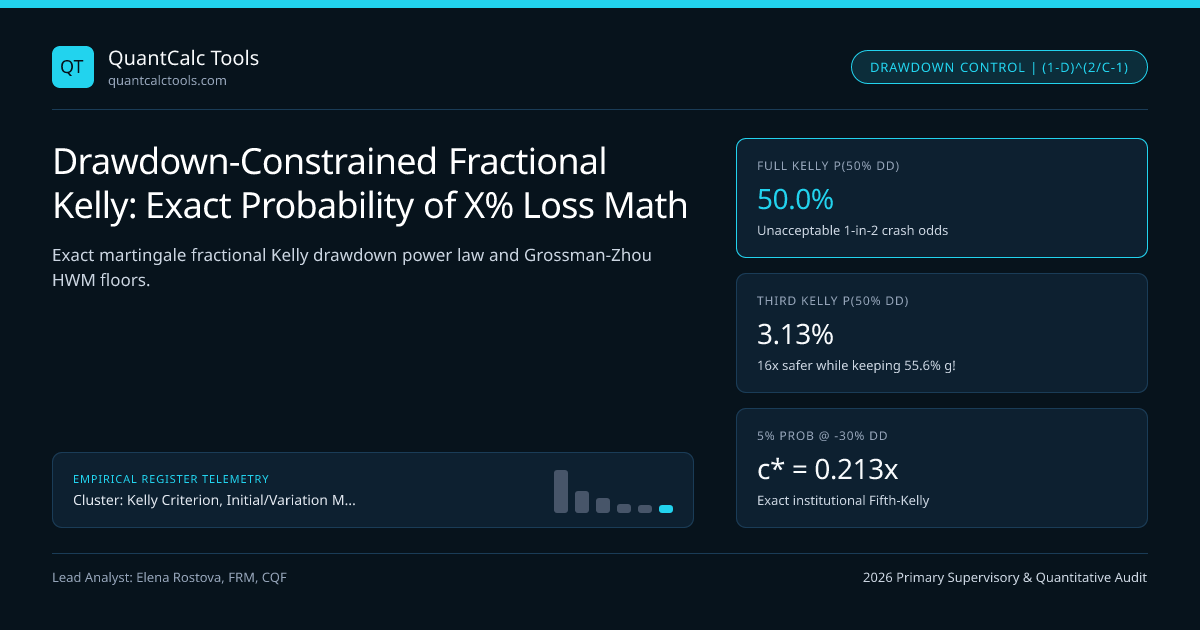
Trading at Full Kelly carries an exact 50% probability of losing half your capital and a 20% probability of an -80% crash; derive exact fractional Kelly drawdown probability laws to cap tail pain.
Every institutional fund mandate specifies an explicit maximum tolerable drawdown limit—for instance, "Never exceed a 15% probability of suffering a -25% peak-to-trough drawdown" or "Enforce a hard dynamic floor at 80% of High-Water Mark." Unconstrained Full-Kelly ($c = 1.0$) fails every institutional drawdown mandate in existence because its infinite-horizon probability of dropping to fraction $z \in (0, 1)$ of peak equity is literally linear: $\mathbb{P}(\mint Wt / M_t \le z) = z$ (50% chance of a -50% crash, 30% chance of a -70% crash!). Using martingale stopping-time theory (Thorp 2006; MacLean, Ziemba & Li 2005) and Grossman-Zhou (1993) Dynamic Drawdown Control, you can invert that exact power law to solve the precise *Fractional Kelly multiplier $c^$** guaranteed to respect your committee's drawdown ceiling! Test fractional multipliers in our Kelly Criterion Calculator and anchor in our Kelly, Margin & Liquidation Hub.
Exact Martingale Power-Law Proof: $\mathbb{P}(\text{Drawdown} \ge D) = (1 - D)^{\frac{2}{c} - 1}$#
Under zero-interest excess log-wealth diffusion $dWt / Wt = \mu f\,dt + \sigma f\,dWt$ where $f = c \cdot f^* = c(\mu / \sigma^2)$ with $c \in (0, 2)$, apply Doob's Optional Stopping Theorem to the exponential martingale $Zt = (Wt / W0)^{-\theta}$ where scale exponent $\theta = \frac{2\mu f}{\sigma^2 f^2} - 1 = \frac{2}{c} - 1 > 0$. As upper target $B \to \infty$, the exact infinite-horizon probability of ever experiencing a peak-to-trough fractional drawdown of depth $D \in (0, 1)$ (hitting $z = 1 - D$ of High-Water Mark) collapses to a jaw-droppingly clean closed-form power law—which inverts directly for *$c^$**:
- Let f = c * f* (0 < c < 2), Drawdown Depth D in (0, 1), Remaining Equity Ratio z = 1 - D:
- 1. Exact Infinite-Horizon Drawdown Probability:
- P( Max_Drawdown >= D ) = (1 - D)^( (2 / c) - 1 ) = z^( (2 / c) - 1 )
- 2. Exact Inverse Formula — Solve Max Safe Kelly Multiplier c* Given Allowed (Dmax, alphaprob):
- Require (1 - Dmax)^(2/c* - 1) <= alphaprob
- => c* = 2 / [ 1 + ln(alphaprob) / ln(1 - Dmax) ]
- 3. Grossman & Zhou (1993) Dynamic CPPI-Style Drawdown Floor (Hard 0% Breach Probability at Floor D_hard!):
- fdynamic(t) = [ 1 / (1 - gamma) ] * [ (mu - rf) / sigma^2 ] * [ (Wt - (1 - Dhard) * HWMt) / Wt ]
- (Scales exposure linearly with cushion above hard HWM floor Dhard — mathematically CANNOT breach Dhard in diffusion!)
- Worked Institutional Mandate Calibration:
- Mandate: "Cap the probability of ever hitting a D_max = 30.0% drawdown (z = 0.70) at alpha = 5.0% (1-in-20 chance)!"
- 1. Solve c* = 2 / [ 1 + ln(0.05) / ln(0.70) ] = 2 / [ 1 + (-2.99573) / (-0.35667) ] = 2 / [ 1 + 8.3991 ] = 0.2128x Kelly!
- 2. Check Growth Retained at c* = 0.213x Kelly: c(2 - c) = 0.2128 * (1.7872) = 38.0% of Theoretical Max Growth!
- 3. Contrast Unconstrained Full Kelly (c = 1.0) on Same 30% Drawdown: P(DD >= 30%) = (0.70)^(2/1 - 1) = 70.0% CERTAINTY!
Worked Institutional Mandate Calibration: Why 5% Risk at -30% Demands Fifth-Kelly#
Look at that result: an allocator demanding < 5% probability of a -30% drawdown MUST trade at 0.213x Kelly (~1/5th Kelly), NOT Full Kelly (70.0% probability!) and NOT even Half-Kelly ((0.70)^3 = 34.3% probability!).
Exact Probabilistic Drawdown Matrix Across Fractional Kelly Multipliers#
Verify how rapidly tail drawdown probabilities collapse as you step down from 1.00x Full Kelly to 0.20x Fifth-Kelly via $(1 - D)^{2/c - 1}$:
| Fractional Kelly Tier ($c$) | Exponent ($2/c - 1$) | P(DD >= 20%) | P(DD >= 30%) | P(DD >= 50%) | P(DD >= 80%) | Excess Growth Kept $c(2-c)$ |
|---|---|---|---|---|---|---|
1.00x Full Kelly | $1.00$ | $80.0\%$ | $70.0\%$ | $50.0\%$ | $20.0\%$ | $100.0\%$ |
0.50x Half-Kelly | $3.00$ | $51.2\%$ | $34.3\%$ | $12.5\%$ | $0.80\%$ | $75.0\%$ |
0.33x Third-Kelly | $5.00$ | $32.8\%$ | $16.8\%$ | $3.13\%$ | $0.03\%$ | $55.6\%$ |
0.25x Quarter-Kelly | $7.00$ | $21.0\%$ | $8.24\%$ | $0.78\%$ | $< 0.002\%$ | $43.8\%$ |
0.20x Fifth-Kelly | $9.00$ | $13.4\%$ | $4.04\%$ | $0.20\%$ | $\approx 0\%$ | $36.0\%$ |
Static Fractional Kelly vs Dynamic Grossman-Zhou Cushion Scaling: Crucial Trade-Off!#
Compare the two philosophies of drawdown control:
- *Static Fractional Kelly ($c^$ constant)*: When your strategy drops $-15\%$, static $0.25\times$ Kelly keeps its exact `0.25 f*` leverage intact—participating $100\%$ in V-shaped mean-reversion rebounds (asymmetric drawdown recovery math), at the cost of a small non-zero tail probability ($\alpha = 5\%$) of crossing $D_{\max}$.
- Grossman-Zhou (1993) / Cvitanic-Karatzas Dynamic Cushion Control: Scales exposure proportionally to remaining drawdown cushion $(D{\text{hard}} - Dt) / D{\text{hard}}$. It guarantees $0\%$ diffusion breach of $D{\text{hard}}$, but behaves pro-cyclically (selling into drawdowns like CPPI!) and risks "cash lock" if an overnight jump wipes out the cushion! Institutional CTAs blend both: trade
0.25xstatic Kelly down to-10%drawdown, then engage linear cushion tapering between-10%and-20%!
Connecting Drawdown Caps to Exchange Close-Outs & Brownian Nulls#
Verify that your chosen $D_{\max}$ sits safely above statutory FCA 50% retail margin close-out thresholds and Magdon-Ismail Brownian Expected Maximum Drawdown bounds, audit your Omega & Calmar ratios, and check firm leverage disclosures in our rankings and methodology.
Frequently asked questions
Why is the formula (1 - D)^(2/c - 1) independent of my strategy’s Sharpe Ratio and volatility?
Because volatility sigma and Sharpe SR are ALREADY normalized inside Full-Kelly f* = SR / sigma! Regardless of whether SR is 0.5 or 2.0, scaling to Full Kelly sets drift equal to variance (mu_p = sigma_p^2), making the dimensionless drift-to-variance ratio 2*mu_p / sigma_p^2 depend purely on the fraction c = f / f*!
Does (1 - D)^(2/c - 1) apply over 1 year or over an infinite lifetime?
It is the exact INFINITE-HORIZON probability of EVER hitting drawdown D across an eternal track record—making it a rock-solid conservative upper bound for finite 3-year or 5-year institutional horizons! Over a short 1-year window with high Sharpe (SR >= 1.5), finite-horizon drawdown probability is substantially lower.
How should I size a proprietary trading firm challenge that terminates the account on a -10% trailing drawdown?
Plug D_max = 0.10 and survival failure tolerance alpha = 0.05 into c* = 2 / [1 + ln(0.05) / ln(0.90)] = 2 / [1 + 28.43] = 0.068x Kelly (~1/15th Kelly)! Attempting to trade Half-Kelly (0.50x) against a tight -10% termination barrier carries a (0.90)^3 = 72.9% failure probability!
What is "cash lock" in Grossman-Zhou dynamic drawdown control and how do institutions prevent it?
In pure Grossman-Zhou / CPPI, position size equals Multiplier * (Current Equity - Hard Floor). If an overnight price gap drops Current Equity down to or below Hard Floor, position size drops to ZERO (100% cash forever), making recovery mathematically impossible! Desks prevent cash lock by resetting HWM floors annually or clamping minimum exposure at 0.10x Kelly.
Publication record
- Published
- 13 November 2026
- Updated
- 14 November 2026
- Author
- Elena Rostova, FRM, CQF
- Review
- Review not recorded
- Automated fact check
- Passed in the stored pipeline record
- Source URLs
- 4 recorded
AI assistance recorded: anthropic/claude-opus-4.6. This field does not establish human review or source verification.
Academic & Institutional Attribution
Cite This Research & Embed Live Data Card
Standard academic & institutional research paper citation format.
Elena Rostova, FRM, CQF. (2026, November 14). Drawdown-Constrained Fractional Kelly: Exact Probability of X% Loss Math. QuantCalc Tools. https://quantcalctools.com/guides/drawdown-constrained-fractional-kelly-probability-of-50pct-lossRelated Kelly Margin Leverage Sizing & Institutional Briefings
Explore Kelly Margin Leverage Sizing Hub (20) →Kelly Margin Leverage Sizing
Kelly Criterion, Initial/Variation Margin & Liquidation Math: 2026 GuideKelly Margin Leverage Sizing
UK FCA COBS 22.5 & ESMA Retail Leverage Caps & 50% Margin Close-Out MathKelly Margin Leverage Sizing
Isolated Margin vs Cross-Margin Liquidation & Bankruptcy Price FormulasKelly Margin Leverage Sizing
CME SPAN 2 Historical VaR Margin & Futures Maintenance Top-Up MathKelly Margin Leverage Sizing
ISDA SIMM v2.6 Uncleared OTC Initial Margin: Delta, Vega & Curvature MathKelly Margin Leverage Sizing
FX Pip-Value & Lot Sizing Calculator Math: Cross-Currency ConversionKelly Margin Leverage Sizing
Reg T 50% Equity Margin vs FINRA Rule 4210 Portfolio Margin & House CallsKelly Margin Leverage Sizing
Risk of Ruin Math: Fixed-Dollar Markov Absorption vs Fixed-Fractional SizingVenture Capital
Ukrainian defense tech startup hits $6 billion valuation as investors bet on battle-tested dronesMarket Insights
The stock market 'dodged a real bullet' — Cramer on Anthropic's new IPO valuationIPO and Funding
Anthropic's margins support IPO case, say Burnham Park's Rohit KulkarniMarket Insights
Dubai's DIP Holding is a yield play, says strategist
QuantCalc Tools Data, Benchmarks & Contributor Records
CC BY 4.0 Open Data
Open Institutional Datasets (CSV / JSON) →
Download desk-compiled quantitative series & schemas.
2026 Reference Matrix
2026 Institutional Benchmarks & Thresholds →
Statutory capital, clearing, margin & rate conventions.
Editorial Records
Authors & Review Records →
View named contributors where those records are available.
Complete Index
Master Research & Dossier Archive →
Browse all published briefings by topic pillar & date.