
Inverse Coin-Margined vs Linear Dollar Perpetual Liquidation & Convexity Math
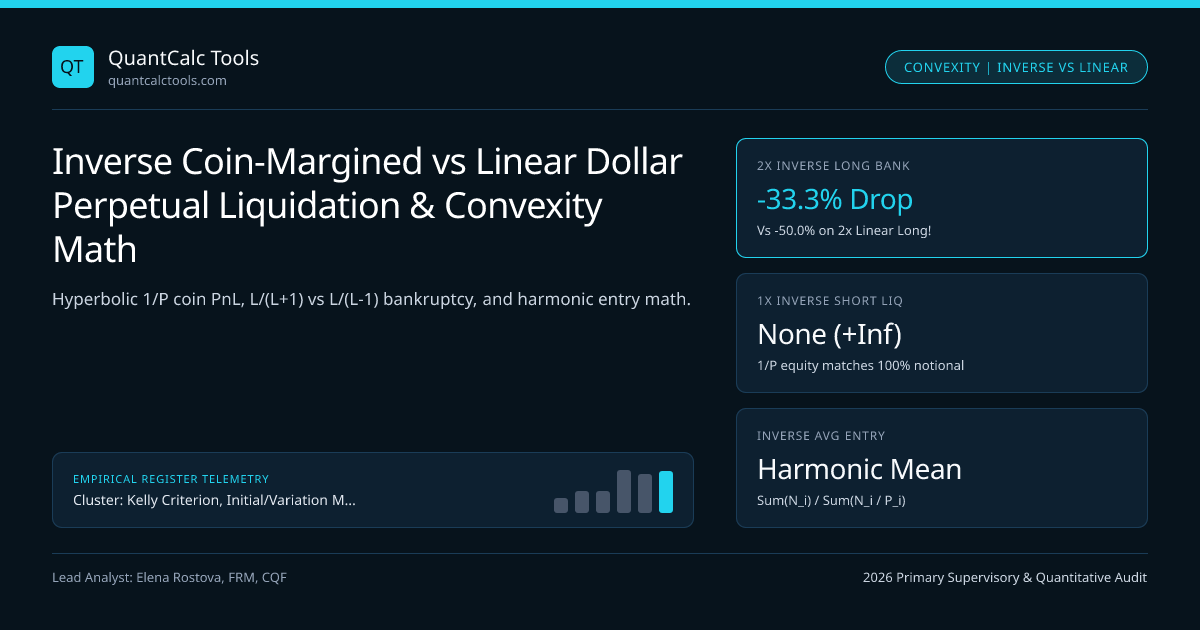
Opening a 1.0x Short Inverse Coin-Margined perpetual CANNOT be liquidated even if price rises to infinity, while a 2.0x Long Inverse perpetual gets wiped out on a -33.3% drop—not -50%!
Derivatives traders transitioning from CME linear futures (PnL = N * (P - P_0)) to Inverse Perpetual & Quarterly Contracts (originally pioneered by BitMEX XBTUSD and institutional basis desks on Deribit/CME-adjacent venues, where contracts have a fixed $1 or $100 USD notional settled and collateralized strictly in the underlying asset itself, so PnL_coin = N_usd * (1/P_0 - 1/P)) suffer shocking liquidation surprises when they apply linear mental math! Why? Because in an Inverse Contract, your margin collateral's USD value rises and falls simultaneously with the mark price $P$, turning PnL into a strictly convex 1/P hyperbola! Pair exact liquidation math with our Kelly Criterion Calculator, Isolated vs Cross-Margin Guide, and Kelly, Margin & Liquidation Hub.
Exact Hyperbolic PnL, Bankruptcy Price & Liquidation Price of Inverse Contracts#
Let $N{\text{usd}}$ be fixed USD contract notional (e.g., $100,000 worth of $100 contracts), $P0$ be entry price, and $L$ be initial leverage so initial coin collateral posted is $M{\text{coin}} = \frac{N{\text{usd}}}{L \cdot P0}$ coins. When price moves to $P$, a Long position's coin-denominated PnL is $+N{\text{usd}}\left(\frac{1}{P0} - \frac{1}{P}\right)$ coins, and a Short position's coin-denominated PnL is $+N{\text{usd}}\left(\frac{1}{P} - \frac{1}{P0}\right)$ coins. Set remaining coin equity equal to zero (Bankruptcy) or `MMR * (Nusd / P) (Liquidation`) and solve for $P$—watch the algebra flip upside down!
- Inverse Coin PnL (Long) : PnLcoin = Nusd * ( 1/P0 - 1/P ) [USD Equivalent = Nusd * (P / P_0 - 1)]
- Inverse Coin Equity : Eqcoin(P) = Nusd / (L * P0) + s * Nusd * (1/P_0 - 1/P) (s = +1 Long, -1 Short)
- 1. INVERSE LONG Bankruptcy & Liquidation Prices (Collateral SHRINKS as Price Falls!):
- Zero-Coin Bankruptcy : 1/(LP0) + 1/P0 - 1/Pbank = 0 => Pbank,invlong = P0 [ L / (L + 1) ] !
- (Compare Linear Long : Pbank,linlong = P_0 * [ (L - 1) / L ] !)
- Maintenance Liq Price: Pliq,invlong = P0 * [ L * (1 + MMR + fc) ] / [ L + 1 ]
- 2. INVERSE SHORT Bankruptcy & Liquidation Prices (Collateral APPRECIATES in USD as Price Rises!):
- Zero-Coin Bankruptcy : 1/(LP0) - 1/P0 + 1/Pbank = 0 => 1/Pbank = (L - 1) / (L P_0)
- => Pbank,invshort = P0 * [ L / (L - 1) ] for L > 1; and Pbank = +INFINITY for L <= 1.0x!!
- Maintenance Liq Price: Pliq,invshort = P0 * [ L * (1 - MMR - fc) ] / [ L - 1 ] (Never liquidates if L <= 1 - MMR!)
- Worked Proof @ Entry P_0 = $100,000 (Compare 2.0x Long vs 1.0x Short):
- A. 2.0x LONG ($200k Notional on $100k Equity):
- Linear USDT Long P_bank = $100,000 * (2 - 1)/2 = $50,000 (-50.00% drop to wipeout)
- Inverse Coin Long P_bank = $100,000 * (2 / 3) = $66,667 (-33.33% drop WIPES OUT 100% OF COIN! 16.7% earlier!)
- B. 1.0x SHORT ($100k Notional Hedging 1.0 Coin Held as Margin Collateral!):
- Linear USDT 1.0x Short P_bank = $100,000 * (1 + 1) = $200,000 (+100% rally wipes out $100k USDT!)
- Inverse Coin 1.0x Short = NEVER LIQUIDATED EVEN AT P = $10,000,000! (Synthetic USD stablecoin lock!)
Why a 1.0x Short Inverse Perpetual Creates a Liquidation-Free Synthetic USD Lock#
STOP AND ADMIRE RESULT B (1.0x Inverse Short): Suppose you hold 1.0 BTC at $100,000 and short $100,000 notional of the Inverse Perpetual (L = 1.0x) using that 1.0 BTC as margin.
- If BTC surges to
$1,000,000(+900%), your short loses0.90 BTC(100k * (1/100k - 1/1M)), leaving you with *0.10 BTCworth `0.10 $1,000,000 = $100,000.00 USD`**! - If BTC crashes to
$10,000(-90%), your short gains+9.00 BTC, leaving you with *10.00 BTCworth `10.00 $10,000 = $100,000.00 USD`**!
A 1.0x Short Inverse Perpetual synthetically locks USD value across ($0 to +infinity) with ZERO liquidation price, while collecting positive perpetual funding rates—the exact foundational engine behind institutional delta-neutral basis yield strategies!
Complete Side-by-Side Bankruptcy Price Schedule: Linear vs Inverse (Entry = $100.00)#
Verify the dramatic divergence between Linear Dollar-Margined ((L-1)/L Long, (L+1)/L Short) and Inverse Coin-Margined (L/(L+1) Long, L/(L-1) Short) across leverage tiers:
| Leverage ($L$) | Linear LONG P_bank | Inverse LONG P_bank | Linear SHORT P_bank | Inverse SHORT P_bank | Strategic Verdict |
|---|---|---|---|---|---|
1.0x Leverage | $0.00 (-100.0%) | $50.00 (-50.0%!) | $200.00 (+100.0%) | Never (+Infinity!) | 1x Inverse Long = 2x Linear! |
2.0x Leverage | $50.00 (-50.0%) | $66.67 (-33.3%!) | $150.00 (+50.0%) | $200.00 (+100.0%!) | Inverse Short has 2x wider room! |
5.0x Leverage | $80.00 (-20.0%) | $83.33 (-16.7%) | $120.00 (+20.0%) | $125.00 (+25.0%) | Asymmetry narrows slowly at high $L$ |
10.0x Leverage | $90.00 (-10.0%) | $90.91 (-9.09%) | $110.00 (+10.0%) | $111.11 (+11.11%) | Converges as $1/L \to 0$ |
25.0x Leverage | $96.00 (-4.00%) | $96.15 (-3.85%) | $104.00 (+4.00%) | $104.17 (+4.17%) | MMR (0.5%–1.5%) dominates both! |
Coding Trap Alert: Average Entry Price on Inverse Contracts Is the HARMONIC Mean, Not Arithmetic!#
If you buy $10,000 of an Inverse Contract at $50,000 (0.20 coins) and another $10,000 at $100,000 (0.10 coins), your breakeven average entry price is NOT $75,000! Total USD notional is $20,000 across 0.30 coins, so exact breakeven price is the Harmonic Mean: $$P{\text{avg, inverse}} = \frac{\sum Ni}{\sum (Ni / Pi)} = \frac{20{,}000}{0.20 + 0.10} = \$66{,}666.67$$ Coding arithmetic (50k + 100k)/2 = $75,000 into an execution dashboard misstates breakeven and liquidation prices by $8,333 (12.5%)!
Institutional Wrong-Way Collateral Rules Across Asset Classes#
Notice that Inverse Long liquidation (Wrong-Way Collateral Risk — posting the exact asset you are buying on margin!) is identical in mathematical spirit to posting emerging-market local bonds as collateral for a long EM FX forward! Compare isolated vs cross-margin liquidation, repo haircut wrong-way leverage caps, and UK FCA COBS 22.5/22.6 rules.
Frequently asked questions
Why does a 1.0x Long Inverse Perpetual have a liquidation price near -50% when a 1.0x Long Linear Perpetual has no liquidation?
Think in total USD wealth! On a 1.0x Linear Long, you hold $100,000 stable USD cash collateral + $100,000 perp exposure = $100,000 total asset delta (wipes out only at $0). On a 1.0x Inverse Long, you ALREADY hold $100,000 of volatile coin collateral PLUS you added ANOTHER $100,000 of long perp = $200,000 total delta on $100k equity (secretly 2.0x effective USD leverage)!
Can a 1.0x Inverse Short actually get liquidated if Maintenance Margin Rate (MMR) is 1.0%?
Check the exact maintenance inequality: Coin Equity = N/P passes safely above MMR * (N/P) for EVERY finite price P > 0 whenever L <= 1 / (1 + MMR + fee)? Wait—let’s check! At L = 1.0x exact, 1/(1*P_0) - (1/P_0 - 1/P) = 1/P, which ALWAYS equals 100% of current contract coin value N/P >> 1.0% MMR*(N/P)! Only cumulative negative funding payments draining coin balance below L = 1/(1 - MMR) could ever create a finite liquidation price!
When would an institutional desk intentionally choose a LONG Inverse contract despite its faster liquidation?
For convex upside "coin accumulation" WITH strict stop-losses! In USD terms, an Inverse Long’s USD profit is N_usd * (P/P_0 - 1) PLUS the appreciation of the coin collateral itself—AND winning coin PnL is paid in appreciating coin, creating positive upside convexity in rallies!
What is a "Quanto Perpetual" contract and why does it embed a correlation adjustment?
A Quanto contract quotes an asset (say Nikkei 225 in JPY, or ETH/USD) with a FIXED multiplier in a THIRD currency (say USD or BTC) regardless of FX/cross-rate moves! Pricing a Quanto forward/perp requires subtracting -rho * sigma_asset * sigma_FX * T (the Siegel/Quanto covariance drift adjustment).
Publication record
- Published
- 13 November 2026
- Updated
- 14 November 2026
- Author
- Elena Rostova, FRM, CQF
- Review
- Review not recorded
- Automated fact check
- Passed in the stored pipeline record
- Source URLs
- 4 recorded
AI assistance recorded: anthropic/claude-opus-4.6. This field does not establish human review or source verification.
Academic & Institutional Attribution
Cite This Research & Embed Live Data Card
Standard academic & institutional research paper citation format.
Elena Rostova, FRM, CQF. (2026, November 14). Inverse Coin-Margined vs Linear Dollar Perpetual Liquidation & Convexity Math. QuantCalc Tools. https://quantcalctools.com/guides/inverse-coin-margined-vs-linear-usdt-perpetual-liquidation-mathRelated Kelly Margin Leverage Sizing & Institutional Briefings
Explore Kelly Margin Leverage Sizing Hub (20) →Kelly Margin Leverage Sizing
Kelly Criterion, Initial/Variation Margin & Liquidation Math: 2026 GuideKelly Margin Leverage Sizing
Volatility-Target, Wilder ATR Stop-Loss & Equal Risk Contribution SizingKelly Margin Leverage Sizing
Central Clearing Variation Margin Liquidity Spirals & Cash Buffer MathKelly Margin Leverage Sizing
Ralph Vince Optimal f & Terminal Wealth Relative (TWR): Empirical Sizing MathKelly Margin Leverage Sizing
Short Naked Option Margin Math: Reg T 20%/10% Rule & Gamma Crash ExpansionKelly Margin Leverage Sizing
Repo Haircut, Rehypothecation Multiplier & Leveraged Bond Carry MathKelly Margin Leverage Sizing
Black-Litterman Posterior Expected Return & Bayesian Kelly Sizing MathKelly Margin Leverage Sizing
Guaranteed Stop-Loss Order (GSLO) Premium vs Gap Slippage & Option MathIPO and Stock Market
Anthropic heads for lower than expected $1.3 trillion valuation in stock market debutMarket Insights
Stifel cuts Everus stock price target on valuation resetMarket Insights
JPMorgan lowers ViaSat stock price target to $120 on valuationMarket Insights
UBS downgrades DraftKings stock rating on valuation concerns
QuantCalc Tools Data, Benchmarks & Contributor Records
CC BY 4.0 Open Data
Open Institutional Datasets (CSV / JSON) →
Download desk-compiled quantitative series & schemas.
2026 Reference Matrix
2026 Institutional Benchmarks & Thresholds →
Statutory capital, clearing, margin & rate conventions.
Editorial Records
Authors & Review Records →
View named contributors where those records are available.
Complete Index
Master Research & Dossier Archive →
Browse all published briefings by topic pillar & date.