
ISDA SIMM v2.6 Uncleared OTC Initial Margin: Delta, Vega & Curvature Math
Why did the entire global banking system converge on one single open-source sensitivity formula for uncleared swaps and FX options? Master exact ISDA SIMM v2.6 variance-covariance aggregation.
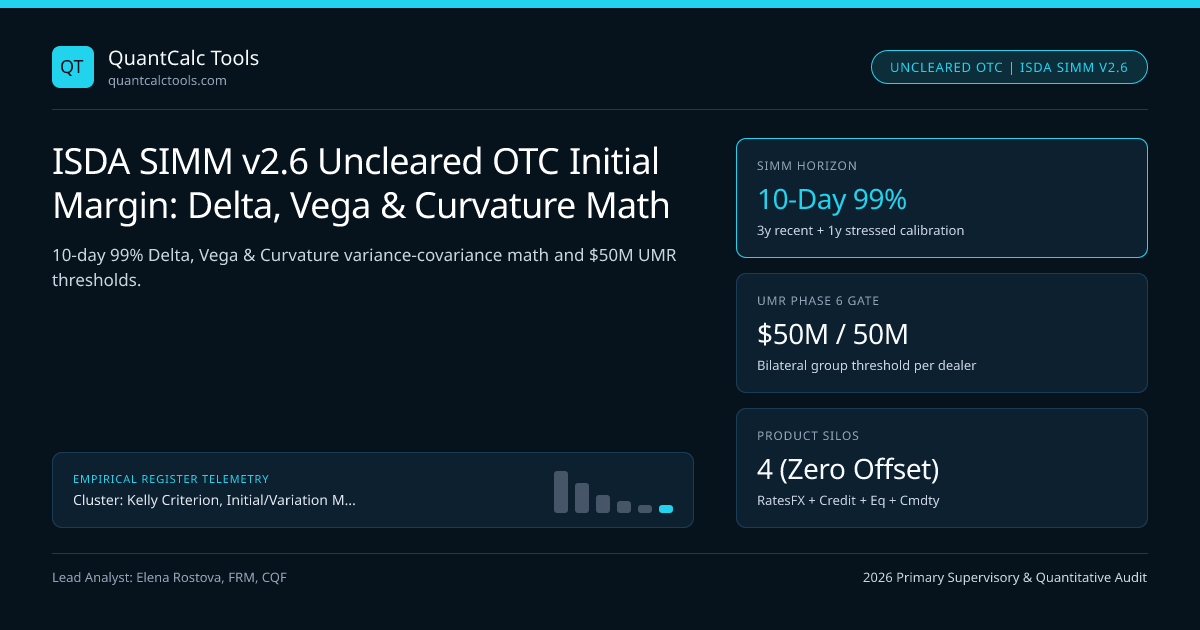
Under post-2008 BCBS-IOSCO Uncleared Margin Rules (UMR Phases 1–6, enforced by the UK PRA, Fed, ECB, and CFTC), whenever two financial institutions trade non-centrally-cleared OTC derivatives—such as cross-currency swaps, swaptions, exotic FX options, or equity total-return swaps—both sides must calculate and post 99% 10-day Initial Margin (IM) gross to segregated third-party custodians. Imagine the chaos if Goldman Sachs and a European pension fund ran two proprietary Monte Carlo engines that disagreed by $45 million every morning! To prevent endless bilateral margin disputes, the industry standardized on ISDA SIMM (Standard Initial Margin Model, v2.6+)—a deterministic sensitivity-based variance-covariance formula closely mirroring Basel FRTB SBA! Inspect our ISDA SIMM v2.6 Sensitivity Grid, test baseline VaR in the Value-at-Risk Calculator, and consult our Kelly, Margin & Liquidation Hub.
Exact ISDA SIMM Hierarchical Aggregation: Bucket $\to$ Risk Class $\to$ Product Class#
ISDA SIMM partitions every OTC trade into four isolated Product Classes (RatesFX, Credit, Equity, Commodity — zero cross-offsetting across Product Classes!), and within each Product Class aggregates six Risk Classes (Interest Rate, Credit Qualifying, Credit Non-Qualifying, Equity, Commodity, FX) across DeltaMargin + VegaMargin + CurvatureMargin + BaseCorrMargin:
- 1. Weighted Sensitivity (Risk Factor k) : WSk = RWk * sk * CRk
- s_k : Net sensitivity (e.g., Key-Rate PV01 in USD/bp across 12 tenors 2w..30y, or 1% FX spot delta!)
- RW_k : ISDA-calibrated 99% 10-day Risk Weight (calibrated to 3y recent + 1y stressed 2008/2020 period!)
- CRk : Concentration Risk Factor = max( 1, sqrt( |Sum sk| / Threshold_b ) )
- 2. Intra-Bucket Variance-Covariance : Kb = sqrt( Sumk WSk^2 + Sum{k != l} (rho{kl} * f{kl} * WSk * WSl) )
- 3. Cross-Bucket Aggregation (Risk Class): DeltaMarginr = sqrt( Sumb Kb^2 + Sum{b != c} gamma{bc}*g{bc}S_bSc ) + Kresidual
- 4. Risk-Class Total & Cross-Risk-Class : IMr = DeltaMarginr + VegaMarginr + CurvatureMarginr
- Product-Class SIMM : SIMMprod = sqrt( Sumr IMr^2 + Sum{r != s} psi{rs} * IMr * IM_s )
- Total CounterpartyCSA SIMM : SIMMTotal = SIMMRatesFX + SIMMCredit + SIMMEquity + SIMM_Commodity
- Worked 10Y USD Interest-Rate Swap vs 2s10s Curve Steepener SIMM Comparison ($100M 10Y PV01 = $85,000/bp):
- Assume SIMM 10Y USD Regular-Vol Risk Weight RW_10y = 111 bps (10-day 99% shock!), Threshold = $210M/bp -> CR = 1.0:
- 1. Unhedged $100M 10Y Pay-Fixed Swap : WS_10y = 111 * $85,000 = $9,435,000 SIMM Initial Margin (~9.44% of Notional!)
- 2. DV01-Neutral 2s10s Steepener (-$85k/bp 2Y @ RW2y=108 => -$9.18M; +$85k/bp 10Y => +$9.435M; SIMM rho{2y,10y} = 0.68):
- K_USD = sqrt( (-9.18)^2 + (9.435)^2 + 2(0.68)(-9.18)*(9.435) ) = sqrt( 84.27 + 89.02 - 117.80 ) = $7.45M (-21.0% Offset!)
Concentration Thresholds, Curvature Gamma Residuals & $50M UMR Optimization#
Look closely at three critical engineering details inside that formula block:
- Concentration Factor $CRk = \max(1, \sqrt{|\sum sk| / T_b})$: Once your net Key-Rate DV01 exceeds ISDA's liquidity threshold $Tb$, SIMM scales risk weight with the square root of excess size AND dampens cross-tenor correlation via $f{kl} = \min(CRk, CRl) / \max(CRk, CRl)$—preventing monster books from claiming full correlation relief!
- Curvature Margin Captures Gamma Tail Convexity: Delta and Vega are linear; short option books add a dedicated Black-Scholes two-sided shock residual
CVR_k = -[V(x + RW) - V(x) - RW * s_k]scaled by a tail-adjustment factor so short gamma cannot hide inside zero delta! $50 MillionUMR Group Threshold Optimization: Under global UMR Phase 6 rules, bilateral SIMM exchange only activates once consolidated counterparty-groupIMexceeds€50M / $50M—making SIMM Optimization / Compression (moving Delta between cleared LCH/CME swaps and uncleared OTC books to stay< $50Mper dealer!) a massive institutional alpha saver!

Cleared CCP Margin (LCH / CME) vs Uncleared Bilateral ISDA SIMM v2.6#
Why is clearing a vanilla interest-rate swap at LCH or CME almost always cheaper in margin funding (MVA) than keeping it bilateral under ISDA SIMM—while exotic FX/rates hybrids stay bilateral?
| Margin Feature | Cleared CCP (CME SPAN 2 / LCH SwapClear) | Uncleared Bilateral OTC (ISDA SIMM v2.6) | MVA (Margin Valuation Adjustment) Impact |
|---|---|---|---|
Margin Period of Risk (MPOR) | 5 Business Days (Rates) / 1–2d (Futures) | 10 Business Days (sqrt(2) ~= +41.4% higher!) | Bilateral OTC costs $\sim 1.41\times$ more IM! |
| Multilateral Dealer Netting? | YES! (Long Dealer A nets Short Dealer B at CCP!) | NO! (Post gross to A AND gross to B!) | Multilateral clearing slashes gross IM $60\%+$ |
| Segregation & Rehypothecation | CCP default waterfall pool | Strict 3rd-party custody; ZERO rehypothecation | Funding posted IM costs 40–85 bps/yr MVA |
| FX Principal Notional Risk | Cleared NDFs only | Exempts physically settled FX swap principal (SIMM covers FX Vega/Curv; SA-CCR still hits!) | Keeps G10 FX forwards liquid, options SIMM-heavy |
Physical FX Forwards Nuance Under UMR & SIMM#
Here is a subtle regulatory rule every FX quant must know: under BCBS-IOSCO UMR, physically settled FX forwards and FX swaps are EXEMPT from mandatory regulatory Initial Margin (they still exchange mandatory daily cash Variation Margin!), whereas FX Options (vanilla and barrier) ARE fully subject to ISDA SIMM Delta, Vega, and Curvature Initial Margin! Thus delta-hedging an uncleared FX option book with physical FX forwards in the same CSA can actually reduce net FX Delta SIMM!
Cross-Linking OTC Margin to FX Swap Drag & Liquidity Buffers#
Audit how dealer SIMM and SA-CCR charges widen FX forward basis wedges in SA-CCR and ISDA SIMM FX forward margin drag, size cash reserves for daily CSA calls in Variation Margin liquidity spiral math, and compare cleared CME SPAN 2 futures margin and UK PRA supervisory rules.
Frequently asked questions
Why are there ZERO diversification offsets between Equity derivatives and Interest Rate swaps in ISDA SIMM?
Regulators require SIMM to segregate trades into four silos ("Product Classes": RatesFX, Credit, Equity, Commodity) and sum their SIMM numbers linearly (SIMM_Total = Sum SIMM_p) because cross-asset stock-bond correlations frequently flip sign from -0.40 to +0.75 during inflationary stress regimes (like 2022)!
What is MVA (Margin Valuation Adjustment) on an institutional derivatives desk?
Because SIMM Initial Margin must be posted into a segregated third-party custodian with zero rehypothecation for the entire 5-to-30 year life of a swap, funding that locked collateral costs the bank its unsecured funding spread s_fund (~50–85 bps/yr) times expected discounted SIMM profile—priced upfront into swap quotes as MVA!
How does ISDA SIMM avoid procyclical margin explosions when market volatility spikes?
ISDA calibrates SIMM Risk Weights (RW_k) using a fixed 75% three-year recent window PLUS a mandatory 25% one-year extreme-stress window (such as 2008 Lehman or 2020 COVID), updating parameters on an annual/semi-annual governance cycle rather than jumping 300% intraday.
What is a CRIF file in institutional OTC margin operations?
CRIF stands for Common Risk Interchange Format—a standardized tab-delimited sensitivity schema (TradeID, ProductClass, RiskType, Qualifier, Bucket, Label1, Label2, AmountUSD) exchanged nightly via AcadiaSoft so both counterparties pinpoint any >$500k Greek discrepancy in seconds.
Publication record
- Published
- 13 November 2026
- Updated
- 14 November 2026
- Author
- Elena Rostova, FRM, CQF
- Review
- Review not recorded
- Automated fact check
- Passed in the stored pipeline record
- Source URLs
- 4 recorded
AI assistance recorded: anthropic/claude-opus-4.6. This field does not establish human review or source verification.
Academic & Institutional Attribution
Cite This Research & Embed Live Data Card
Standard academic & institutional research paper citation format.
Elena Rostova, FRM, CQF. (2026, November 14). ISDA SIMM v2.6 Uncleared OTC Initial Margin: Delta, Vega & Curvature Math. QuantCalc Tools. https://quantcalctools.com/guides/isda-simm-v26-uncleared-otc-initial-margin-delta-vega-curvatureRelated Kelly Margin Leverage Sizing & Institutional Briefings
Explore Kelly Margin Leverage Sizing Hub (20) →Kelly Margin Leverage Sizing
Kelly Criterion, Initial/Variation Margin & Liquidation Math: 2026 GuideKelly Margin Leverage Sizing
FX Pip-Value & Lot Sizing Calculator Math: Cross-Currency ConversionKelly Margin Leverage Sizing
Reg T 50% Equity Margin vs FINRA Rule 4210 Portfolio Margin & House CallsKelly Margin Leverage Sizing
Risk of Ruin Math: Fixed-Dollar Markov Absorption vs Fixed-Fractional SizingKelly Margin Leverage Sizing
Inverse Coin-Margined vs Linear Dollar Perpetual Liquidation & Convexity MathKelly Margin Leverage Sizing
Volatility-Target, Wilder ATR Stop-Loss & Equal Risk Contribution SizingKelly Margin Leverage Sizing
Central Clearing Variation Margin Liquidity Spirals & Cash Buffer MathKelly Margin Leverage Sizing
Ralph Vince Optimal f & Terminal Wealth Relative (TWR): Empirical Sizing MathIPO and Funding
Anthropic's IPO valuation could reach $1.4 trillionMarket Insights
Junk bonds are 'flashing yellow.' Watch these warning signsIPO and Funding
Anthropic targets valuation of up to $1.4tn in stock market flotationMarket Insights
Why stocks are falling and 10-year yields are climbing back near 5% after Tuesday’s inflation report
QuantCalc Tools Data, Benchmarks & Contributor Records
CC BY 4.0 Open Data
Open Institutional Datasets (CSV / JSON) →
Download desk-compiled quantitative series & schemas.
2026 Reference Matrix
2026 Institutional Benchmarks & Thresholds →
Statutory capital, clearing, margin & rate conventions.
Editorial Records
Authors & Review Records →
View named contributors where those records are available.
Complete Index
Master Research & Dossier Archive →
Browse all published briefings by topic pillar & date.