
Isolated Margin vs Cross-Margin Liquidation & Bankruptcy Price Formulas
Liquidation fires at the Maintenance Margin threshold BEFORE your equity hits the zero-equity Bankruptcy Price; master exact isolated vs cross-margin liquidation formulas and fee buffers.
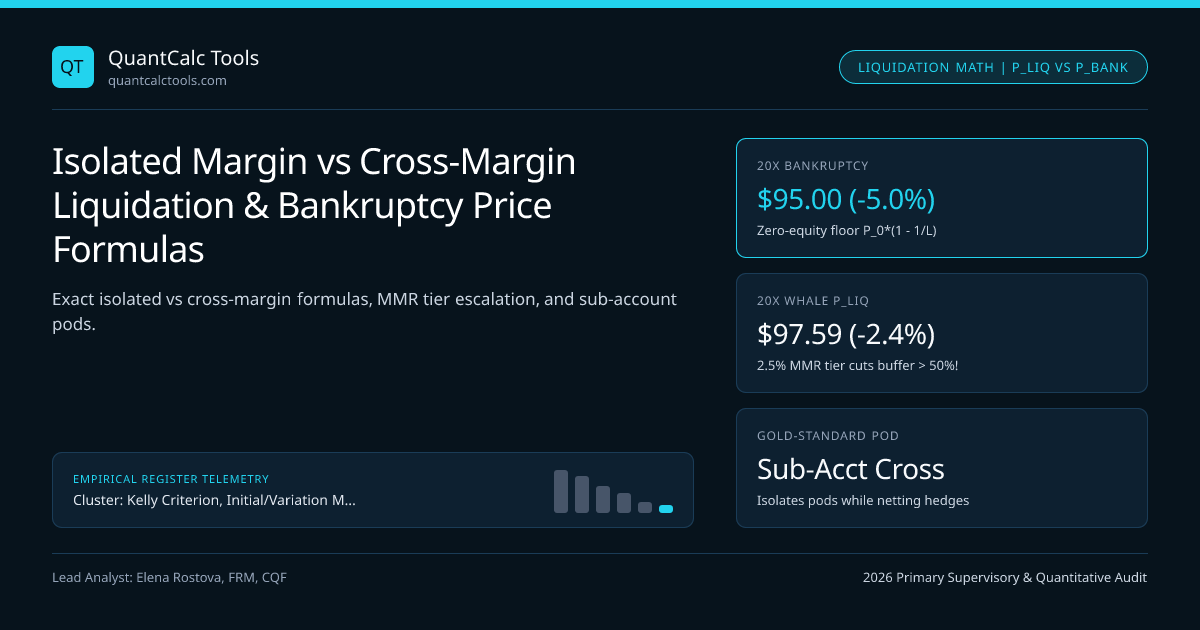
Ask a trader leveraged 20x Long from $100.00 where their position gets liquidated, and most reply instinctively: "$95.00, because 1 / 20 = 5.0%!" Wrong—$95.00 is your Zero-Equity Bankruptcy Price (P_bank), NOT your Liquidation Price (P_liq)! Every derivatives exchange and prime broker triggers liquidation strictly earlier—when remaining margin drops to Maintenance Margin (MMR) plus closing taker fees (say $95.65)—so the liquidation engine can unwind the position in the order book before slippage pierces $95.00 and drains the exchange Insurance Fund! Pair liquidation buffers with our Kelly Criterion Calculator, Value-at-Risk Calculator, and Kelly, Margin & Liquidation Hub.
Exact Linear Isolated-Margin vs Cross-Margin Liquidation & Bankruptcy Equations#
Consider a linear dollar-margined contract with quantity $Q > 0$, entry price $P0$, leverage $L$ (so initial locked margin is $\text{IM} = Q P0 / L$), tiered Maintenance Margin Rate $\text{MMR}$ (with tier maintenance deduction $K{\text{maint}}$ if applicable), taker close-out fee rate $fc$, and extra wallet/free margin $B_{\text{extra}}$ ($0 in standard Isolated Margin; full Available Wallet Balance in Cross-Margin, minus unrealized losses on other open cross positions!):
- 1. Isolated LONG Position (Entry P0, Leverage L, Extra Added Margin Madd >= 0):
- Zero-Equity Bankruptcy Price : Pbank,long = P0 * (1 - 1/L) - (M_add / Q)
- Maintenance Liquidation Price: Pliq,long = [ P0 * (1 - 1/L) - (Madd / Q) ] / (1 - MMR - fc)
- (Common Fixed-Notional MMR Convention: Pliq,long = P0 * [ 1 - (1 / L) + MMR + fc ] - Madd / Q)
- 2. Isolated SHORT Position (Entry P0, Leverage L, Extra Added Margin Madd >= 0):
- Zero-Equity Bankruptcy Price : Pbank,short = P0 * (1 + 1/L) + (M_add / Q)
- Maintenance Liquidation Price: Pliq,short = [ P0 * (1 + 1/L) + (Madd / Q) ] / (1 + MMR + fc)
- 3. Multi-Position CROSS-MARGIN Trigger (Total Wallet Cash W_cash across K Positions):
- Liquidate ALL Cross Positions when: Wcash + Sum{i=1..K} PnLmark,i <= Sum{i=1..K} (MMRi + fc) * |Qi| * Pmark,i
- Worked $500,000 Large-Tier Long Liquidation Audit (Entry P_0 = $100.00, Q = 5,000 units, L = 20x -> IM = $25,000):
- Large-notional tier raises MMR = 2.50%, Taker Liquidation Fee f_c = 0.15%:
- 1. Isolated Margin (M_add = $0):
- Bankruptcy Price P_bank = $100.00 * (1 - 0.05) = $95.00 (-5.00% move)
- Liquidation Price P_liq = $95.00 / (1 - 0.0265) = $97.59! (Liquidated on just a -2.41% move — LESS THAN HALF of 5%!)
- 2. Cross-Margin ($25,000 IM + $35,000 Idle Cash = $60,000 Total Wallet, Zero Other Trades):
- Effective Leverage drops to $500k / $60k = 8.33x -> P_liq,cross = ($100 - $12) / (1 - 0.0265) = $90.40 (-9.60% room, BUT risks ALL $60k!)
Tiered Maintenance Margin Escalation & Insurance-Fund Clearance Penalties#
Stop and read that $500,000 notional tier result again: the trader thought 20x leverage gave -5.00% room ($95.00), yet because large position size bumped MMR from 0.50% up to 2.50%, liquidation fired at $97.59 (-2.41%)—and when liquidated at $97.59, the leftover $97.59 - $95.00 = $2.59/unit ($12,950 of real equity!) was swept into exchange liquidation fees / Insurance Fund depending on the venue's clearance penalty structure!
Structural Trade-Off Matrix: Isolated Margin vs Cross-Margin vs Portfolio Margin#
Choose your collateral isolation architecture deliberately based on strategy correlation and stop-loss discipline:
| Margin Mode | Collateral Pool Shared? | Delta Hedge Offset? | Risk of Single Runaway Trade | Ideal Institutional / Systematic Use Case |
|---|---|---|---|---|
| Isolated Margin | No (Ring-fenced per symbol) | None (Long & Short liquidate independently!) | Capped strictly at IM + M_add | High-vol directional breakout pods |
| Cross-Margin (Standard) | Yes (Full wallet cash shared) | Partial PnL offset (PnL_A + PnL_B) | 100% of cross-wallet wiped out! | Multi-pair low-leverage swing books |
| Portfolio Margin (PM / SPAN 2) | Yes (Scenario stress netted) | Full Delta/Vega IM & MMR reduction! | Account-wide house stress call | Basis carry, hedged options & CME SPAN 2 |
| Sub-Account Pod Isolation | Cross within pod; isolated across pods | Full within strategy pod | Capped at single pod allocation | Institutional multi-strategy gold standard! |
Why Basis Arbitrageurs Need Sub-Account Cross-Margin—While Directional Traders Need Isolated!#
Suppose you run a delta-neutral cash-and-carry basis trade: Long $1,000,000 physical asset + Short $1,000,000 futures/perpetual. If you put the short leg in Isolated Margin at 10x and spot rallies +11% overnight, your isolated short leg gets liquidated at the top, leaving you naked +$1,110,000 long right before spot reverses -15%! Putting both legs inside a dedicated Sub-Account Cross/Portfolio Margin lets unrealized gains on the long leg offset unrealized losses on the short leg—while ring-fencing the rest of your firm's capital!
Convexity Twist on Inverse Coin-Margined Contracts & CCP Clearing#
Notice every equation above assumed linear dollar-margined PnL (Q * (P - P_0)). If you trade inverse coin-margined contracts where collateral itself depreciates alongside a falling price, P_liq rushes upward hyperbolically—derived in full in inverse coin-margined vs linear USDT perpetual liquidation math! Also compare CME SPAN 2 maintenance top-ups and FCA 50% retail close-out rules across execution platforms.
Frequently asked questions
Why do exchanges trigger liquidation using "Mark Price" instead of the "Last Traded Price"?
On a thin order book during volatile news, a single market order can briefly flash the Last Traded Price down -8% for 200 milliseconds before snapping back. Computing unrealized margin equity against a composite Spot Index + decaying funding-basis EMA ("Mark Price") prevents predatory stop-hunting wicks from causing unfair mass liquidations.
What is "partial / incremental tier liquidation" on large futures or perpetual positions?
Suppose a $5M position sits in Tier 4 (MMR = 2.50%) and Mark Price touches P_liq. Instead of dumping all $5M at market, modern engines liquidate just $1.5M to drop remaining notional ($3.5M) into Tier 3 (MMR = 1.50%), instantly lowering required Maintenance Margin and halting further liquidation!
How can adding a SECOND trade in Cross-Margin accidentally bring the liquidation price of my FIRST trade closer?
Two ways: (1) Opening Trade 2 consumes Free Margin into Trade 2’s Maintenance Margin floor Sum(MMR_i * Notional_i); and (2) Any unrealized mark-to-market drawdown on Trade 2 drains the shared W_cash buffer protecting Trade 1!
What is Auto-Deleveraging (ADL) and how does it differ from socialized clawbacks?
During an extreme crash where a liquidated long cannot be filled above its Bankruptcy Price P_bank AND the deficit exhausts the exchange Insurance Fund, Auto-Deleveraging (ADL) automatically closes a matching slice of the highest-leverage, highest-profit opposing short traders at P_bank rather than socializing losses across all users.
Publication record
- Published
- 13 November 2026
- Updated
- 14 November 2026
- Author
- Elena Rostova, FRM, CQF
- Review
- Review not recorded
- Automated fact check
- Passed in the stored pipeline record
- Source URLs
- 4 recorded
AI assistance recorded: anthropic/claude-opus-4.6. This field does not establish human review or source verification.
Academic & Institutional Attribution
Cite This Research & Embed Live Data Card
Standard academic & institutional research paper citation format.
Elena Rostova, FRM, CQF. (2026, November 14). Isolated Margin vs Cross-Margin Liquidation & Bankruptcy Price Formulas. QuantCalc Tools. https://quantcalctools.com/guides/isolated-margin-vs-cross-margin-liquidation-bankruptcy-price-mathRelated Kelly Margin Leverage Sizing & Institutional Briefings
Explore Kelly Margin Leverage Sizing Hub (20) →Kelly Margin Leverage Sizing
Kelly Criterion, Initial/Variation Margin & Liquidation Math: 2026 GuideKelly Margin Leverage Sizing
CME SPAN 2 Historical VaR Margin & Futures Maintenance Top-Up MathKelly Margin Leverage Sizing
ISDA SIMM v2.6 Uncleared OTC Initial Margin: Delta, Vega & Curvature MathKelly Margin Leverage Sizing
FX Pip-Value & Lot Sizing Calculator Math: Cross-Currency ConversionKelly Margin Leverage Sizing
Reg T 50% Equity Margin vs FINRA Rule 4210 Portfolio Margin & House CallsKelly Margin Leverage Sizing
Risk of Ruin Math: Fixed-Dollar Markov Absorption vs Fixed-Fractional SizingKelly Margin Leverage Sizing
Inverse Coin-Margined vs Linear Dollar Perpetual Liquidation & Convexity MathKelly Margin Leverage Sizing
Volatility-Target, Wilder ATR Stop-Loss & Equal Risk Contribution SizingIPO and Funding
Anthropic's margins support IPO case, say Burnham Park's Rohit KulkarniMarket Insights
Dubai's DIP Holding is a yield play, says strategistIPO and Funding
Anthropic's IPO valuation could reach $1.4 trillionMarket Insights
Junk bonds are 'flashing yellow.' Watch these warning signs
QuantCalc Tools Data, Benchmarks & Contributor Records
CC BY 4.0 Open Data
Open Institutional Datasets (CSV / JSON) →
Download desk-compiled quantitative series & schemas.
2026 Reference Matrix
2026 Institutional Benchmarks & Thresholds →
Statutory capital, clearing, margin & rate conventions.
Editorial Records
Authors & Review Records →
View named contributors where those records are available.
Complete Index
Master Research & Dossier Archive →
Browse all published briefings by topic pillar & date.