
TWRR (CAGR) vs MWRR (XIRR): Irregular Cashflow Timing Divergence Math
An active ETF can post a +14.2% Time-Weighted CAGR while its average shareholder loses -4.8% via Money-Weighted XIRR; master exact sub-period linking and dollar-timing gap math.
Between 2020 and 2022, several flagship thematic technology funds reported cumulative positive Time-Weighted CAGRs since inception while losing tens of billions of dollars in aggregate shareholder wealth—triggering heated disputes over whether the fund outperformed or destroyed value. Both numbers were 100% mathematically accurate because they answered two fundamentally distinct questions: Time-Weighted Rate of Return (TWRR / CAGR) isolates the underlying asset manager's security selection by neutralizing external client subscriptions and redemptions, whereas Money-Weighted Rate of Return (MWRR / XIRR) weights each sub-period by the actual dollar capital deployed at that moment. Verify portfolio CAGRs in our CAGR Calculator and anchor your performance reporting in the CAGR, IRR & Drawdown Hub.
Exact Sub-Period Linking (TWRR) vs Polynomial Discounting (XIRR)#
Under CFA Institute Global Investment Performance Standards (GIPS), whenever an external cashflow $CFk$ enters or exits a portfolio on date $dk$, the accounting engine must strike an exact pre-flow portfolio market value $Vk^{-}$ so that sub-period return $Rk$ reflects strictly market appreciation prior to the capital injection. Conversely, XIRR treats the starting balance $V0$, all intermediate external flows $CFk$ (negative for contributions/investments, positive for withdrawals/distributions in spreadsheet convention, or signed net investor cashflows), and final liquidation value $V_T$ as a single Net Present Value root-finding equation on an ACT/365 calendar:
- Sub-period return k : 1 + Rk = Vk(pre-flow) / [ V{k-1}(pre-flow) + CF{k-1} ]
- Annualized TWRR CAGR: CAGR = [ Product{k=1..M} (1 + Rk) ]^(365 / (dM - d0)) - 1
- Money-Weighted Return (Exact Calendar-Day XIRR):
- Solve for XIRR: -V0 + Sum{k=1..M-1} [ -CFk / (1 + XIRR)^((dk - d0)/365) ] + VM / (1 + XIRR)^((dM - d0)/365) = 0
- Investor Timing Gap (Behavior Gap) = XIRR - TWRR_CAGR
- Worked 2-Year Fund Chasing Divergence:
- Year 1 (d=0 to 365) : Manager invests $1,000,000; rallies +80.0% -> V1(pre-flow) = $1,800,000 (R1 = +80.0%)
- Day 365 Subscription : Excited by +80% headline, investor wires +$8,200,000 -> Post-flow capital = $10,000,000
- Year 2 (d=365 to 730): Market corrects -30.0% -> Ending NAV V2 = $7,000,000 (R2 = -30.0%)
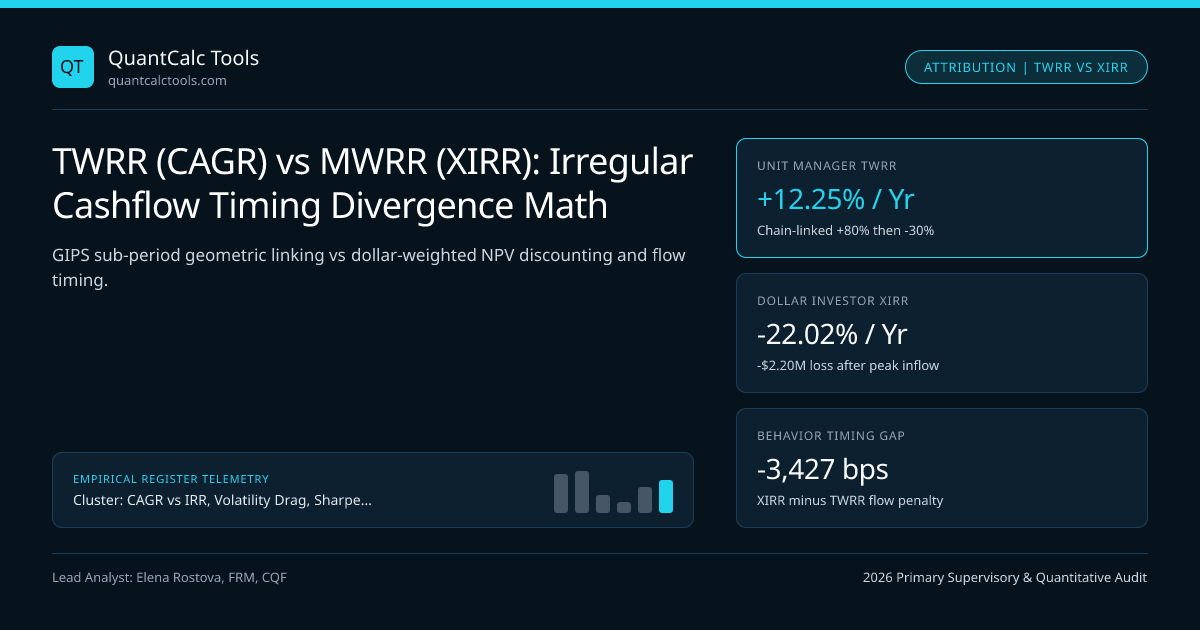
- 1. Manager TWRR CAGR = sqrt(1.80 * 0.70) - 1 = sqrt(1.26) - 1 = +12.25% / year! (Total cumulative TWRR = +26.0%)
- 2. Investor Net Dollar Profit = $7,000,000 - ($1,000,000 + $8,200,000) = -$2,200,000 CASH LOSS!
- 3. Investor Exact XIRR: Solve -1.0 - 8.2/(1 + r) + 7.0/(1 + r)^2 = 0
- Let x = 1/(1+r) -> 7.0x^2 - 8.2x - 1.0 = 0 -> x = [8.2 + sqrt(67.24 + 28.0)] / 14 = 1.2823 -> XIRR = -22.02% / year!
- Divergence = -22.02% (XIRR) - (+12.25% TWRR) = -3,427 bps (-34.27% annualized gap)!
Look at the magnitude of that result: the fund's GIPS-compliant tear-sheet legitimately advertises a +$12.25\%$ annualized CAGR, yet the investor lost $-\$2.20\text{ million}$ (-22.02% XIRR) because $10\times$ more capital sat exposed to Year 2's $-30\%$ drawdown than enjoyed Year 1's $+80\%$ surge!
Why Private Equity Uses XIRR (Since-Inception IRR) While Mutual Funds Must Use TWRR#
Regulatory attribution rules follow discretionary control over cashflows (verified under CFA GIPS and UK FCA COBS performance standards):
- Open-End Funds, ETFs & Separately Managed Accounts (
TWRR Mandatory): An equity ETF manager cannot stop retail investors from wiring billions at market peaks or redeeming at market bottoms. Penalizing or rewarding the manager for client cashflow timing would distort manager comparison—so GIPS requires TWRR. - Private Equity, Venture Capital & Closed-End Drawdown Funds (
MWRR / IRR Standard): A buyout General Partner (GP) exercises contractual discretion over when to issue capital calls against LP commitments and when to harvest exits. Because capital timing is part of GP skill, private markets quote Since-Inception IRR (XIRR) alongside TVPI/DPI multiples—though allocators must guard against subscription-line credit facility gaming (borrowing on a bank credit line for 180 days to delay LP capital calls and artificially inflate XIRR without adding $1$ dollar of TVPI!).
GIPS Attribution Matrix: Daily TWRR vs Modified Dietz vs XIRR & MIRR#
Audit cashflow discretion assumptions, valuation frequencies, and gaming vectors across all four institutional return engines:
| Attribution Metric | Cashflow Control Assumption | Valuation Frequency Required | Vulnerable Manipulation / Distortion Vector |
|---|---|---|---|
| Exact Daily TWRR (CAGR) | Client controls inflows/outflows | Daily NAV strike on every external flow | Masks dollar wealth loss when AUM surges right before a crash |
| Modified Dietz TWRR | Client controls flows (small flows) | Monthly NAV + day-weighted cashflows | Distorts by $80\text{--}250\text{ bps}$ if $>15\%$ flow hits mid-crash |
| Exact Calendar XIRR | Manager/Investor controls timing | Only initial, external flows & final NAV | PE subscription credit lines delay $d_0$ to juice annualized XIRR |
| Modified IRR (MIRR) | Explicit financing & reinvestment rates | Cashflow dates + external WACC/reinvest | Eliminates unrealistic reinvestment at $45\%$ internal IRR |
Auditing Both Numbers Side-by-Side: The Two-Metric Institutional Rule#
Sophisticated allocators and wealth platforms (broker lookup) compute both TWRR and XIRR on every client account:
- Compare Account TWRR against the benchmark index CAGR (e.g., S&P 500 Total Return) to audit security selection and fee drag.
- Compare Account XIRR minus Account TWRR to measure the client's or allocator's Capital Allocation Timing Alpha (positive if deposits preceded rallies; negative if deposits chased peaks).
Resolving Numerical Edge Cases When Computing XIRR and Sub-Period TWRR#
When external cashflows alternate sign (e.g., contributions followed by distributions followed by clawbacks or margin calls), XIRR can exhibit multiple real roots or fail to converge—which we solve rigorously in XIRR Newton-Raphson convergence and Modified IRR (MIRR). When custody systems lack daily pre-flow valuations on private holdings, approximate TWRR via Simple vs Modified Dietz sub-period cashflow weighting, and check decumulation sequence sensitivity in sequence-of-returns withdrawal ruin math alongside our methodology.
Frequently asked questions
Under what exact condition are CAGR (TWRR) and XIRR mathematically equal?
Whenever there are zero intermediate external cashflows between initial investment date d_0 and final valuation date d_M (assuming reinvested dividends stay inside the portfolio). In that single-cashflow case, -V_0 + V_M / (1 + XIRR)^T = 0 solves directly to XIRR = (V_M / V_0)^(1/T) - 1 === CAGR.
How do dividends affect TWRR versus XIRR calculations?
If dividends are automatically reinvested into the portfolio, neither TWRR nor XIRR treats them as external cashflows—they remain inside V_k. If dividends are swept out as cash distributions to the investor’s bank account, they count as positive external outflows (+CF_k) on the ex-date/pay-date in both formulas.
Why does Excel XIRR sometimes return #NUM! on a profitable trading account?
Excel XIRR uses an unguarded Newton-Raphson loop starting at a +10% initial guess. If an account has multiple sign changes (deposits, withdrawals, then margin top-ups) or steep negative returns below -60%, the derivative flattens or jumps past r = -100%, requiring bracketed Brent’s method or MIRR.
What is Kaplan-Schoar Public Market Equivalent (PME) and why does it beat raw PE XIRR?
Kaplan-Schoar PME discounts every LP capital call and distribution using the actual realized return of a public index (like the S&P 500) over the exact same dates rather than a constant IRR. A PME > 1.0 proves the private fund beat investing those exact cashflows into the public index.
Publication record
- Published
- 13 November 2026
- Updated
- 14 November 2026
- Author
- Elena Rostova, FRM, CQF
- Review
- Review not recorded
- Automated fact check
- Passed in the stored pipeline record
- Source URLs
- 4 recorded
AI assistance recorded: anthropic/claude-opus-4.6. This field does not establish human review or source verification.
Academic & Institutional Attribution
Cite This Research & Embed Live Data Card
Standard academic & institutional research paper citation format.
Elena Rostova, FRM, CQF. (2026, November 14). TWRR (CAGR) vs MWRR (XIRR): Irregular Cashflow Timing Divergence Math. QuantCalc Tools. https://quantcalctools.com/guides/twrr-cagr-vs-mwrr-xirr-irregular-cashflow-timing-divergence-mathRelated Cagr Irr Drawdown Compounding & Institutional Briefings
Explore Cagr Irr Drawdown Compounding Hub (20) →Cagr Irr Drawdown Compounding
CAGR vs IRR, Volatility Drag, Sharpe/Sortino & Drawdown Recovery: 2026 GuideCagr Irr Drawdown Compounding
XIRR Newton-Raphson Convergence, Descartes Multiple Roots & MIRR MathCagr Irr Drawdown Compounding
Asymmetric Drawdown Recovery Hyperbola & Breakeven Compounding Time MathCagr Irr Drawdown Compounding
Sharpe Ratio IID Annualization Trap & Lo (2002) Autocorrelation HaircutCagr Irr Drawdown Compounding
Sortino Ratio & Target Downside Semi-Deviation (MAR): Exact LPM2 MathCagr Irr Drawdown Compounding
Calmar, Sterling & Ulcer Performance Index: Path-Dependent Drawdown MathCagr Irr Drawdown Compounding
Omega Ratio Threshold Partition (LPM1): Full-Distribution Skew & Kurtosis MathCagr Irr Drawdown Compounding
Probabilistic & Deflated Sharpe Ratio (DSR): Backtest Multiple-Testing MathKelly Margin Leverage Sizing
Multi-Asset Kelly Portfolio Sizing: Inverse-Covariance & Shrinkage MathKelly Margin Leverage Sizing
Drawdown-Constrained Fractional Kelly: Exact Probability of X% Loss MathKelly Margin Leverage Sizing
UK FCA COBS 22.5 & ESMA Retail Leverage Caps & 50% Margin Close-Out MathKelly Margin Leverage Sizing
Isolated Margin vs Cross-Margin Liquidation & Bankruptcy Price Formulas
QuantCalc Tools Data, Benchmarks & Contributor Records
CC BY 4.0 Open Data
Open Institutional Datasets (CSV / JSON) →
Download desk-compiled quantitative series & schemas.
2026 Reference Matrix
2026 Institutional Benchmarks & Thresholds →
Statutory capital, clearing, margin & rate conventions.
Editorial Records
Authors & Review Records →
View named contributors where those records are available.
Complete Index
Master Research & Dossier Archive →
Browse all published briefings by topic pillar & date.