
Second-Order Bond Convexity Formula: Taylor Error Under Large Yield Shocks
Bond convexity scales with squared cashflow maturity t*(t + 1/k), generating strictly positive quadratic price protection that rescues linear duration estimates from 150+ bps errors.
Why do institutional bond traders pay a yield give-up to own high-convexity securities ahead of volatile central-bank cycles? Because the present-value curve $P(y)$ of any option-free fixed-coupon bond is strictly convex ($\partial^2 P / \partial y^2 > 0$): as yields fall, duration lengthens and accelerates capital gains; as yields rise, duration shortens and brakes capital losses! Yet a notorious industry convention split—some vendor screens report raw $C = \frac{1}{P}\frac{\partial^2 P}{\partial y^2}$ while legacy spreadsheets divide by $2$ or $100$—causes costly $2\times$ valuation bugs unless verified against Macaulay Duration, Modified Duration & Second-Order Convexity. Pair convexity math with risk-budgeting in our Value at Risk (VaR) calculator and consult our Modified Duration, Convexity & DV01 master guide.
Exact Discrete Semiannual Convexity Formula and Taylor Expansion#
For a bond paying $N$ fixed cashflows $CFi$ at period index $i = k ti$ ($k = 2$ semiannual periods per year) discounted at yield $y$, differentiating $P(y) = \sum{i=1}^N CFi (1 + y/k)^{-i}$ twice with respect to $y$ pulls down $(-i)(-i - 1)/k^2$:
$$C = \frac{1}{P{dirty}}\frac{\partial^2 P{dirty}}{\partial y^2} = \frac{1}{P{dirty}\,(1 + y/k)^2}\sum{i=1}^{N} \frac{i(i + 1)}{k^2}\,\frac{CF_i}{(1 + y/k)^i}$$
Notice the discrete period shift $ti\left(ti + \frac{1}{k}\right)$ inside the numerator! On a 10-year zero-coupon bond ($t = 10, i = 20, k = 2$) at $y = 4.00\%$, convexity does not equal $10^2 = 100$; it equals $\frac{10 \times 10.5}{(1.02)^2} = \mathbf{100.923}\text{ years}^2$! Expanding $\Delta P / P{dirty}$ in a Taylor series around $y0$ (including the third-order skewness derivative $S_3 = \frac{1}{P}\frac{\partial^3 P}{\partial y^3} < 0$ for 200+ bps stress tests!):
$$\frac{\Delta P{dirty}}{P{dirty}} = -D{mod}\,\Delta y + \frac{1}{2}\,C\,(\Delta y)^2 + \frac{1}{6}\,S3\,(\Delta y)^3 + \mathcal{O}\big((\Delta y)^4\big)$$
Worked 30-Year Treasury +/-250 bps Taylor Series vs Exact Pricing Audit#
- Bond Specs: M = 30 Years (60 semiannual coupons of 2.00), Initial YTM y0 = 4.00%, P0 = 100.00000
- Exact Derivatives at y_0 = 4.00%:
- Modified Duration (D_mod) = 17.38087 years
- 2nd-Order Convexity (C) = 405.8115 years^2 (WARNING: Bloomberg "CNVX" quotes C/100 = 4.058!)
- 3rd-Order Derivative (S3) = -11,862.4 years^3
- Scenario A: Massive -250 bps Deflationary Rally (y drops 4.00% -> 1.50%, Delta_y = -0.0250):
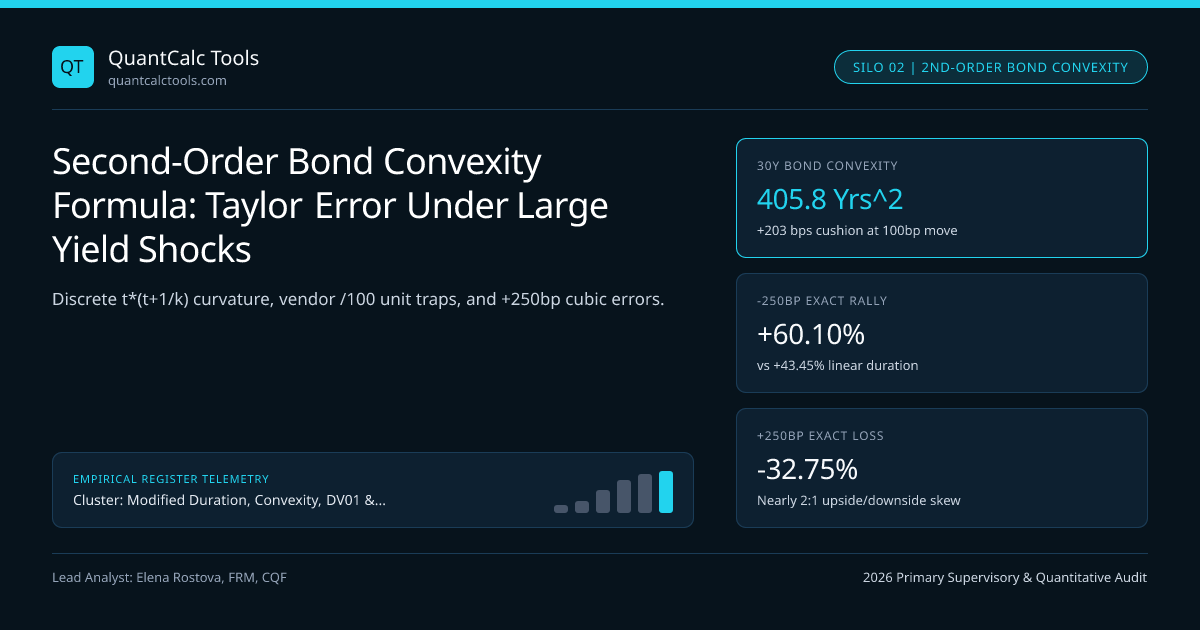
- Exact Re-Priced Bond Value P(1.50%) = 160.10042 => EXACT GAIN = +60.10042%!
- 1) 1st-Order Linear Duration Only: -17.38087 * (-0.025) ........................ = +43.45218% (-16.65% ERROR!)
- 2) 2nd-Order Duration + Convexity: +43.45218% + 0.5 * 405.8115 * (-0.025)^2 .... = +56.13379% (-3.97% ERROR)
- 3) 3rd-Order Cubic Taylor Series: +56.13379% + (1/6)(-11,862.4)(-0.025)^3 ... = +59.22296% (-0.88% close!)
- Scenario B: Massive +250 bps Inflationary Selloff (y jumps 4.00% -> 6.50%, Delta_y = +0.0250):
- Exact Re-Priced Bond Value P(6.50%) = 67.25308 => EXACT LOSS = -32.74692%!
- 1) 1st-Order Linear Duration Only: -17.38087 * (+0.025) ........................ = -43.45218% (Overstates loss by 10.71%!)
- 2) 2nd-Order Duration + Convexity: -43.45218% + 12.68161% ...................... = -30.77057% (+1.98% overshoot)
- 3) 3rd-Order Cubic Taylor Series: -30.77057% - 3.08917% ....................... = -33.85974% (Within 1.11%!)
Examine Scenario A and Scenario B side by side! Across a symmetric $\pm 250\text{ bps}$ rate shock on a 30-year Treasury, exact price rallies $+60.10\%$ yet falls only $-32.75\%$—nearly a 2-to-1 upside-to-downside payoff ratio! Linear duration ($\pm 43.45\%$) misses $+16.65$ percentage points of rally profit and exaggerates selloff losses by $10.71$ percentage points, while second-order convexity captures $76\%$ of the gap (with the negative third derivative $S_3 < 0$ explaining why rallies outperform even quadratic Taylor above $200\text{ bps}$!).
The Mathematical Value of Convexity Under Stochastic Yield Volatility#
By Jensen's Inequality (and Itô's Lemma on $P(yt)$), if yields fluctuate with annual volatility $\sigmay$ around zero drift ($\mathbb{E}[\Delta y] = 0, \mathbb{E}[(\Delta y)^2] = \sigmay^2$), the expected 1-year return gain purely from holding convexity $C$ equals: $$\mathbb{E}\left[\frac{\Delta P}{P}\right]{\text{convexity}} \approx \frac{1}{2}\,C\,\sigmay^2$$ On our 30-year Treasury ($C = 405.8$) in a regime where 30-year yield volatility is $\sigmay = 100\text{ bps} = 0.0100$ per year, convexity generates $0.5 \times 405.8 \times (0.01)^2 = +0.02029 = +20.3\text{ bps}$ of expected annual alpha! That exact formula explains why the 30-year point of the Treasury curve frequently trades at a lower yield (an inverted 10s30s tail) than 20-year bonds: LDI pension funds and convexity desks bid down 30Y yields until the negative yield give-up equals $\frac{1}{2}C\sigma_y^2$!
Quadratic Convexity Cushion & Volatility Breakeven Across Curve Tenors#
| Bond Benchmark (4.00% Initial YTM) | Modified Duration ($D_{mod}$) | Raw Convexity $C$ ($\text{yrs}^2$) | $+100\text{ bps}$ Convexity Cushion | Break-Even Yield Give-Up at $\sigma_y = 100\text{ bps}$ |
|---|---|---|---|---|
| 2-Year US Treasury Note | $1.904$ yrs | $4.57$ | $+2.29\text{ bps}$ | $0.23\text{ bps/yr}$ |
| 5-Year US Treasury Note | $4.491$ yrs | $22.84$ | $+11.42\text{ bps}$ | $1.14\text{ bps/yr}$ |
| 10-Year US Treasury Note (MACAULAY-CONVEXITY-STD) | $8.192$ yrs | $76.15$ | $+38.08\text{ bps}$ | $3.81\text{ bps/yr}$ |
| 30-Year US Treasury Bond | $17.381$ yrs | $405.81$ | $+202.91\text{ bps}$ | $20.29\text{ bps/yr}$ |
| 30-Year Zero-Coupon STRIP | $29.412$ yrs | $879.47$ | $+439.74\text{ bps}$ | $43.97\text{ bps/yr}$ |
Finite-Difference Effective Convexity Formula for Options & Grids#
When cashflows vary with rates, compute Effective Convexity via the second-order central difference $C{eff} = \frac{P{-\Delta y} + P{+\Delta y} - 2P0}{P_0\,(\Delta y)^2}$! Contrast positive option-free curvature with negative convexity in callable bonds and MBS, harvest curvature via DV01-neutral barbell vs bullet immunization, and explore the Modified Duration & Key-Rate Hedging Topic Hub.
Frequently asked questions
Why does Bloomberg report a 10-year Treasury convexity near 0.76 while quantitative textbooks report 76?
Bloomberg divides raw mathematical convexity (1/P * d^2P/dy^2 in decimal yield units, ~76.15 years^2) by 100 so multiplying by (percentage-point yield change)^2 * 0.5 gives percentage price impact directly. Always check units before coding Taylor expansions!
Why is the third-order derivative of an option-free bond negative, and how does that help in rallies?
Differentiating P(y) three times brings down (-i)(-i-1)(-i-2) < 0. In a Taylor expansion +(1/6)*S3*(dy)^3, a negative yield shock (dy < 0) multiplied by negative S3 produces a POSITIVE cubic contribution, accelerating big rally gains even further!
Between two bonds with the exact same Modified Duration, which one has higher convexity?
Convexity equals Macaulay cashflow time-squared expectation plus cashflow dispersion around the mean! Thus a cashflow-dispersed portfolio (such as a low-coupon bond or a 2Y/30Y barbell) always has higher convexity than a concentrated bullet of identical duration.
When should fixed-income risk managers stop trusting Duration-plus-Convexity Taylor approximations?
For maturities <= 10 years, second-order Taylor stays within 5 bps up to +/-150 bps shocks. For 30Y-50Y sovereigns, STRIPS, or callable/MBS bonds, switch to exact cashflow or OAS-tree full revaluation whenever rate scenarios exceed +/-75 bps.
Publication record
- Published
- 14 November 2026
- Updated
- 14 November 2026
- Author
- Elena Rostova, FRM, CQF
- Review
- Review not recorded
- Automated fact check
- Passed in the stored pipeline record
- Source URLs
- 3 recorded
AI assistance recorded: anthropic/claude-opus-4.6. This field does not establish human review or source verification.
Academic & Institutional Attribution
Cite This Research & Embed Live Data Card
Standard academic & institutional research paper citation format.
Elena Rostova, FRM, CQF. (2026, November 14). Second-Order Bond Convexity Formula: Taylor Error Under Large Yield Shocks. QuantCalc Tools. https://quantcalctools.com/guides/second-order-bond-convexity-taylor-series-large-yield-shock-errorRelated Bond Duration Convexity Math & Institutional Briefings
Explore Bond Duration Convexity Math Hub (20) →Bond Duration Convexity Math
Modified Duration, Convexity, DV01 & Key-Rate Hedging: 2026 Quantitative GuideBond Duration Convexity Math
Negative Convexity in Callable Bonds & Agency MBS: OAS Finite-Difference MathBond Duration Convexity Math
DV01-Neutral Barbell vs Bullet Portfolio: Convexity Pickup vs Yield MathBond Duration Convexity Math
Key-Rate Duration (KRD) Tent Functions: Partial DV01 Curve Bucketing MathBond Duration Convexity Math
50/50 vs Regression-Weighted 2s5s10s Butterfly Curve Trades: DV01 MathBond Duration Convexity Math
Cheapest-to-Deliver (CTD) Treasury Futures Conversion Factor & DV01 MathBond Duration Convexity Math
Leveraged Treasury Repo Carry, Curve Rolldown & Breakeven Yield Spike MathBond Duration Convexity Math
Redington Liability Immunization: Duration Matching & Convexity Dispersion MathCovered Interest Parity Forwards
Overnight (O/N), Tom-Next (T/N) & Spot-Next (S/N) T+2 FX Roll MathCovered Interest Parity Forwards
Broken-Date FX Forward Interpolation: Linear Points vs Central-Bank Kink MathCovered Interest Parity Forwards
Quarter-End & Year-End G-SIB Window-Dressing FX Swap Turn Premium MathCovered Interest Parity Forwards
SOFR, ESTR & SONIA OIS Compounded In-Arrears FX Forward Discounting Math
QuantCalc Tools Data, Benchmarks & Contributor Records
CC BY 4.0 Open Data
Open Institutional Datasets (CSV / JSON) →
Download desk-compiled quantitative series & schemas.
2026 Reference Matrix
2026 Institutional Benchmarks & Thresholds →
Statutory capital, clearing, margin & rate conventions.
Editorial Records
Authors & Review Records →
View named contributors where those records are available.
Complete Index
Master Research & Dossier Archive →
Browse all published briefings by topic pillar & date.