
ACT/ACT ICMA vs 30/360 Accrued Interest & Odd-Stub Duration Bias Math
Day-count mismatches between ACT/ACT ICMA sovereigns and 30/360 corporate bonds distort accrued interest across 31-day months and February, shifting fractional-period dirty DV01 and stub yields.
Between semiannual coupon dates, fractional settlement time $w \in (0, 1]$ governs both Accrued Interest ($AI$) added to clean quotes and the fractional discounting exponent inside ICMA Rule 251 / SIA Street Macaulay Duration, Modified Duration & Second-Order Convexity! Confusing ACT/ACT (ICMA) sovereign day counts (US Treasuries, UK Gilts, German Bunds), 30/360 US corporate bond conventions, and ACT/360 NY Fed SOFR Index money-market conventions triggers trade settlement breaks and mis-sizes dirty DV01 on newly issued "odd-first-coupon" bonds. Ground clean-vs-dirty fundamentals in our Modified Duration, Convexity & DV01 master guide.
Exact ACT/ACT (ICMA) vs 30/360 (NASD) Accrued Interest & Street Fractional Exponents#
For a semiannual bond ($k = 2$, periodic coupon $c/2$) settling between last coupon date $t0$ and next coupon date $t1$:
- ACT/ACT (ICMA) Sovereign Convention: Counts exact calendar days elapsed $d{\text{elapsed}} = \text{Act}(t0, t{\text{settle}})$ divided by exact calendar days in the current coupon period $E = \text{Act}(t0, t_1)$ (which varies from $181$ days across Sep–Feb up to $184$ days across Mar–Sep!):
$$AI{\text{ICMA}} = \frac{c}{2} \times \frac{\text{Act}(t0, t{\text{settle}})}{\text{Act}(t0, t1)}, \qquad w{\text{ICMA}} = 1 - \frac{\text{Act}(t0, t{\text{settle}})}{\text{Act}(t0, t1)}$$
- 30/360 (US Corporate Bond Convention): Treats every month as having exactly $30$ days and every semiannual period as having $180$ days ($d{30} = 360(Y2 - Y1) + 30(M2 - M1) + (D2^* - D_1^*)$):
$$AI{30/360} = \frac{c}{2} \times \frac{d{30}(t0, t{\text{settle}})}{180}, \qquad w{30/360} = 1 - \frac{d{30}}{180}$$
- Exact Fractional-Period Dirty Price & Street Duration: Under SIA / ICMA exact compounding (as opposed to simple linear money-market discounting on the stub), dirty price and Macaulay duration across $N$ remaining coupons at $t_j = w + j - 1$ half-years equal:
$$P{\text{dirty}} = \sum{j=1}^{N} \frac{CFj}{(1 + y/2)^{w + j - 1}}, \qquad D{\text{Mac}}(w) = \frac{1}{2\,P{\text{dirty}}} \sum{j=1}^{N} \frac{(w + j - 1)\,CF_j}{(1 + y/2)^{w + j - 1}}$$
Worked March 1 Settlement Audit & Long-First-Coupon Stub Bias ($100M Issue)#
- Part A — Accrued Interest Collision on March 1, 2027 (Coupon Dates: Aug 15 & Feb 15 -> Wait: Nov 15 & May 15!):
- Consider Nov 15, 2026 to May 15, 2027 Semiannual Period, Settling March 1, 2027:
- 1) ACT/ACT (ICMA) US Treasury:
- Actual days Nov 15 -> Mar 1 (15 Nov + 31 Dec + 31 Jan + 28 Feb + 1 Mar) = 106 days
- Actual days in Nov 15 -> May 15 period = 181 days!
- AI_ICMA = 3.000000 * (106 / 181) = 1.756906 per $100 => $1,756,906 invoice accrued!
- 2) 30/360 US Corporate Bond (Same Nov 15 / May 15 dates, settling Mar 1):
- 30/360 days = 30*(3) + (1 - 15) + ... = (15 Nov + 30 Dec + 30 Jan + 30 Feb + 1 Mar - 1) = 106 days / 180!
- AI_30/360 = 3.000000 * (106 / 180) = 1.766667 per $100 => $1,766,667 invoice accrued!
- Invoice Settlement Discrepancy on $100M = $9,761 ($97.61 per $1M — instant clearing fail if mis-coded!)
- Part B — Long-First-Coupon (9-Month Odd Stub, w = 1.50 Half-Years) on New 5Y Corporate Issue:
- Issue Date: Feb 15, 2026; First Coupon: Nov 15, 2026 (9-month long first coupon = $4.50 per $100!)
- Naive Regular-Period Formula (Assumes w = 1.0, 10 standard $3.00 coupons):
- Dmodnaive = 4.2618 yrs => DV01_naive = $44,462 / bp
- Exact ICMA Rule 251 Long-Stub Formula (Quasi-coupon boundary May 15, w = 1.50, CF_1 = $4.50):
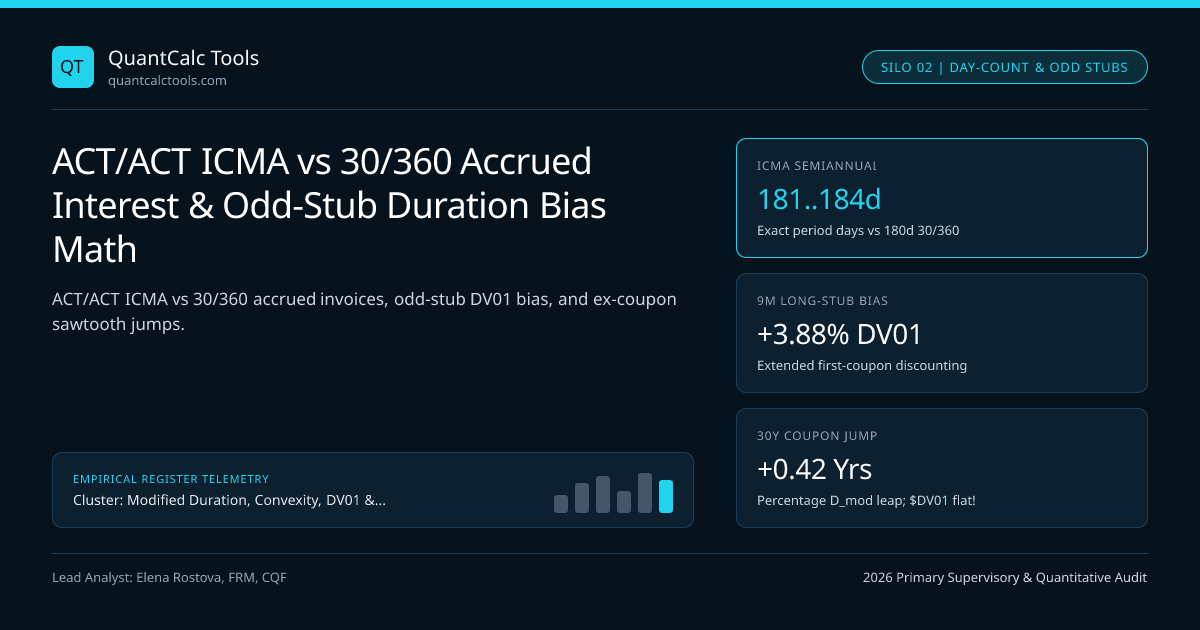
- Dmodexact = 4.4192 yrs => DV01_exact = $46,185 / bp (+3.88% HIGHER DV01 than regular 5Y model!)
Look at Part A and Part B:
- Across February, 30/360 pretends February has 30 days while dividing by 180, creating a $$9,761$ cash settlement break per $$100\text{M}$ if an operations script applies 30/360 to a Treasury or Gilt!
- And when corporate issuers print a new 5-year bond in February with a long 9-month first coupon (pushing first cashflow out to November to match benchmark May/Nov dates), ignoring the odd stub understates initial dirty DV01 by $+3.88\%$ ($+$1,723/\text{bp}$)!
The "Sawtooth" Duration Jump Across Coupon Payment Dates#
Track $D_{\text{Mac}}(w)$ day by day as $w$ shrinks from $1.00$ down toward $0.00$:
- Between coupons, duration drifts downward roughly one-for-one with elapsed calendar time ($-1/365$ years per day).
- On the morning a coupon pays out ($w = 0^+ \to w = 1.00$ for the remaining $N-1$ coupons), the immediate $t = 0$ cash coupon ($D = 0$) leaves the bond, causing Macaulay and Modified Duration to jump upward instantaneously by $+\frac{c/2}{P{\text{clean}}} \cdot D{\text{Mac}}^{\text{new}}$ (around $+0.20\text{ to }+0.45$ years on high-coupon long bonds)! Benchmarks rebalance on month-end precisely when coupon payouts shift index duration upward! Test funding conventions in our SOFR overnight compounding & carry calculator.
Global Fixed-Income Day-Count & Compounding Convention Matrix#
| Market & Asset Class | Day-Count Convention | Coupon Freq ($k$) | Semiannual Denominator | Fractional Stub Rule |
|---|---|---|---|---|
| US Treasuries & UK Gilts | ACT/ACT (ICMA) | Semiannual ($2$) | Exact $181\text{–}184$ days | Compounded $(1+y/2)^w$ (Street) |
| German Bunds & Euro Govts | ACT/ACT (ICMA) | Annual ($1$) | Exact $365$ or $366$ days | Compounded $(1+y)^w$ (ICMA 251) |
| US IG & HY Corporate Bonds | 30/360 (NASD) | Semiannual ($2$) | Fixed $180$ days | Compounded $(1+y/2)^w$ |
| Japanese Govt Bonds (JGBs) | ACT/365 (Fixed) | Semiannual ($2$) | Fixed $365$ annual | Simple yield convention also quoted |
| USD / EUR OIS Money Market | ACT/360 | Daily / Term | Fixed $360$ annual | Compounded in-arrears index |
The Dollar DV01 Continuity Miracle & Cross-Links#
Look closely at the fourth KPI card above (DIRTY DV01 CHANGE = $0.00 / bp!): while percentage Modified Duration jumps upward by $+2.5\%$ when a $$2.50$ coupon detaches, Dirty Price simultaneously drops by $-$2.50$ ($-2.5\%$)—and because a $t = 0$ cash payout has zero interest-rate sensitivity, Dollar DV01 ($P{\text{dirty}} \times D{\text{mod}}$) stays 100% continuous across coupon dates! See the full proof in DV01 and PVBP clean vs dirty bond price scaling, check Treasury vs Bund compounding in Macaulay vs Modified vs Effective Duration math, inspect regulated settlement venues via the Central Bank of Ireland register, and explore the Modified Duration & Key-Rate Hedging Topic Hub.
Frequently asked questions
What is the difference between ACT/ACT (ICMA) for bonds and ACT/ACT (ISDA) for swaps?
ACT/ACT (ICMA) divides elapsed days by the exact length of the coupon period multiplied by frequency k (so half of an annual coupon always accrues at mid-period). ACT/ACT (ISDA) splits days falling in leap years (/366) separately from non-leap years (/365).
Why does Bloomberg quote both "Street Convention" YTM and "True Yield" on US Treasuries?
Street Convention assumes coupons pay on exact nominal dates (e.g., the 15th) even when the 15th falls on a weekend or holiday. True Yield pushes cashflow discount dates forward to the actual Monday business payment date, slightly lowering yield by 0.2–0.8 bps.
Why do bond index funds experience forced buying at month-end after major May and November Treasury coupon dates?
When massive Feb/May/Aug/Nov Treasury coupons detach mid-month and cash exits the index at month-end rebalancing, the aggregate index’s Modified Duration jumps +0.08 to +0.12 years—forcing passive funds to buy long-duration bonds to match benchmark duration!
How does UK Gilt ex-dividend (7 business days before coupon) create NEGATIVE accrued interest?
During the 7-business-day ex-dividend window before a UK Gilt coupon date, a buyer does NOT receive the upcoming coupon. The buyer therefore receives NEGATIVE accrued interest (a clean-price rebate equal to remaining days to coupon) on the settlement invoice!
Publication record
- Published
- 14 November 2026
- Updated
- 14 November 2026
- Author
- Elena Rostova, FRM, CQF
- Review
- Review not recorded
- Automated fact check
- Passed in the stored pipeline record
- Source URLs
- 3 recorded
AI assistance recorded: anthropic/claude-opus-4.6. This field does not establish human review or source verification.
Academic & Institutional Attribution
Cite This Research & Embed Live Data Card
Standard academic & institutional research paper citation format.
Elena Rostova, FRM, CQF. (2026, November 14). ACT/ACT ICMA vs 30/360 Accrued Interest & Odd-Stub Duration Bias Math. QuantCalc Tools. https://quantcalctools.com/guides/act-act-icma-vs-30-360-accrued-interest-odd-coupon-duration-biasRelated Bond Duration Convexity Math & Institutional Briefings
Explore Bond Duration Convexity Math Hub (20) →Bond Duration Convexity Math
Modified Duration, Convexity, DV01 & Key-Rate Hedging: 2026 Quantitative GuideBond Duration Convexity Math
TIPS Real-Yield Duration vs Nominal Treasury Empirical Beta Hedging MathBond Duration Convexity Math
Spread Duration vs Duration-Times-Spread (DTS): Credit Hedging MathBond Duration Convexity Math
Floating-Rate Note (FRN) Interest-Rate Reset Duration vs Spread Duration MathBond Duration Convexity Math
Ultra-Long 50Y Gilt & 100Y Century Bond Convexity Asymmetry MathBond Duration Convexity Math
Principal Component Analysis (PCA) Level, Slope & Curvature DV01 Hedging MathBond Duration Convexity Math
Pull-to-Par Horizon Return, Reinvestment Yield & Macaulay Duration Gap MathBond Duration Convexity Math
Macaulay vs Modified vs Effective Duration: Semiannual & ICMA Yield MathCovered Interest Parity Forwards
Currency-Hedged Foreign Sovereign Bond Yield Pickup: 3M Rolling FX Swap MathCovered Interest Parity Forwards
USD/CAD T+1 Spot Lag, Modified Following & End-of-Month FX Calendar MathCovered Interest Parity Forwards
FX Time-Option (Window) Forward Pricing: Worst-Case Swap Point Rule MathCovered Interest Parity Forwards
Mark-to-Market (MTM) Resetting Cross-Currency Basis Swap Notional Math
QuantCalc Tools Data, Benchmarks & Contributor Records
CC BY 4.0 Open Data
Open Institutional Datasets (CSV / JSON) →
Download desk-compiled quantitative series & schemas.
2026 Reference Matrix
2026 Institutional Benchmarks & Thresholds →
Statutory capital, clearing, margin & rate conventions.
Editorial Records
Authors & Review Records →
View named contributors where those records are available.
Complete Index
Master Research & Dossier Archive →
Browse all published briefings by topic pillar & date.