
Hedge Fund 2-and-20 Fee Drag, High-Water Mark & Hurdle Net CAGR Math
Because annual 20% incentive fees crystallize on up years without rebating losses on down years, a volatile fund with +10% gross CAGR can pay 48% of its cumulative 10-year gains in fees!
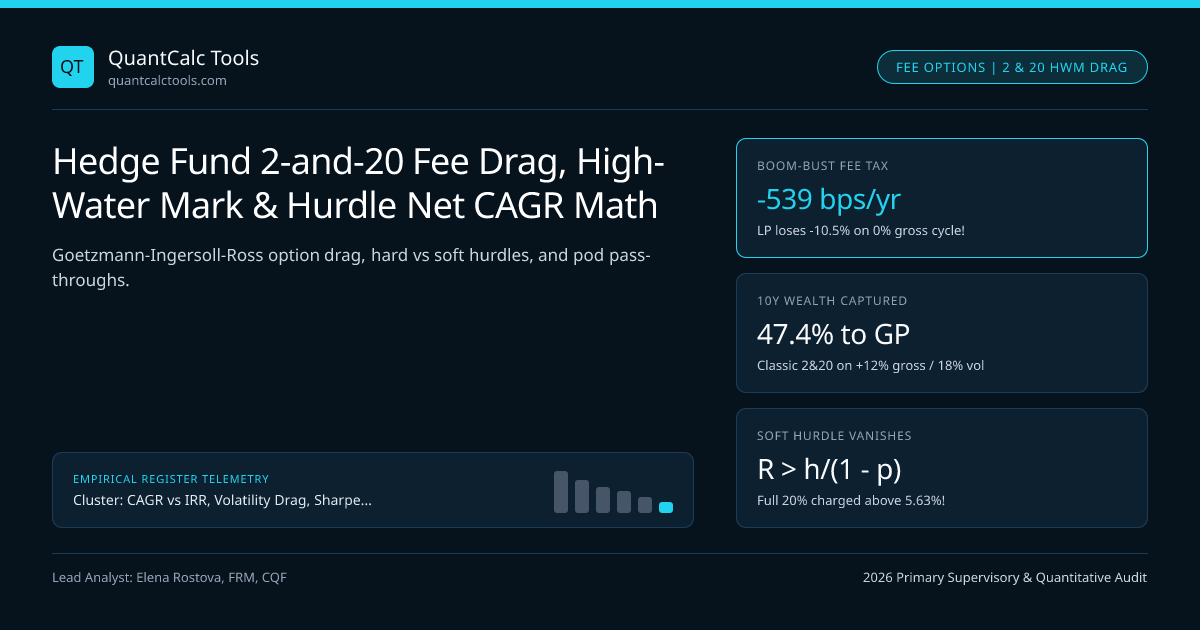
Ask a casual allocator how much a classic "2-and-20" hedge fund (2.0% management fee + 20.0% performance fee) subtracts from a +10.0% long-run gross CAGR, and nine out of ten will guess dynamically: "10% minus 2% leaves 8%, minus 20% of 8% (1.6%) leaves +6.40% net CAGR (360 bps fee drag)." That linear back-of-the-envelope calculation understates actual multi-year fee drag whenever returns are volatile! As Nobel laureate Robert Merton and Goetzmann, Ingersoll & Ross (2003) proved using Black-Scholes option pricing (BSM Implied Vol Engine), an annual-crystallizing incentive contract with a High-Water Mark (HWM) is a sequence of resetting at-the-money call options whose value increases with volatility—meaning a fund can earn $0.00$ net cumulative LP profit across a boom-bust cycle while keeping millions in crystallized Year-1 incentive fees! Audit net compounding in our CAGR Calculator and CAGR, IRR & Drawdown Hub.
Exact Path-Dependent High-Water Mark, Hard Hurdle vs Soft Hurdle Catch-Up Math#
Track LP unit NAV $Nt$ and running High-Water Mark $Ht = \max{0 \le s \le t} Ns$ across annual crystallization dates. Management fee $m$ (1.5%–2.0%) is deducted unconditionally regardless of loss, reducing gross return $R{g,t}$ to pre-incentive value $Nt^{} = N{t-1}(1 + R{g,t})(1 - m)$ (or $N{t-1}(1 + R{g,t} - m)$). Next, distinguish carefully between No Hurdle, Hard Hurdle* (LP keeps all gains up to SOFR $h$, GP takes $p = 20\%$ strictly above $h$), and Soft Hurdle with 100% Catch-Up (common in private credit/PE, where once $R > h$, GP catches up to $20\%$ of entire profit!):
- Pre-Incentive NAV : Nt* = N{t-1} * (1 + R_{g,t} - m)
- Hurdle Benchmark Base : Bt = max( H{t-1}, N{t-1} * (1 + hhard) ) [If non-compounding annual hard hurdle; compounding HWM scales H_{t-1}*(1+h)!]
- 1. Hard Hurdle Fee : Feeperf,t = p * max( 0, Nt* - B_t )
- 2. Soft Hurdle (100% Catch-Up above h, rate p = 20% => full catch-up at h / (1 - p) = 1.25*h):
- GainHWM = max(0, Nt* - H{t-1}); HurdleDollar = H_{t-1} * h
- If GainHWM <= HurdleDollar : Fee_perf,t = 0
- Else : Feeperf,t = min( p * GainHWM, GainHWM - HurdleDollar )
- Post-Fee LP NAV & New HWM: Nt = Nt* - Feeperf,t; Ht = max( H{t-1}, Nt )
- Worked 2-Year Boom-Bust Asymmetry Proof ($100.00 Start, 2% Mgmt / 20% Perf, No Hurdle, Gross +50% then -33.33%):
- Gross Unfee'd Portfolio: $100 * 1.50 * (2/3) = $100.00 (Exact 0.00% Gross CAGR! Zero true value created!)
- Year 1 (+50.00% Gross) : N_1* = $100 * (1 + 0.50 - 0.02) = $148.00 (above $100 HWM by +$48.00)
- Incentive Fee = 20% * $48.00 = $9.60 crystallized in cash! -> LP N_1 = $138.40 (New HWM = $138.40)
- Year 2 (-33.33% Gross) : N_2* = $138.40 * (1 - 0.33333 - 0.02) = $138.40 * 0.64667 = $89.50! (Perf Fee = $0, NO clawback!)
- Result: Gross strategy broke even ($100.00), yet GP pocketed +$14.37 in fees and LP sits at $89.50 (-5.39%/yr Net CAGR -> -539 bps/yr drag!)
Look at that 2-year path: the underlying portfolio went $100 -> $150 -> $100 (0.00% gross return), yet the investor lost $-10.50\%$ of principal (-539 bps/yr fee drag!) because the GP crystallized $9.60 of performance fees at the Year-1 peak and kept every penny when Year 2 erased the gain! Even worse, if the GP shuts down the fund at $89.50 and launches "Fund II" with a fresh $100 High-Water Mark, the LP loses the unamortized $48.90 HWM deficit forever!
Hard Hurdle vs Soft Hurdle vs Multi-Manager Pass-Through Fee Structures#
In a 4.50% SOFR rate environment, a hedge fund WITHOUT a risk-free hurdle charges a $20\%$ "alpha fee" on pure Treasury-bill cash interest! Compare effective LP net CAGRs across five real institutional fee contracts assuming $+12.0\%$ Gross CAGR at $18\%$ volatility over 10 years:
10-Year Net LP Compounding Across Five Institutional Hedge Fund Fee Contracts#
Measure how management fees, SOFR hard hurdles, soft catch-ups, and pod pass-throughs split gross compounding:
| Institutional Fee Structure | Mgmt Fee / Pass-Thru | Hurdle Type ($h = 4.5\%$ SOFR) | 10-Yr LP Net CAGR | GP Share of Gross Excess Gain | Institutional Allocator Verdict |
|---|---|---|---|---|---|
| Institutional "1-and-15" + Hard SOFR | $1.00\%$ | Compounding Hard SOFR | $+9.62\%$ | $23.8\%$ | Gold-standard institutional alignment |
| Founders Class "1.5-and-20" Soft | $1.50\%$ | Soft ($100\%$ GP catch-up) | $+8.38\%$ | $39.4\%$ | Hurdle vanishes above $5.63\%$ return! |
| Classic Legacy "2-and-20" (No Hurdle) | $2.00\%$ | None ($0.0\%$) | $+7.74\%$ | $46.8\%$ | Charges $20\%$ on risk-free T-bills! |
| Multi-Year Clawback / 3y Rolling Fee | $1.50\%$ | Hard SOFR + 3y Escrow | $+9.35\%$ | $27.1\%$ | Eliminates 1-year boom-bust option |
| Multi-Strategy Pod Pass-Through | $5.50\%$ pass-thru | Un-netted pod payouts ($20\%+$) | $+4.95\%$ | $68.2\%$ | Viable ONLY if Gross SR $> 2.50$ (+18% gross)! |
Expose the "Soft Hurdle with 100% Catch-Up" Illusion Before Signing Side Letters#
Many fund Offering Memoranda advertise a "5.0% Hurdle Rate" in bold print on Page 1 while burying "subject to a 100% General Partner Catch-Up" in Footnote 14. Check the algebra in Formula 2 above: between $5.00\%$ and $5.00\% / (1 - 0.20) =$ $6.25\%$, $100\%$ of every marginal dollar goes strictly to the GP until the GP reaches $20\%$ of ALL profits from $0.00\%$ upward! Above $6.25\%$, a Soft Hurdle with $100\%$ catch-up pays the exact same dollar fee down to the cent as having ZERO hurdle at all!
Institutional Side-Letter Protections & Equalization Accounting#
Always negotiate compounding hard hurdles indexed to NY Fed SOFR plus multi-year crystallization or loss-recovery accounts, combine net-of-fee CAGR audits with after-tax Fisher real CAGR math and hyperbolic drawdown HWM clocks, and verify fund regulatory registrations on the Central Bank of Ireland and UK FCA registers.
Frequently asked questions
What is "equalization accounting" (or series-of-shares accounting) in hedge fund High-Water Marks?
Suppose a fund drops from $100 HWM to $80 NAV and a NEW investor subscribes at $80. Without equalization shares or deficit adjustments, if the fund rebounds from $80 to $100 (+25%), the new investor would enjoy a +25% free ride with $0 performance fee! Equalization issues separate share series or depreciation deposits so each investor pays 20% strictly above their personal entry HWM.
Why do multi-strategy pod shops charge investors performance fees even in a year when the overall fund loses money?
Under un-netted pass-through expense terms, if Pod A makes +$50M and Pod B loses -$55M (net fund loss -$5M before overhead), Pod A’s portfolio manager still collects their contractual 20% payout ($10M) passed through as a fund operating expense—leaving LPs down -$15M before desk technology costs!
What is a "Modified High-Water Mark" (or multi-year amortizing HWM) in institutional side letters?
In exchange for a lower 1.0% management fee and 10%–15% incentive rate, some institutional side letters allow a deep HWM deficit to amortize over 3–5 years (or require 50% of post-trough profits to pay down the loss recovery account first) so the manager is not tempted to shut the fund and walk away after a -30% drawdown.
How does an European-style waterfall in Private Equity avoid the hedge fund annual crystallization trap?
In a whole-fund European PE waterfall, the GP receives ZERO carried interest until LPs have received 100% of ALL contributed capital (plus fees and an 8% compounded preferred return) back in cash—preventing early Year-2 wins from generating un-clawed incentive payouts if Year-5 holdings fail.
Publication record
- Published
- 13 November 2026
- Updated
- 14 November 2026
- Author
- Elena Rostova, FRM, CQF
- Review
- Review not recorded
- Automated fact check
- Passed in the stored pipeline record
- Source URLs
- 4 recorded
AI assistance recorded: anthropic/claude-opus-4.6. This field does not establish human review or source verification.
Academic & Institutional Attribution
Cite This Research & Embed Live Data Card
Standard academic & institutional research paper citation format.
Elena Rostova, FRM, CQF. (2026, November 14). Hedge Fund 2-and-20 Fee Drag, High-Water Mark & Hurdle Net CAGR Math. QuantCalc Tools. https://quantcalctools.com/guides/hedge-fund-2-and-20-high-water-mark-hurdle-net-cagr-erosion-mathRelated Cagr Irr Drawdown Compounding & Institutional Briefings
Explore Cagr Irr Drawdown Compounding Hub (20) →Cagr Irr Drawdown Compounding
CAGR vs IRR, Volatility Drag, Sharpe/Sortino & Drawdown Recovery: 2026 GuideCagr Irr Drawdown Compounding
Treynor Ratio, Jensen’s Alpha & Modigliani M-Squared (M2) Leverage MathCagr Irr Drawdown Compounding
Continuous Log Returns vs Simple Returns: Time Additivity vs Asset WeightsCagr Irr Drawdown Compounding
Fisher Exact Real CAGR, Inflation & Annual Tax Drag Compounding MathCagr Irr Drawdown Compounding
Arithmetic vs Geometric Mean Return: 0.5*Sigma^2 Variance Drain DerivationCagr Irr Drawdown Compounding
TWRR (CAGR) vs MWRR (XIRR): Irregular Cashflow Timing Divergence MathCagr Irr Drawdown Compounding
XIRR Newton-Raphson Convergence, Descartes Multiple Roots & MIRR MathCagr Irr Drawdown Compounding
Asymmetric Drawdown Recovery Hyperbola & Breakeven Compounding Time MathKelly Margin Leverage Sizing
Repo Haircut, Rehypothecation Multiplier & Leveraged Bond Carry MathKelly Margin Leverage Sizing
Black-Litterman Posterior Expected Return & Bayesian Kelly Sizing MathKelly Margin Leverage Sizing
Guaranteed Stop-Loss Order (GSLO) Premium vs Gap Slippage & Option MathMarket Insights
Cboe Global Markets (CBOE) Earnings Strength Keeps Valuation Debate In Focus - Yahoo Finance
QuantCalc Tools Data, Benchmarks & Contributor Records
CC BY 4.0 Open Data
Open Institutional Datasets (CSV / JSON) →
Download desk-compiled quantitative series & schemas.
2026 Reference Matrix
2026 Institutional Benchmarks & Thresholds →
Statutory capital, clearing, margin & rate conventions.
Editorial Records
Authors & Review Records →
View named contributors where those records are available.
Complete Index
Master Research & Dossier Archive →
Browse all published briefings by topic pillar & date.