
XIRR Newton-Raphson Convergence, Descartes Multiple Roots & MIRR Math
Standard XIRR Newton-Raphson loops diverge past the r = -100% singularity or return arbitrary roots when cashflows flip sign twice; master Brent-Newton solvers and closed-form MIRR.
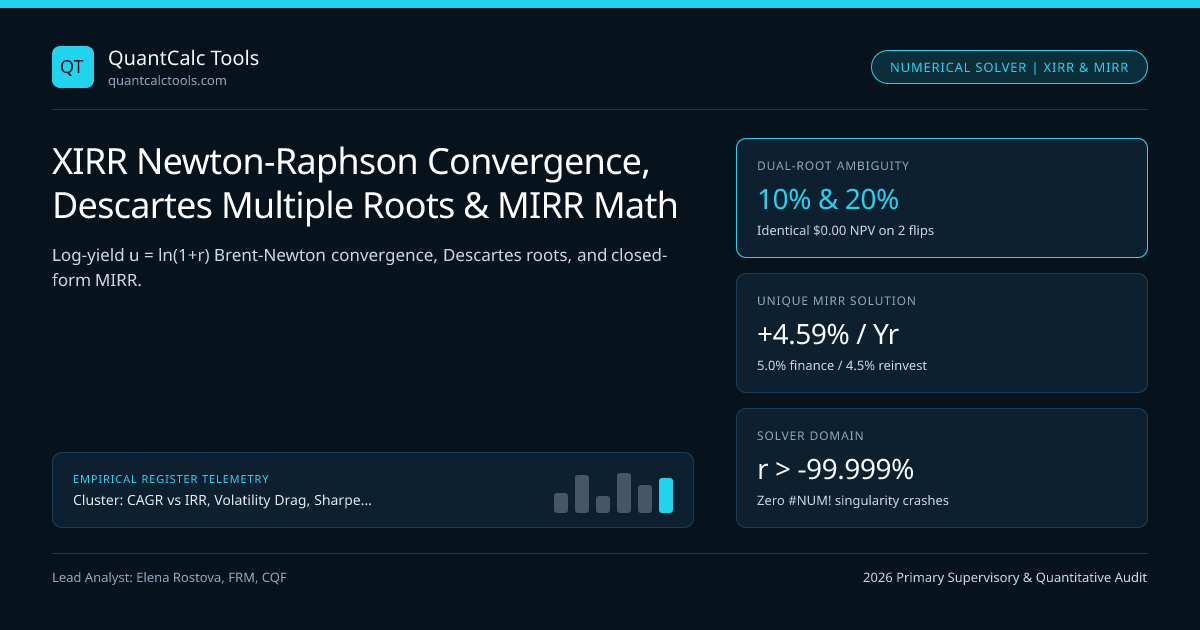
Portfolio analytics engineers building automated performance dashboards inevitably encounter two classic failures in standard spreadsheet XIRR implementations: first, Newton-Raphson iteration explodes into #NUM! or NaN whenever a tangent step overshoots the $r = -100\%$ singularity (where $(1 + r)^{-t_k}$ attempts fractional powers of a negative number); second, structured-product, mining, or leveraged margin accounts whose external cashflows change sign more than once possess multiple mathematically valid real IRRs (or zero real IRRs) by Descartes' Rule of Signs. Compare pure geometric benchmarks in our CAGR Calculator and review our CAGR, IRR & Drawdown Hub.
Stabilizing XIRR via Log-Yield Variable Substitution ($u = \ln(1 + r)$)#
Why does naive Newton-Raphson iteration on $f(r) = \sum{k=0}^M CFk (1 + r)^{-tk} = 0$ (where $tk = (dk - d0)/365$) fail so frequently? Because $f(r)$ has a vertical asymptote at $r \to -1^{+}$! If your initial guess is $r0 = +0.10$ on an account that lost $-75\%$, the first linear tangent step $r1 = r0 - f(r0)/f'(r0)$ frequently lands at $r1 = -1.18 < -1.0$, immediately throwing a complex-number domain error.
Transforming to continuous log-yield $u = \ln(1 + r) \in (-\infty, +\infty)$ so that $1 + r = e^u$ completely removes the $-100\%$ domain boundary (just as our Newton-Raphson Implied Volatility Solver safeguards option root-finding) and renders $g(u) = \sum CFk e^{-u tk}$ infinitely differentiable everywhere on $\mathbb{R}$:
- Let tk = (dk - d_0) / 365, u = ln(1 + r) <=> r = exp(u) - 1
- Objective : g(u) = Sum{k=0..M} [ CFk * exp(-u * t_k) ] = 0
- Derivative : g'(u) = -Sum{k=0..M} [ tk * CFk * exp(-u * tk) ]
- Newton Step: u{n+1} = un - g(un) / g'(un) (fallback to Brent bisection if |g'(u_n)| < 1e-12)
- Closed-Form Modified Internal Rate of Return (MIRR, Unique Single Root Always!):
- PVneg (at financing rate rfin) = Sum{CFk < 0} [ |CFk| / (1 + rfin)^t_k ]
- FVpos (at reinvest rate rreinv) = Sum{CFk > 0} [ CFk * (1 + rreinv)^(T - t_k) ]
- MIRR = ( FVpos / PVneg )^(1 / T) - 1
- Worked Dual-Root Cashflow Stream (2 Sign Changes: - -> + -> -):
- t = 0.0y: -$1,000,000 (Initial outlay)
- t = 1.0y: +$2,300,000 (Interim distribution)
- t = 2.0y: -$1,320,000 (Decommissioning / margin clawback)
- Polynomial: -1.00 + 2.30/(1+r) - 1.32/(1+r)^2 = 0 => (1+r)^2 - 2.30*(1+r) + 1.32 = 0
- Exact Roots: (1+r - 1.10)*(1+r - 1.20) = 0 => BOTH XIRR1 = +10.00% AND XIRR2 = +20.00% give NPV = $0.00!
- Unique MIRR Fix (rfin = 5.0% SOFR+spread, rreinv = 4.5% Treasury bill):
- PV_neg = 1,000,000 + 1,320,000 / 1.05^2 = $2,197,279
- FV_pos = 2,300,000 * 1.045^1 = $2,403,500
- MIRR = sqrt(2,403,500 / 2,197,279) - 1 = +4.59% / year (Unambiguous, realistic economic return!)
Look at that dual-root trap: $f(r)$ is negative below $+10\%$, rises to become positive strictly between $+10.0\%$ and $+20.0\%$ (peaking at $+\$2{,}500$ NPV at $r = +14.89\%$), and turns negative again above $+20.0\%$! Depending on whether a spreadsheet initializes at $r0 = 0\%$ or $r0 = 25\%$, it silently reports either $+10.00\%$ or $+20.00\%$ on the exact same ledger—whereas MIRR (+4.59%) resolves the economic return uniquely without iteration!
The Implicit Reinvestment Fallacy Inside High-IRR Projects#
Even when a cashflow stream has only one sign change ($S = 1$, guaranteeing a unique real XIRR whenever $\sum{k} CFk$ has a valid crossing), XIRR embeds an aggressive mathematical assumption: interim positive cash distributions $CF_k > 0$ appear discounted at XIRR itself, which is algebraically equivalent to assuming interim distributions can be reinvested externally at the same high XIRR through maturity $T$. If an early-stage venture fund returns $2\times$ capital in Year 1 (XIRR = +65%) and drips tiny distributions through Year 8, XIRR credits the investor as if Year 1 cash kept compounding at $+65\%$/yr rather than earning $4.5\%$ in SOFR money-market funds (SOFR Carry Calculator).
Numerical Stability & Reinvestment Matrix Across IRR Solver Architectures#
Compare domain safety near $r \to -100\%$, multi-root handling, and interim cash reinvestment realism across solvers:
| Solver / Metric Method | Singularity Safe ($r \to -1$)? | Handles $S \ge 2$ Sign Flips? | Interim Reinvestment Rate Assumption | Institutional Standard |
|---|---|---|---|---|
Naive Spreadsheet XIRR | No (crashes if tangent $< -1$) | Silent arbitrary single root! | Reinvests at internal XIRR | Retail quick check only |
| Log-Space Brent-Newton XIRR | Yes ($u \in [-15, +15]$) | Enumerates all real roots | Reinvests at internal XIRR | Quant portfolio engine |
Modified IRR (MIRR) | Yes (closed-form nth root) | Yes (strictly unique root) | Explicit $r{\text{reinv}}$ (e.g., SOFR) & $r{\text{fin}}$ | Corporate treasury & PE audit |
Sub-Period TWRR (CAGR) | Yes (product of $1+R_k$) | Yes (requires pre-flow NAVs) | Full portfolio stay-invested | GIPS liquid fund standard |
Day-Count Nuance: ACT/365F vs Exact Calendar Years in XIRR Engines#
Standard spreadsheet XIRR hardcodes $(dk - d0) / 365$ regardless of leap years. Over a single leap year (366 days from Jan 1, 2024 to Jan 1, 2025), a $+10.00\%$ simple annual return solves to $(1.10)^{365/366} - 1 = 9.971\%$ in XIRR. Institutional performance engines document whether their calendar exponent uses ACT/365F, ACT/365.25, or ACT/ACT ISDA in their methodology disclosures.
Implementation Rules for Production Portfolio Engines#
- Always Run Sign-Change Pre-Flight: Reject streams where all $CFk \ge 0$ or all $CFk \le 0$ immediately, and trigger an automatic
MIRRcompanion alert whenever sign flips $S \ge 2$. - Pair With TWRR and Dietz Approximations: Cross-verify investor XIRR against TWRR vs XIRR flow timing math and Simple vs Modified Dietz cashflow weighting, and check compliant return reporting across UK FCA and Central Bank of Ireland regimes.
Frequently asked questions
Why does a cashflow stream of -$100 (Yr 0), +$200 (Yr 1), -$150 (Yr 2) have NO real IRR at all?
Check the quadratic -(1+r)^2 + 2*(1+r) - 1.5 = 0: its discriminant is b^2 - 4ac = 4 - 6 = -2 < 0! For every real discount rate r > -100%, the Net Present Value is strictly negative (peaking at -$50 when r = 0%), so NPV never crosses zero and XIRR has only complex-conjugate roots.
What financing and reinvestment rates should be plugged into Modified IRR (MIRR)?
For institutional treasury or private-fund evaluation, set financing rate r_fin equal to the committed credit-line or margin borrowing cost (e.g., SOFR + 150 bps) and set reinvestment rate r_reinv equal to the liquid benchmark or cash sweep yield (e.g., risk-free Treasury bill yield or public benchmark CAGR).
How many iterations does a hybrid Brent-Newton solver in u = ln(1+r) space require?
Scanning 40 coarse grid points over u in [-6, +4] (covering r from -99.75% to +5,359%) brackets every economically relevant sign crossing in microseconds, after which safeguarded Newton-Raphson reaches 1e-12 precision in 4 to 6 iterations with zero division-by-zero failures.
Does Excel XIRR depend on the chronological ordering of rows in the input array?
Interestingly, Excel’s legacy XIRR anchors t_0 to the FIRST date in the dates array (values[1], dates[1]) even if an earlier date appears lower down! Production engines always sort (date, cashflow) pairs chronologically and net same-day cashflows before solving.
Publication record
- Published
- 13 November 2026
- Updated
- 14 November 2026
- Author
- Elena Rostova, FRM, CQF
- Review
- Review not recorded
- Automated fact check
- Passed in the stored pipeline record
- Source URLs
- 4 recorded
AI assistance recorded: anthropic/claude-opus-4.6. This field does not establish human review or source verification.
Academic & Institutional Attribution
Cite This Research & Embed Live Data Card
Standard academic & institutional research paper citation format.
Elena Rostova, FRM, CQF. (2026, November 14). XIRR Newton-Raphson Convergence, Descartes Multiple Roots & MIRR Math. QuantCalc Tools. https://quantcalctools.com/guides/xirr-newton-raphson-convergence-multiple-roots-modified-mirr-fixRelated Cagr Irr Drawdown Compounding & Institutional Briefings
Explore Cagr Irr Drawdown Compounding Hub (20) →Cagr Irr Drawdown Compounding
CAGR vs IRR, Volatility Drag, Sharpe/Sortino & Drawdown Recovery: 2026 GuideCagr Irr Drawdown Compounding
Asymmetric Drawdown Recovery Hyperbola & Breakeven Compounding Time MathCagr Irr Drawdown Compounding
Sharpe Ratio IID Annualization Trap & Lo (2002) Autocorrelation HaircutCagr Irr Drawdown Compounding
Sortino Ratio & Target Downside Semi-Deviation (MAR): Exact LPM2 MathCagr Irr Drawdown Compounding
Calmar, Sterling & Ulcer Performance Index: Path-Dependent Drawdown MathCagr Irr Drawdown Compounding
Omega Ratio Threshold Partition (LPM1): Full-Distribution Skew & Kurtosis MathCagr Irr Drawdown Compounding
Probabilistic & Deflated Sharpe Ratio (DSR): Backtest Multiple-Testing MathCagr Irr Drawdown Compounding
Sequence-of-Returns Risk & Withdrawal Depletion: Breaking CAGR InvarianceKelly Margin Leverage Sizing
Drawdown-Constrained Fractional Kelly: Exact Probability of X% Loss MathKelly Margin Leverage Sizing
UK FCA COBS 22.5 & ESMA Retail Leverage Caps & 50% Margin Close-Out MathKelly Margin Leverage Sizing
Isolated Margin vs Cross-Margin Liquidation & Bankruptcy Price FormulasKelly Margin Leverage Sizing
CME SPAN 2 Historical VaR Margin & Futures Maintenance Top-Up Math
QuantCalc Tools Data, Benchmarks & Contributor Records
CC BY 4.0 Open Data
Open Institutional Datasets (CSV / JSON) →
Download desk-compiled quantitative series & schemas.
2026 Reference Matrix
2026 Institutional Benchmarks & Thresholds →
Statutory capital, clearing, margin & rate conventions.
Editorial Records
Authors & Review Records →
View named contributors where those records are available.
Complete Index
Master Research & Dossier Archive →
Browse all published briefings by topic pillar & date.