
Covered Interest Parity Forwards
Mark-to-Market (MTM) Resetting Cross-Currency Basis Swap Notional Math
Standard constant-notional 10-year cross-currency swaps accumulate massive unhedged FX principal exposure when spot moves 25%; interdealer MTM Resetting XCCY Swaps reset USD notional every quarter.
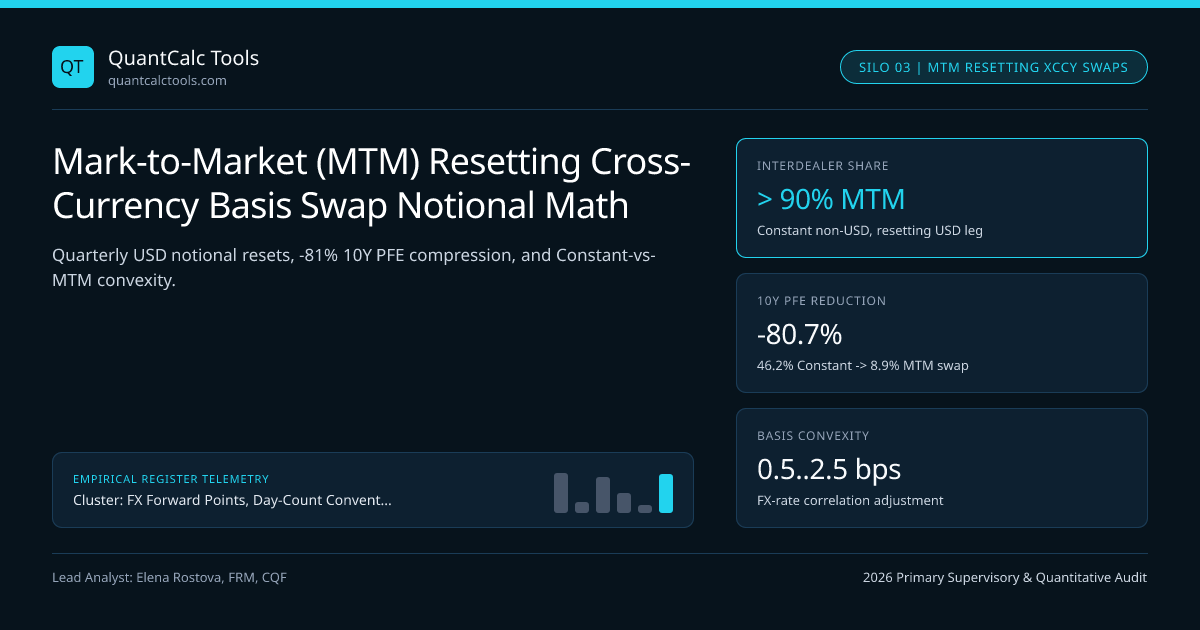
Suppose two banks enter a 10-year Constant-Notional USD/JPY Cross-Currency Basis Swap when Spot is 110.00 ($100M USD vs ¥11.0B JPY), and four years later USD/JPY surges to 154.00 (¥11.0B is now worth only $71.43M USD)! The bank receiving Yen principal at Year 10 now holds a $$28,570,000$ Potential Future Exposure (PFE) credit balloon, exploding Basel SA-CCR counterparty capital and Credit Valuation Adjustment (CVA)! To eliminate multi-year FX credit balloons, over $90\%$ of interdealer G10 Cross-Currency Basis Swaps trade as Mark-to-Market (MTM / Resettable) Cross-Currency Swaps! Test daily SOFR legs in our SOFR overnight compounding & carry calculator and ground short-end swap math in our Covered Interest Parity & FX Forward Points master guide.
Exact Quarterly Notional Reset Cashflow Mechanics of an MTM XCCY Swap#
In an interdealer MTM EUR/USD or USD/JPY Cross-Currency Basis Swap, the Non-USD Notional ($N_f$, e.g. €100,000,000 or ¥15,000,000,000) stays CONSTANT for all 10 years, while the USD Leg Notional ($N_{\text{USD},j}$) RESETS EVERY QUARTER to match the prevailing FX spot fixing $S_j$:
- Start of Quarter $j$ ($t{j-1}$, Spot Fixing $S{j-1}$): Active USD Notional is set to $N{\text{USD},j} = Nf \cdot S{j-1}$ (for
EUR/USD; or $Nf / S_{j-1}$ forUSD/JPY). - End of Quarter $j$ ($tj$, New Spot Fixing $Sj$):
- Counterparties exchange quarterly compounded floating interest: $Nf \cdot \alpha{f,j}(R{\text{RFR},f} + x{\text{basis}})$ vs $N{\text{USD},j} \cdot \alpha{\text{USD},j}\,R_{\text{SOFR}}$.
- AND they wire a Quarterly USD Principal Reset Cashflow equal to the exact FX mark-to-market change:
$$\text{USD MTM Reset Cashflow at } tj = Nf \times (Sj - S{j-1}) \quad \text{(for EUR/USD; paid by USD-receiver when EUR rallies!)}$$
- Result: Immediately after each quarterly reset $tj$, the swap's FX principal mark-to-market snaps back to
$0.00—turning a 10-year cross-currency swap into a **10-year strip of auto-rolling 3-month FX swaps with a locked basis spread $x{\text{basis}}$**!
Worked €100M 5-Year Constant-Notional vs MTM Resetting XCCY Swap Audit#
- Quarter 1 Shock: EUR/USD Rallies +650 Pips from S0 = 1.0800 to Q1 Spot Fixing S1 = 1.1450 (+6.02% move!)
- Rates: Q1 Compounded SOFR = 4.55% (91/360); Q1 Compounded ESTR = 2.65% (91/360); Locked Basis = -20.0 bps
- 1) Constant-Notional XCCY Swap (Corporate Issuer Standard — Fixed €100M vs Fixed $108.00M for all 5 Years):
- Q1 Interest Exchanged: Receive €619,306 [€100M(2.65%-0.20%)91/360] vs Pay $1,242,150 [$108M4.55%91/360]
- Q1 Principal Reset Cashflow = $0.00!
- Unsettled Swap Mark-to-Market Balloon = €100M*(1.1450) - $108.00M = +$6,500,000 Credit / VM Exposure!
- Notice: USD interest continues accruing on STALE $108.00M instead of €100M’s true $114.50M value!
- 2) Interdealer MTM Resetting XCCY Swap (Interbank Standard — Fixed €100M vs Resetting USD Leg!):
- Q1 Interest Exchanged: Identical in Q1 (since Q1 USD notional started at $108.00M)
- Q1 Principal MTM Reset Wire: USD Payer wires -$6,500,000 USD -> New Q2 USD Notional = $114,500,000!
- Post-Reset Swap FX MTM = $0.00! (Peak FX PFE Capped at 3-Month Volatility vs 5-Year Volatility -> -55% PFE!)
- Q2 USD Interest Now Accrues on UPDATED $114,500,000 * 4.55% * (91/360) = $1,316,909!
Look closely at the Convexity / FX-Rate Correlation Adjustment (MTM Basis Convexity) hiding between Case 1 and Case 2! In Case 2, whenever EUR rallies (S_1 = 1.1450) AND US SOFR rises (positive correlation rho(S, r_USD) > 0), the MTM swap forces the USD payer to pay higher SOFR on a LARGER $114.50M USD notional! Consequently, a Constant-Notional corporate swap and an Interdealer MTM swap do NOT trade at the exact same basis spread—they differ by 0.5 to 2.5 bps of FX-IR Covariance Convexity Adjustment!
Danger Alert on MTM Swaps: Intra-Quarter Spot FX Delta Jumps on Reset Dates!#
Look at that fourth KPI card (RESIDUAL FX DELTA = Current Qtr!)—this surprises junior rates traders!
- Between reset dates $t{j-1}$ and $tj$, the current quarter's USD notional $N{\text{USD},j} = Nf S{j-1}$ is already fixed, while all future quarters reset to $Sj$—so an MTM swap DOES carry full Spot FX Delta ($\pm Nf$) during the active quarter until the next reset fixing $tj$ (unless hedged or immediately offset by the underlying cash asset)!
- Why do corporate bond issuers (
Appleissuing a 10-year €2B Reverse Yankee bond) insist on Constant-Notional (Non-MTM) XCCY swaps instead of interdealer MTM swaps? Because Apple doesn't want to wire out$130Mof random quarterly FX reset cashflows on a 10-year fixed-debt financing! Dealer banks therefore absorb the Constant-vs-MTM mismatch on their XVA books and charge corporates a2–6 bpsCVA/KVA capital spread!
Constant-Notional vs Mark-to-Market Resetting XCCY Swap Comparison Matrix#
| Swap Feature | Constant-Notional XCCY Swap | MTM Resetting XCCY Swap | Institutional Risk Impact |
|---|---|---|---|
| Non-USD Principal ($N_f$) | Constant (€100M) | Constant (€100M) | Matches foreign bond par face |
| USD Principal ($N_{\text{USD}}$) | Fixed at $t=0$ ($108M) | Resets Quarterly ($Nf \cdot Sj$) | MTM eliminates multi-year FX drift |
| Quarterly Cashflow Volatility | Low (Interest spread only) | High (Wires full $\Delta S$ principal!) | Corporates avoid MTM liquidity swings |
| Uncollateralized 10Y FX PFE | 35%–55% of Notional! | ~8% of Notional (90d cap) | MTM slashes CVA by >65% |
| Quoted Basis Spread ($x_{ccy}$) | Adjusted for FX-IR correlation | Primary Interdealer Screen Quote! | 0.5–2.5 bps convexity spread |
Connecting MTM XCCY Swaps to Basis Curves, CSA Discounting & SA-CCR Capital#
Now you see why bootstrapping multi-year FX forward curves in SOFR, ESTR, and SONIA OIS FX forward discounting applies a tiny convexity adjustment when splicing interdealer MTM XCCY basis quotes from cross-currency basis swap CIP deviations onto long-dated outright forwards! Quantify exact regulatory margin and RWA costs next in SA-CCR and ISDA SIMM FX forward margin drag and explore the FX Forward Points & Basis Topic Hub.
Frequently asked questions
Which leg resets in a standard interdealer EUR/USD or USD/JPY Mark-to-Market Cross-Currency Swap?
Market convention ALWAYS keeps the NON-USD currency notional constant (e.g., €100M EUR or ¥15B JPY stays fixed for all 10 years) and resets the USD leg notional every quarter! That allows foreign bond/asset hedgers to match fixed foreign principal cleanly.
Wait—what happens on a cross-currency swap between two non-USD currencies like EUR/GBP or AUD/JPY?
When trading an interdealer MTM cross-currency swap via two USD basis legs, the currency with the higher hierarchy or issuer target stays constant (or dealers match two USD-resetting swaps so the intermediate USD reset cashflows cancel out every quarter!).
Does a quarterly MTM Resetting Cross-Currency Swap eliminate Basel SA-CCR FX Add-On completely?
Not completely! Under Basel CRE52 (SA-CCR), FX derivatives carry a fixed 4.0% Supervisory Factor on notional regardless of MTM resets unless structured/settled to reset exposure—though quarterly MTM resets prevent deep negative Replacement Cost or CVA maturity blowouts.
Why does an MTM XCCY swap have the same economic cashflow profile as rolling 3-month FX swaps?
Both exchange quarterly spot-change cashflows and swap 3-month RFR interest differentials! The key difference is that an MTM XCCY swap LOCKS IN the multi-year cross-currency basis spread (say -22 bps for 5 years), eliminating quarterly basis/turn roll risk!
Publication record
- Published
- 13 November 2026
- Updated
- 14 November 2026
- Author
- Elena Rostova, FRM, CQF
- Review
- Review not recorded
- Automated fact check
- Passed in the stored pipeline record
- Source URLs
- 3 recorded
AI assistance recorded: anthropic/claude-opus-4.6. This field does not establish human review or source verification.
Academic & Institutional Attribution
Cite This Research & Embed Live Data Card
Standard academic & institutional research paper citation format.
Elena Rostova, FRM, CQF. (2026, November 14). Mark-to-Market (MTM) Resetting Cross-Currency Basis Swap Notional Math. QuantCalc Tools. https://quantcalctools.com/guides/marked-to-market-resetting-cross-currency-swap-notional-rebalancingRelated Covered Interest Parity Forwards & Institutional Briefings
Explore Covered Interest Parity Forwards Hub (20) →Covered Interest Parity Forwards
Covered Interest Parity, FX Forward Points & Cross-Currency Basis: 2026 GuideCovered Interest Parity Forwards
Basel SA-CCR & ISDA SIMM v2.6 FX Forward Margin & Capital Drag MathCovered Interest Parity Forwards
Mark-to-Market (MTM) Valuation of Seasoned FX Forwards: Discounted PV MathCovered Interest Parity Forwards
ACT/360 vs ACT/365 FX Forward Day-Count Mismatch: GBP/USD & USD/CAD MathCovered Interest Parity Forwards
JPY 100 Pip Multiplier vs 10,000 Four-Decimal FX Forward Points MathCovered Interest Parity Forwards
Cross-Currency Basis Swap Deviation: Covered Interest Parity Wedge MathCovered Interest Parity Forwards
Overnight (O/N), Tom-Next (T/N) & Spot-Next (S/N) T+2 FX Roll MathCovered Interest Parity Forwards
Broken-Date FX Forward Interpolation: Linear Points vs Central-Bank Kink MathCagr Irr Drawdown Compounding
Continuous Log Returns vs Simple Returns: Time Additivity vs Asset WeightsCagr Irr Drawdown Compounding
Fisher Exact Real CAGR, Inflation & Annual Tax Drag Compounding MathKelly Margin Leverage Sizing
Discrete Binomial Kelly Criterion: Win Rate & Asymmetric Payoff ProofKelly Margin Leverage Sizing
Continuous Merton-Kelly Leverage ((mu - r_f)/sigma^2) & Half-Kelly Math
QuantCalc Tools Data, Benchmarks & Contributor Records
CC BY 4.0 Open Data
Open Institutional Datasets (CSV / JSON) →
Download desk-compiled quantitative series & schemas.
2026 Reference Matrix
2026 Institutional Benchmarks & Thresholds →
Statutory capital, clearing, margin & rate conventions.
Editorial Records
Authors & Review Records →
View named contributors where those records are available.
Complete Index
Master Research & Dossier Archive →
Browse all published briefings by topic pillar & date.