
Negative Convexity in Callable Bonds & Agency MBS: OAS Finite-Difference Math
Because borrowers hold an embedded call option to refinance when mortgage rates drop, agency MBS pass-throughs suffer negative convexity that slashes rally upside and triggers extension risk.
Every fixed-rate agency Mortgage-Backed Security (FNMA / FHLMC 30-year pass-through) and callable corporate bond is economically a long straight bullet bond PLUS a short American/Bermudan receiver swaption (call option) sold to the borrower: $P{\text{callable}} = P{\text{straight}} - V{\text{call}}$. Because a long call option carries positive price-yield convexity ($\partial^2 V{\text{call}} / \partial y^2 > 0$), shorting that option subtracts curvature—driving net Effective Convexity below zero ($C_{eff} < 0$) whenever market yields fall near the refinancing strike! Benchmark implied option volatility dynamics via Black-Scholes-Merton implied volatility and anchor fixed-income sensitivities in our Modified Duration, Convexity & DV01 master guide.
Exact OAS Central Finite-Difference Effective Duration & Convexity#
Closed-form Macaulay and Modified Duration formulas fail completely on MBS because Conditional Prepayment Rates ($CPR = 1 - (1 - SMM)^{12}$) accelerate from $6\%\text{ CPR}$ ($100\text{ PSA}$) to $35\%+\text{ CPR}$ ($600\text{ PSA}$) when prevailing mortgage rates drop $100\text{ bps}$ below the pool's Weighted Average Coupon ($WAC$), returning principal at $100.00$ par just when non-callable Treasuries surge to $110$! Holding the calibrated Option-Adjusted Spread (OAS) constant across parallel $\pm\Delta r$ shifts of the SOFR zero curve inside an interest-rate Monte Carlo engine yields:
$$D{eff} = \frac{P{-\Delta r} - P{+\Delta r}}{2\,P0\,\Delta r}, \qquad C{eff} = \frac{P{-\Delta r} + P{+\Delta r} - 2\,P0}{P_0\,(\Delta r)^2}$$
Look closely at the numerator of $C{eff}$: if a $-25\text{ bps}$ rally produces a smaller price gain ($P{-25\text{bp}} - P0 = +0.92$) than the price loss suffered on a $+25\text{ bps}$ selloff ($P0 - P{+25\text{bp}} = 1.28$), then $P{-\Delta r} + P{+\Delta r} - 2P0 = +0.92 - 1.28 = -0.36 < 0$, proving strictly negative convexity!
Worked Current-Coupon FNMA 30Y MBS OAS Finite-Difference Convexity Audit#
- Base Market Price P_0 = 100.2500 (OAS = +48 bps over SOFR curve, Base Prepayment = 165 PSA / ~9.9% CPR)
- Parallel SOFR Curve Bump Grid: Delta_r = 25 bps = 0.0025 (Holding OAS = +48 bps constant):
- 25 bps Rally Re-Valuation: Refi wave jumps to 340 PSA => P_{-25bp} = 101.1700 (+0.9200 gain)
- +25 bps Selloff Re-Valuation: Lock-in slows to 95 PSA => P_{+25bp} = 98.9700 (-1.2800 loss!)
- 1) OAS Effective Duration (D_eff):
- D_eff = (101.1700 - 98.9700) / (2 * 100.2500 * 0.0025)
- = 2.2000 / 0.50125 = 4.3890 years (Current-coupon duration)
- 2) OAS Effective Convexity (C_eff):
- Numerator = 101.1700 + 98.9700 - 2 * (100.2500) = 200.1400 - 200.5000 = -0.3600 (< 0!)
- C_eff = -0.3600 / [ 100.2500 * (0.0025)^2 ]
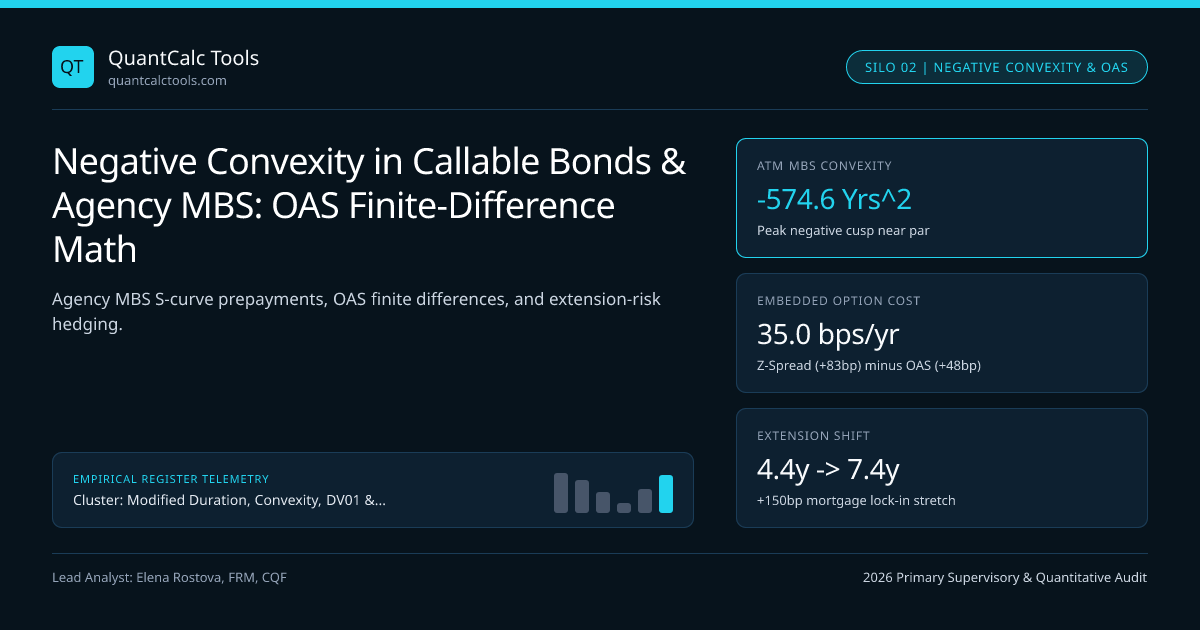
- = -0.3600 / 0.00062656 = -574.56 years^2! (Bloomberg scaled CNVX = -5.75!)
- 3) Expected 1-Year Convexity Drag Under Rate Volatility sigma_r = 110 bps (0.0110):
- Annual Convexity Cost = 0.5 * (-574.56) * (0.0110)^2 = -0.03476 = -34.8 bps/yr!
- (Explains why nominal MBS Zero-Volatility Spread Z-Spread = +83 bps vs OAS = +48 bps -> Option Cost = 35 bps!)
Look at Step 3's exact identity: $$\text{Z-Spread} = \text{OAS} + \text{Embedded Option Cost}$$ A naive yield buyer celebrates earning $+83\text{ bps}$ nominal Z-Spread over Treasuries on the MBS pool—not realizing $35\text{ bps}$ per year is consumed purely by negative-convexity delta-hedging decay ($\frac{1}{2}|C{eff}|\sigmar^2$), leaving $+48\text{ bps}$ true option-adjusted carry!
Contraction Risk, Extension Risk, and the Systemic "Convexity Vortex"#
Negative convexity creates a brutal double-whammy across big rate cycles—and historically amplified systemic Treasury selloffs (1994, 2003, and 2022–2023):
- Contraction Risk in Rallies: Drop mortgage rates $-150\text{ bps}$, and homeowner refinancing collapses $D_{eff}$ from $4.39$ years down to $1.80$ years—starving the investor of price appreciation and forcing reinvestment at lower yields.
- Extension Risk in Selloffs: Hike rates $+150\text{ bps}$, and homeowners with locked-in low-rate mortgages stop moving or refinancing ("mortgage lock-in"), stretching $D_{eff}$ from $4.39$ years out to $7.40$ years! Because MBS hedge desks (GSEs, banks, REITs) suddenly hold $+3.01$ extra years of duration per $$100\text{M}$, they are forced to pay fixed on 10Y SOFR swaps or sell 10Y Treasury futures into a falling market—buying high and selling low in a classic short-gamma loop!
Agency MBS Coupon Stack Profile: Lock-In Bullets vs ATM Negative Cusp#
| Coupon Cohort (Prevailing Par Mortgage = 6.25%) | Moneyness of Borrower Call | Typical Price | Effective Duration ($D_{eff}$) | Effective Convexity ($C_{eff}$) |
|---|---|---|---|---|
| Deep Discount FNMA 2.50% ("Lock-In" Pool) | Deep Out-of-the-Money | $81.40$ | $7.65$ yrs (Extended) | $+42$ (Positive! Acts like bullet) |
| Belly Discount FNMA 4.00% | Out-of-the-Money | $90.85$ | $6.40$ yrs | $-95$ (Mild negative curvature) |
| Slightly Discount FNMA 5.00% | Near-the-Money | $96.90$ | $5.35$ yrs | $-340$ (Accelerating refi S-curve) |
| Current-Coupon FNMA 5.50%–6.00% | At-the-Money Cusp | $100.25$ | $4.39$ yrs | $-575$ (Maximum negative cusp!) |
| Premium Seasoned FNMA 7.00% (Burned Out) | Deep In-the-Money | $103.60$ | $2.15$ yrs (Contracted) | $-210$ (Capped near par call ceiling) |
Key-Rate Hedging Negative Convexity Across 2Y, 5Y, and 10Y Swaps#
Because homeowner refinancing responds primarily to the 5-year and 10-year Treasury/SOFR par rates rather than overnight rates, hedging an MBS book with a single maturity swap leaves massive twist exposure; desks compute OAS Key-Rate Duration tent buckets and pair swaps with 2Y10Y swaption straddles. Contrast MBS curvature with second-order positive bond convexity, evaluate risk-adjusted carry in our Sharpe & Sortino ratio benchmark calculator, and explore the Modified Duration & Key-Rate Hedging Topic Hub.
Frequently asked questions
Why does a 30-year current-coupon MBS reach maximum negative convexity near par (100-101)?
The prepayment S-curve is steepest right when prevailing mortgage rates cross 50 bps below the pool’s Weighted Average Coupon (the refinancing media/cusp threshold). Because option gamma peaks at-the-money, shorting that call creates peak negative convexity right around par.
What is the exact difference between Z-Spread and Option-Adjusted Spread (OAS) on callable debt?
Z-Spread assumes a single deterministic cashflow schedule with zero interest-rate volatility (sigma_r = 0). OAS averages discounted cashflows across hundreds of volatile interest-rate paths where calls/prepayments fire optimally; Z-Spread minus OAS equals the embedded option cost.
How can a mortgage-backed security exhibit POSITIVE convexity?
When market mortgage rates surge 300+ bps above an older pool’s coupon (for example, 2.50% COVID-era mortgages in a 6.50% rate market), refinancing incentive is near zero across +/-100 bps moves, so cashflows behave like a fixed amortizing bond with positive convexity!
How does implied volatility (MOVE Index) affect callable bond and MBS prices even if yields stay flat?
Because callable bond and MBS investors are short an interest-rate option (negative vega), a spike in swaption implied volatility (the MOVE Index) increases the value of the borrower’s embedded call and immediately widens Z-Spreads / depresses MBS prices!
Publication record
- Published
- 14 November 2026
- Updated
- 14 November 2026
- Author
- Elena Rostova, FRM, CQF
- Review
- Review not recorded
- Automated fact check
- Passed in the stored pipeline record
- Source URLs
- 3 recorded
AI assistance recorded: anthropic/claude-opus-4.6. This field does not establish human review or source verification.
Academic & Institutional Attribution
Cite This Research & Embed Live Data Card
Standard academic & institutional research paper citation format.
Elena Rostova, FRM, CQF. (2026, November 14). Negative Convexity in Callable Bonds & Agency MBS: OAS Finite-Difference Math. QuantCalc Tools. https://quantcalctools.com/guides/negative-convexity-callable-bonds-mbs-prepayment-effective-durationRelated Bond Duration Convexity Math & Institutional Briefings
Explore Bond Duration Convexity Math Hub (20) →Bond Duration Convexity Math
Modified Duration, Convexity, DV01 & Key-Rate Hedging: 2026 Quantitative GuideBond Duration Convexity Math
DV01-Neutral Barbell vs Bullet Portfolio: Convexity Pickup vs Yield MathBond Duration Convexity Math
Key-Rate Duration (KRD) Tent Functions: Partial DV01 Curve Bucketing MathBond Duration Convexity Math
50/50 vs Regression-Weighted 2s5s10s Butterfly Curve Trades: DV01 MathBond Duration Convexity Math
Cheapest-to-Deliver (CTD) Treasury Futures Conversion Factor & DV01 MathBond Duration Convexity Math
Leveraged Treasury Repo Carry, Curve Rolldown & Breakeven Yield Spike MathBond Duration Convexity Math
Redington Liability Immunization: Duration Matching & Convexity Dispersion MathBond Duration Convexity Math
Zero-Coupon STRIPS Convexity Scaling: Quadratic Maturity Leverage MathCovered Interest Parity Forwards
Broken-Date FX Forward Interpolation: Linear Points vs Central-Bank Kink MathCovered Interest Parity Forwards
Quarter-End & Year-End G-SIB Window-Dressing FX Swap Turn Premium MathCovered Interest Parity Forwards
SOFR, ESTR & SONIA OIS Compounded In-Arrears FX Forward Discounting MathCovered Interest Parity Forwards
FX Carry-to-Volatility Ratio, Forward Discount Puzzle & Breakeven Spot Math
QuantCalc Tools Data, Benchmarks & Contributor Records
CC BY 4.0 Open Data
Open Institutional Datasets (CSV / JSON) →
Download desk-compiled quantitative series & schemas.
2026 Reference Matrix
2026 Institutional Benchmarks & Thresholds →
Statutory capital, clearing, margin & rate conventions.
Editorial Records
Authors & Review Records →
View named contributors where those records are available.
Complete Index
Master Research & Dossier Archive →
Browse all published briefings by topic pillar & date.