
Floating-Rate Note (FRN) Interest-Rate Reset Duration vs Spread Duration Math
Confusing near-zero interest-rate reset duration with credit spread duration on Floating-Rate Notes is a classic fixed-income blunder; a 5-year SOFR FRN still loses ~4.55% per +100 bps widening in Discount Margin.
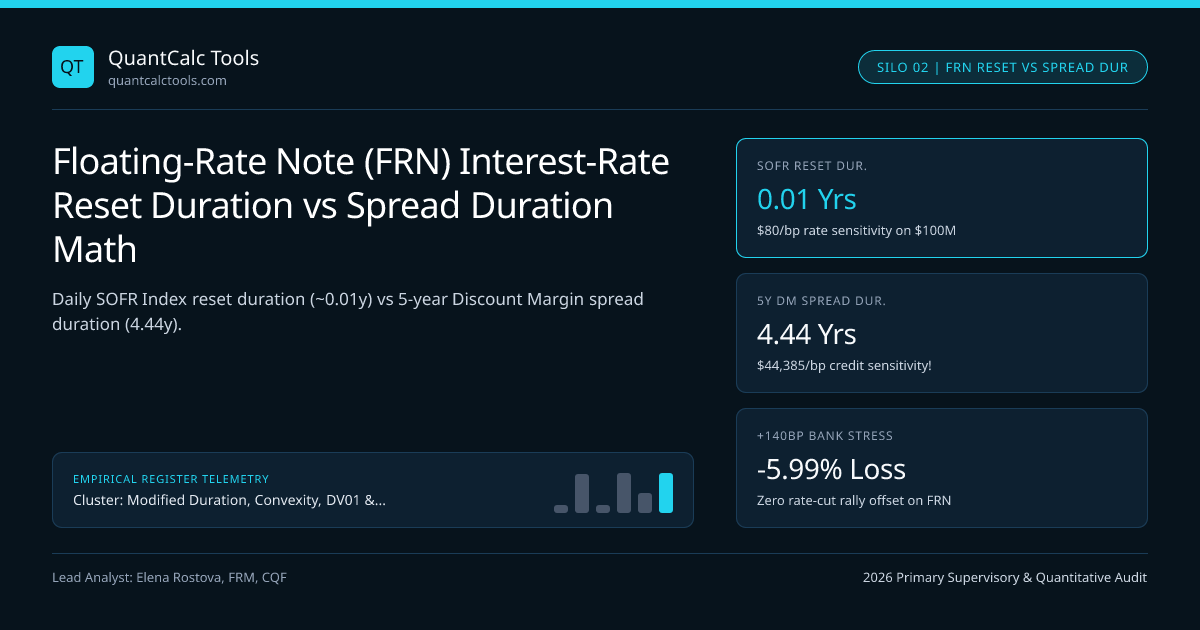
"Floating-rate notes have zero duration, so a 5-year bank FRN cannot lose principal!" Every credit cycle, treasury managers who believe that half-truth suffer rude $-4\%$ to $-8\%$ mark-to-market drawdowns on investment-grade bank FRNs! Why? Because a Floating-Rate Note indexed to Secured Overnight Financing Rate (SOFR) has two completely separate durations: an ultra-short Interest-Rate Reset Duration ($D_{\text{rate}} \approx 0.003\text{ to }0.25$ years) and a full-maturity Discount Margin Spread Duration ($D_{DM} \approx 4.55$ years on a 5Y FRN)! Test daily compounded floating accruals in our SOFR overnight compounding & carry calculator and ground fixed-income math in our Modified Duration, Convexity & DV01 master guide.
Exact Mathematical Proof: Why $D{\text{rate}} = \tau{\text{next}}$ While $D_{DM} \approx 4.55$ Years!#
Value a quarterly-pay FRN maturing in $N$ quarters that pays floating reference rate $Rj$ plus fixed Quoted Margin ($QM$, in bps), discounted at floating forward rate $Rj$ plus market Discount Margin ($DM$, in bps) on an ACT/360 money-market basis ($\alpha = 0.25 \times 365/360$):
- Case 1: Credit Spread Unchanged ($DM = QM$), Benchmark SOFR Curve Shifts $+\Delta R$:
On the very next reset date $t1$ ($\tau{\text{next}}$ years away), all future floating coupons $Rj + QM$ automatically reset upward by $+\Delta R$—returning the FRN identically to $100.00$ par at $t1$! Discounting that known $t1$ value ($100 + \alpha(R0 + QM)$) over $\tau{\text{next}}$ gives exact Interest-Rate Duration: $$D{\text{mod,rate}} = \frac{\tau{\text{next}}}{1 + (R0 + DM)\tau_{\text{next}}} \quad \left(\text{Even shorter—1 business day!—for daily compounded SOFR in-arrears FRNs!}\right)$$
- Case 2: Issuer Credit Spread Widens ($DM > QM$ by $+\Delta DM$), SOFR Curve Fixed:
The FRN's contractual Quoted Margin $QM$ is locked for all 5 years while market investors now demand $DM = QM + \Delta DM$! Subtracting present values leaves a fixed annuity deficit $(QM - DM)$ across every single quarter to final maturity $T$: $$P{\text{FRN}}(DM) \approx 100 + (QM - DM)\sum{j=1}^{N} \frac{\alphaj}{\prod{i=1}^{j}(1 + \alphai(Ri + DM))} \implies D_{DM} = -\frac{1}{P}\frac{\partial P}{\partial DM} \approx \text{5-Year Risky Annuity!}$$
Worked $100M 5-Year Bank SOFR FRN Valuation & Dual-DV01 Audit#
- Contract & Market Inputs:
- Face = $100,000,000; Remaining Maturity = 5.00 yrs (20 quarterly periods, alpha = 91.25/360 = 0.25347)
- Time to Next Reset tau_next = 45 days (0.1250 yrs on ACT/360); Flat Forward SOFR R = 4.40%
- Contractual Quoted Margin QM = +90 bps (0.0090)
- Scenario A — Issued at Par (Market Discount Margin DM = +90 bps = QM):
- 1) Interest-Rate Duration (Term-Reset FRN vs Daily In-Arrears SOFR FRN):
- Quarterly Term-Reset FRN: D_rate = 0.1250 / (1 + 0.0530*0.125) = 0.1242 yrs => Rate DV01 = $1,242 / bp
- Daily Compounded SOFR In-Arrears FRN (NY Fed SOFR Index, 2bd lockout): D_rate ~= 0.008 yrs => Rate DV01 = $80 / bp!
- 2) Discount Margin (Credit Spread) Duration D_DM:
- 20-Quarter Discounted Annuity PV01 = Sum_{j=1..20} [ 0.25347 / (1 + 0.25347*0.0530)^j ] = 4.4385 yrs!
- Spread DV01 (DM01 / CS01) = $100,000,000 * 4.4385 * 0.0001 = $44,385 / bp! (35.7x Rate DV01!)
- Scenario B — Regional Bank Credit Stress (FOMC cuts SOFR -50 bps, Bank DM widens +140 bps to +230 bps!):
- Rate Move Impact (-50 bps * $80/bp on SOFR in-arrears FRN): +$4,000 (~0.00% negligible!)
- Discount Margin Widening Impact (+140 bps * -$44,385/bp + Cnvx): -$5,986,400 (-5.99% PRICE DROP -> P = 94.01!)
Look at Scenario B: during a banking scare where the Fed cuts rates $-50\text{ bps}$ while financial credit spreads widen $+140\text{ bps}$, a fixed-rate 5-year bank bond enjoys a $+2.20\%$ Treasury rally cushion that offsets nearly half the credit widening—whereas the 5-year SOFR FRN gets ZERO rate-cut rally cushion ($+$4,000$) and absorbs the entire $-$5.99\text{M}$ ($-5.99\%$) Discount Margin hit!
Subtle Off-Par Cross-Effect: Why Deep-Discount FRNs Print Negative Rate Duration!#
Here is a classic derivatives quant interview proof: once our 5-year daily-reset FRN drops to $P = 94.01$ ($DM = +230\text{ bps} > QM = +90\text{ bps}$), does its Interest-Rate Duration stay at $+0.01$ years? No—it flips slightly NEGATIVE! Look at $P{\text{FRN}} = 100 - (DM - QM)\cdot A(R + DM)$: when risk-free SOFR $R$ rises $+100\text{ bps}$ while holding $DM$ constant, the 5-year risky annuity factor $A(R + DM)$ shrinks—reducing the present value of the $140\text{ bps}$ coupon deficit and nudging the discount FRN's price upward ($D{\text{rate}} \approx -0.16$ years)! Conversely, a premium FRN ($QM > DM$, $P = 104.00$) holds a positive fixed-spread annuity on top of par, acquiring a small positive rate duration ($+0.12$ years)!
Comparing Floating-Rate Instrument Conventions Across Cash & Loan Markets#
| Floating Instrument Type | Reference Rate Engine | Rate Duration ($D_{\text{rate}}$) | Spread / DM Duration ($5\text{Y}$) | Embedded Floor / Call Feature |
|---|---|---|---|---|
| US Treasury 2Y FRN | 13-Week T-Bill Auction High | $0.02\text{ yrs}$ (Weekly reset!) | $1.92\text{ yrs}$ (vs T-bill basis) | $0.00\%$ interest rate floor |
| IG Bank SOFR FRN (In-Arrears) | NY Fed SOFR Index ACT/360 | $0.01\text{ yrs}$ (Daily reset) | $4.44\text{ yrs}$ (Full credit risk) | Often callable 1Y prior to maturity |
| Legacy / Term SOFR Corporate FRN | 3M CME Term SOFR (In-Advance) | $0.13\text{ yrs}$ (Avg 45d lag) | $4.44\text{ yrs}$ | Clean forward-known coupon |
| Institutional Leveraged Loan (TLB) | 1M / 3M Term SOFR + Spread | $0.10\text{–}0.80\text{ yrs}$ (Floor!) | $3.80\text{ yrs}$ (Prepayable @ 100) | $0.50\%\text{–}1.00\%$ SOFR Floor + 101 soft call |
| AAA CLO Senior Tranche | 3M Term SOFR + ~135 bps | $0.13\text{ yrs}$ | $3.20\text{–}4.10\text{ yrs}$ (WAL) | Callable after 2-year non-call period |
Pairing FRN Discount Margin with Proportional DTS Credit Hedging#
Because a 5-year FRN carries the exact same $4.44$-year Spread Duration as a 5-year fixed-rate bond from the same issuer, risk managers slot FRNs directly into proportional Spread Duration and Duration-Times-Spread (DTS) credit hedges ($DTS{\text{FRN}} = D{DM} \times DM$)! Compare ACT/360 money-market vs ACT/ACT day counts in ACT/ACT ICMA vs 30/360 accrued interest math, verify supervised bank issuer disclosures on the UK FCA register, and explore the Modified Duration & Key-Rate Hedging Topic Hub.
Frequently asked questions
Why do daily compounded SOFR in-arrears FRNs have even less rate duration than old 3-month LIBOR FRNs?
A 3-month LIBOR or 3M Term SOFR FRN locks its coupon at the START of each quarter, leaving an average 45-day (0.125y) fixed-rate stub. A NY Fed SOFR Index in-arrears FRN compounds overnight rates daily right up to a 2-to-5 business-day payment lockout (~0.01y)!
What is the difference between Zero-Discount Margin (Z-DM) and Simple Margin on an FRN?
Simple Margin crudely adds (100 - Clean Price)/Maturity to the Quoted Margin without discounting. Zero-Discount Margin (Z-DM) discounts every projected forward SOFR + QM cashflow across the full term structure at forward SOFR + Z-DM, matching OAS methodology.
How can a deep-discount FRN trading at 94.00 exhibit NEGATIVE interest-rate duration?
Write the FRN price as P = 100 - (DM - QM) * Annuity(SOFR + DM). When risk-free SOFR rises +100 bps while holding credit Discount Margin DM constant, the present value of the fixed (DM - QM) spread deficit shrinks—causing the discount FRN’s clean price to rise slightly!
How do embedded SOFR floors change the interest-rate duration of institutional leveraged loans?
An embedded 1.00% SOFR floor is a strip of long receiver floorlets owned by the lender. When SOFR drops near 1.00%, the coupon stops falling with market rates—turning the floating loan into a fixed-rate bond with 2 to 3.5 years of positive rate duration!
Publication record
- Published
- 14 November 2026
- Updated
- 14 November 2026
- Author
- Elena Rostova, FRM, CQF
- Review
- Review not recorded
- Automated fact check
- Passed in the stored pipeline record
- Source URLs
- 3 recorded
AI assistance recorded: anthropic/claude-opus-4.6. This field does not establish human review or source verification.
Academic & Institutional Attribution
Cite This Research & Embed Live Data Card
Standard academic & institutional research paper citation format.
Elena Rostova, FRM, CQF. (2026, November 14). Floating-Rate Note (FRN) Interest-Rate Reset Duration vs Spread Duration Math. QuantCalc Tools. https://quantcalctools.com/guides/floating-rate-note-frn-reset-duration-discount-margin-sensitivityRelated Bond Duration Convexity Math & Institutional Briefings
Explore Bond Duration Convexity Math Hub (20) →Bond Duration Convexity Math
Modified Duration, Convexity, DV01 & Key-Rate Hedging: 2026 Quantitative GuideBond Duration Convexity Math
Ultra-Long 50Y Gilt & 100Y Century Bond Convexity Asymmetry MathBond Duration Convexity Math
Principal Component Analysis (PCA) Level, Slope & Curvature DV01 Hedging MathBond Duration Convexity Math
Pull-to-Par Horizon Return, Reinvestment Yield & Macaulay Duration Gap MathBond Duration Convexity Math
Macaulay vs Modified vs Effective Duration: Semiannual & ICMA Yield MathBond Duration Convexity Math
DV01 & PVBP Formula: Why Dirty Invoice Price Scales Dollar DurationBond Duration Convexity Math
Second-Order Bond Convexity Formula: Taylor Error Under Large Yield ShocksBond Duration Convexity Math
Negative Convexity in Callable Bonds & Agency MBS: OAS Finite-Difference MathCovered Interest Parity Forwards
Mark-to-Market (MTM) Resetting Cross-Currency Basis Swap Notional MathCovered Interest Parity Forwards
Basel SA-CCR & ISDA SIMM v2.6 FX Forward Margin & Capital Drag MathCovered Interest Parity Forwards
Mark-to-Market (MTM) Valuation of Seasoned FX Forwards: Discounted PV MathCagr Irr Drawdown Compounding
Arithmetic vs Geometric Mean Return: 0.5*Sigma^2 Variance Drain Derivation
QuantCalc Tools Data, Benchmarks & Contributor Records
CC BY 4.0 Open Data
Open Institutional Datasets (CSV / JSON) →
Download desk-compiled quantitative series & schemas.
2026 Reference Matrix
2026 Institutional Benchmarks & Thresholds →
Statutory capital, clearing, margin & rate conventions.
Editorial Records
Authors & Review Records →
View named contributors where those records are available.
Complete Index
Master Research & Dossier Archive →
Browse all published briefings by topic pillar & date.