
Modified Duration, Convexity, DV01 & Key-Rate Hedging: 2026 Quantitative Guide
Linear Modified Duration understates bond gains and overstates losses by 82 bps on a 10-year note during a 150 bps yield shock; this quantitative guide unifies DV01, convexity, KRD, and repo carry math.
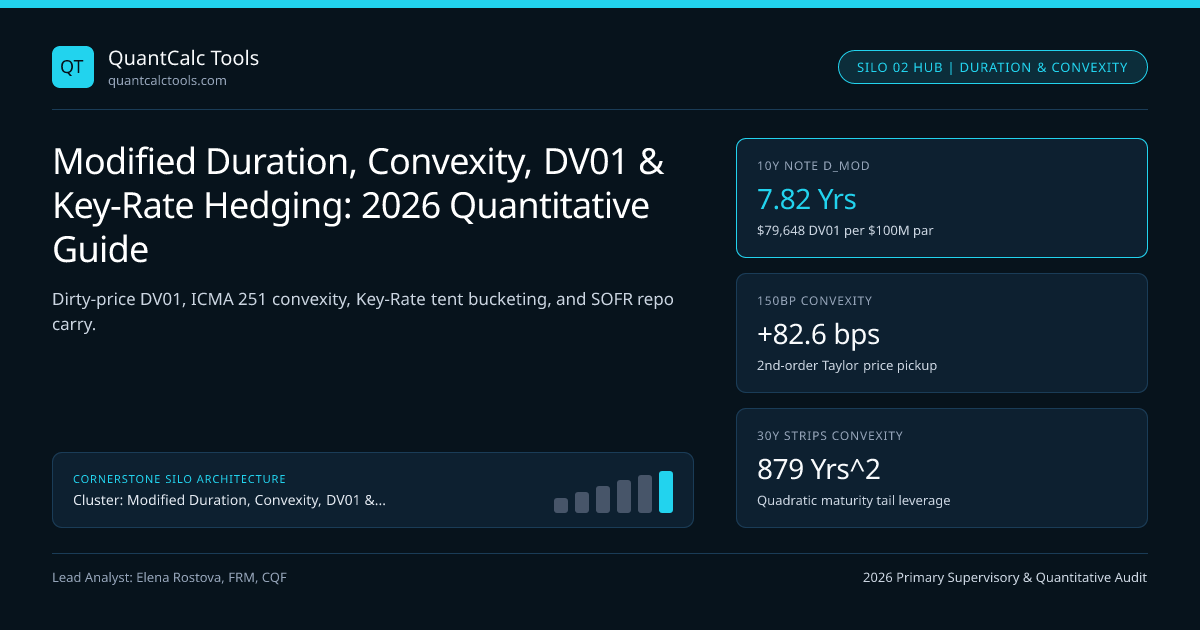
Linear duration approximations omit quadratic yield curvature: across a $\pm 150\text{ bps}$ parallel yield shift on a 10-year sovereign note with Macaulay Duration, Modified Duration & Second-Order Convexity calibrated at $D_{mod} = 7.82$ years and convexity $C = 73.4$, first-order tangent lines misprice clean market value by $+82.6\text{ bps}$ in both directions. Fixed-income desks governed by ICMA Rule 251 and supervised under UK PRA IRRBB (Interest Rate Risk in the Banking Book) standards therefore pair dirty-price DV01 with second-order convexity, partial Key Rate Duration (KRD) & Partial DV01 Yield Curve Bucketing, and repo funding breakevens modeled in our SOFR overnight compounding & carry calculator.
Macaulay, Modified, and Effective Duration Foundations#
Fixed-income sensitivity starts with the discounted cashflow price-yield function $P(y) = \sum{t=1}^{n} \frac{CFt}{(1 + y/k)^t}$ where $k$ is compounding frequency ($k = 2$ for semiannual US Treasuries and UK Gilts; $k = 1$ for annual German Bunds under ICMA ACT/ACT). Differentiating $P(y)$ once and twice with respect to yield $y$ links time-weighted cashflow recovery ($D{Mac}$), percentage price slope ($D{mod}$), dollar basis-point sensitivity ($DV01$), and curvature ($C$):
Worked $100M 10-Year Sovereign Dirty DV01 & Second-Order Taylor Audit#
- Inputs:
- Dirty Price P_dirty = 101.850 (Clean 100.250 + Accrued 1.600), Semiannual YTM y = 4.40% (k = 2)
- Macaulay Duration (DMac) = 7.9921 years => Modified Duration Dmod = 7.9921 / (1 + 0.044/2) = 7.8201 yrs
- Annualized Convexity (C) = 73.40 years^2
- 1) Dirty-Price Dollar Duration & DV01 ($100M Par Face -> Dirty Notional = $101,850,000):
- DV01 = Pdirtynotional * D_mod * 0.0001 = $101,850,000 * 7.8201 * 0.0001 = $79,647.72 per bp
- 2) +150 bps Bearish Yield Shock (Delta_y = +0.0150):
- Linear Duration Forecast: -7.8201 * (+0.0150) = -11.7302% (-$11,947,158)
- Convexity Cushion (+0.5Cdy^2): +0.5 * 73.40 * (0.0150)^2 = +0.8258% (+$841,027 protection!)
- 2nd-Order Taylor Price Change: -11.7302% + 0.8258% = -10.9044% (-$11,106,131)
- 3) -150 bps Bullish Yield Rally (Delta_y = -0.0150):
- 2nd-Order Taylor Price Change: +11.7302% + 0.8258% = +12.5560% (+$12,788,185 — asymmetric upside!)
Three foundational distinctions separate institutional fixed-income analytics from retail bond calculators:
- Compounding & Embedded Option Regimes: Semiannual vs annual yield conventions alter $D_{Mac}/(1 + y/k)$, while callable corporate bonds and mortgage-backed securities require finite-difference OAS shifts—explored in Macaulay vs Modified vs Effective Duration math and negative convexity in callable bonds and MBS.
- Dirty Price vs Clean Price DV01: Scaling Modified Duration by clean price rather than dirty invoice price ($P_{clean} + AI$) introduces up to a $2.5\%$ hedge-ratio error just before coupon dates, proven in DV01 and PVBP clean vs dirty price scaling and ACT/ACT ICMA vs 30/360 stub-period duration bias.
- Taylor Truncation & Extreme Maturities: Above $100\text{ bps}$ rate moves or on 50-year Gilts, even quadratic convexity needs third-order skewness checks—see second-order bond convexity Taylor error, zero-coupon STRIPS quadratic convexity leverage, and ultra-long 50Y Gilt and century bond asymmetry.
Non-Parallel Yield Curve Twists, Key-Rate Bucketing, and Butterflies#
Modified Duration assumes every maturity from 3 months to 30 years shifts in lockstep ($\Delta y(t) = \Delta y$). When the FOMC hikes front-end Secured Overnight Financing Rate (SOFR) by $+50\text{ bps}$ while 30-year yields fall $-20\text{ bps}$ into an inversion, a "DV01-neutral" 2s30s flatteners or barbell blows through risk limits! Institutional rates desks neutralize curve twists through four complementary mathematical frameworks:
- Barbell vs Bullet Convexity Engineering: Matching weighted duration between a 2Y+30Y barbell and a 10Y bullet creates positive net convexity at the price of curve-twist exposure, solved in DV01-neutral barbell vs bullet convexity pickup and Redington liability cashflow immunization.
- Ho (1992) Key-Rate Duration Tent Functions: Bumping individual zero-curve nodes (2Y, 5Y, 10Y, 30Y) with piecewise-linear triangular tents ensures partial KRD sensitivities sum exactly to parallel Effective Duration—derived in Key-Rate Duration tent functions and partial DV01.
- Par Swap Jacobian Transformations & Butterflies: Derivatives desks convert zero-coupon PV01 vectors into tradable par SOFR OIS swap hedges via triangular Jacobian matrices in par swap DV01 vs zero-rate PV01 Jacobian math, weight 2s5s10s curvature flies in 50/50 vs PCA regression-weighted butterfly trades, and orthogonalize yield shocks via PCA level, slope, and curvature DV01 hedging.
Institutional Fixed-Income Sensitivity & Curve Risk Reference Matrix#
| Fixed-Income Sensitivity Metric | Governing Standard / Entity | Exact Mathematical Formula | Captures Twist / Options? | Primary Desk Application |
|---|---|---|---|---|
| Modified Duration ($D_{mod}$) | MACAULAY-CONVEXITY | $-\frac{1}{P{dirty}}\frac{\partial P}{\partial y} = \frac{D{Mac}}{1 + y/k}$ | Parallel shift, option-free | Mandate duration bands & ETFs |
| Effective (OAS) Duration ($D_{eff}$) | MACAULAY-CONVEXITY-STD | $\frac{P{-\Delta y} - P{+\Delta y}}{2 P_0 \Delta y}$ | Parallel OAS, callable/MBS | Agency MBS & callable corporates |
| Key-Rate Partial DV01 ($KRD_i$) | KEY-RATE-DV01 | $-\frac{\partial P}{\partial z(t_i)}\cdot 10^{-4}$ | Non-parallel curve twists | Swaps, LDI & curve immunization |
| Repo Carry Breakeven ($\Delta y_{BE}$) | REPO-CARRY-ROLLED | $\frac{\text{Carry} + \text{Rolldown}}{DV01}$ | Horizon funding cushion | Levered Treasury basis & carry |
| Duration-Times-Spread ($DTS$) | Credit Desk Standard | $D_{spread} \times OAS$ | Proportional credit vol | IG & High-Yield CDS/bond sizing |
Futures Basis, Leveraged Repo Carry, Spread Duration, and Linkers#
Executing duration hedges in live markets requires bridging clean theoretical yields with funding and instrument mechanics:
- Treasury Futures & Repo Carry: Hedging cash bonds with CME 10-Year Note futures requires scaling by the Cheapest-to-Deliver conversion factor ($DV01{fut} \approx DV01{CTD} / CF_{CTD}$) in CTD Treasury futures conversion-factor DV01, while repo-financed cash positions benchmark breakeven yield cushions against NY Fed SOFR Index ACT/360 compounding in leveraged Treasury repo carry and rolldown math.
- Inflation, Credit, Floating & Horizon Return: Separate real duration from nominal inflation beta in TIPS real duration vs empirical nominal beta; weight high-yield credit via Spread Duration vs Duration-Times-Spread (DTS); distinguish reset lag from discount margin on floaters in FRN reset vs spread duration; and reconcile reinvestment yield against capital loss in pull-to-par horizon return and Macaulay duration gap alongside our CAGR calculator.
Browse all 20 quantitative fixed-income deep-dives on the Modified Duration & Key-Rate Hedging Topic Hub, cross-check margin sensitivities with ISDA SIMM v2.6, and verify multi-asset institutional profiles in our broker lookup directory and FCA register index.
Frequently asked questions
What is the exact mathematical difference between Macaulay Duration and Modified Duration?
Macaulay Duration measures the present-value-weighted average time (in years) to receive a bond’s cashflows. Dividing Macaulay Duration by (1 + y/k)—where y is annual yield-to-maturity and k is coupon frequency—converts time-to-receipt into Modified Duration (-1/P * dP/dy).
Why must DV01 be calculated from dirty bond price rather than quoted clean price?
Actual cash settlement and present-value discounting operate on full dirty price (Clean Price + Accrued Interest). Because accrued interest is invariant to instantaneous yield changes (dP_clean/dy = dP_dirty/dy), differentiating P_dirty produces -D_mod * P_dirty.
When does Modified Duration fail and require Effective Duration instead?
Modified Duration assumes cashflows remain fixed regardless of yield shifts. For callable corporate bonds, putable notes, or agency mortgage-backed securities (MBS), falling rates trigger borrower refinancing, requiring finite-difference OAS Effective Duration.
How do Key-Rate Durations (KRDs) relate to total portfolio Effective Duration?
Because Ho’s triangular tent shocks across key maturities (such as 2Y, 5Y, 10Y, and 30Y) form a partition of unity that sums to a flat +1 bp parallel shift everywhere on the zero curve, the sum of all partial Key-Rate Durations equals total Effective Duration.
Publication record
- Published
- 14 November 2026
- Updated
- 14 November 2026
- Author
- Elena Rostova, FRM, CQF
- Review
- Review not recorded
- Automated fact check
- Passed in the stored pipeline record
- Source URLs
- 4 recorded
AI assistance recorded: anthropic/claude-opus-4.6. This field does not establish human review or source verification.
Academic & Institutional Attribution
Cite This Research & Embed Live Data Card
Standard academic & institutional research paper citation format.
Elena Rostova, FRM, CQF. (2026, November 14). Modified Duration, Convexity, DV01 & Key-Rate Hedging: 2026 Quantitative Guide. QuantCalc Tools. https://quantcalctools.com/guides/modified-duration-convexity-dv01-key-rate-hedging-master-guideRelated Bond Duration Convexity Math & Institutional Briefings
Explore Bond Duration Convexity Math Hub (20) →Bond Duration Convexity Math
Macaulay vs Modified vs Effective Duration: Semiannual & ICMA Yield MathBond Duration Convexity Math
DV01 & PVBP Formula: Why Dirty Invoice Price Scales Dollar DurationBond Duration Convexity Math
Second-Order Bond Convexity Formula: Taylor Error Under Large Yield ShocksBond Duration Convexity Math
Negative Convexity in Callable Bonds & Agency MBS: OAS Finite-Difference MathBond Duration Convexity Math
DV01-Neutral Barbell vs Bullet Portfolio: Convexity Pickup vs Yield MathBond Duration Convexity Math
Key-Rate Duration (KRD) Tent Functions: Partial DV01 Curve Bucketing MathBond Duration Convexity Math
50/50 vs Regression-Weighted 2s5s10s Butterfly Curve Trades: DV01 MathBond Duration Convexity Math
Cheapest-to-Deliver (CTD) Treasury Futures Conversion Factor & DV01 MathCovered Interest Parity Forwards
Covered Interest Parity, FX Forward Points & Cross-Currency Basis: 2026 GuideCagr Irr Drawdown Compounding
CAGR vs IRR, Volatility Drag, Sharpe/Sortino & Drawdown Recovery: 2026 GuideKelly Margin Leverage Sizing
Kelly Criterion, Initial/Variation Margin & Liquidation Math: 2026 GuideParametric Var Expected Shortfall
Cornish-Fisher VaR Quantile Expansion: Skewness & Excess Kurtosis Formula Guide
QuantCalc Tools Data, Benchmarks & Contributor Records
CC BY 4.0 Open Data
Open Institutional Datasets (CSV / JSON) →
Download desk-compiled quantitative series & schemas.
2026 Reference Matrix
2026 Institutional Benchmarks & Thresholds →
Statutory capital, clearing, margin & rate conventions.
Editorial Records
Authors & Review Records →
View named contributors where those records are available.
Complete Index
Master Research & Dossier Archive →
Browse all published briefings by topic pillar & date.